
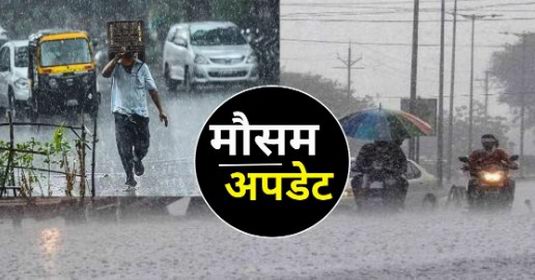
Good news: Monsoon is about to come, when will we get relief from the scorching heat, click to know the weather condition.

New Delhi. The country is currently in the grip of extreme heat and heat wave. From the plains to the mountains, the heat of the sun has left people distressed. According to IMD i.e. India Meteorological Department, severe heat wave will continue in the plains of central and north-west India for the next three to four days, while the effects of heat will remain strong in the mountains of Himachal Pradesh for the next two days.
However, a new western disturbance is going to become active from May 28. This will trigger a period of thunderstorms in the plains and snowfall in the mountains, which will cause a major drop in temperature from May 29. The mercury is scorching between 43 to 47 degrees Celsius in many parts of Punjab, Haryana, Rajasthan, Madhya Pradesh and Vidarbha.
The effect of heat has intensified in many hilly areas including Himachal Pradesh’s capital Shimla. According to IMD, the weather will be dry in the state on May 27. This may increase the temperature by two to five degrees Celsius. Yellow alert has been issued regarding heat wave in some areas of Una, Bilaspur, Hamirpur, Kangra, Solan, Shimla and Sirmaur districts. Una was the hottest area in Himachal at 41.6 degrees Celsius in the last 24 hours, while Keylong in Lahaul-Spiti recorded a minimum temperature of 2.5 degrees Celsius.
According to IMD, a new western disturbance will be active in northwest India from May 28. Due to its effect, the weather patterns in Punjab, Haryana, Delhi-NCR and Uttar Pradesh will completely change. On May 28 and 29, there is a possibility of thunderstorm with speed of 60 to 80 kilometers per hour, rain and hailstorm at isolated places in these states. The weather may change in the capital on Thursday. The Meteorological Department has issued a heat wave warning for Wednesday. There is a possibility of rain in Delhi after the heat wave and after this there are signs of drop in temperature.
According to the Meteorological Department, a new Western Disturbance is likely to become active in North-West India from May 28, which will also affect the Delhi region. There will be a strong possibility of heat wave in the next 24 hours, however, there may be relief in the weather due to light rain and thunderstorm between 28th and 30th May. There will be no major change in the maximum temperature for the next two days, after which it is likely to drop by 5 to 7 degrees Celsius. The minimum temperature may also drop by 3 to 4 degrees Celsius after remaining stable.
Winds in the Pacific Ocean blow from east to west and push warm water towards India-Indonesia. When these winds weaken, the ocean water stops moving in the opposite direction towards the coasts of America and Peru. When the surface temperature of the central and eastern Pacific Ocean increases by 0.5 degrees above normal, it is called El Nino. But when it increases by 2 degrees or more, it is called Super El Nino. It has a wide-ranging impact on monsoons, ocean currents, temperatures, heat, cyclones as well as food prices. Its effect remains in India.
Due to Super El Nino, monsoon rains in India may be much less than normal. Drought-like conditions arise in many parts of the country, especially in North-West and Central India. India receives an average of 870 mm rainfall between June and September. But according to IMD, it may decrease in 2026 due to El Nino.
Super El Nino divides the weather of the entire world into two parts. At some places there is severe drought and at other places there are devastating floods. Severe drought occurs in Indonesia, Australia and South Africa. Due to lack of water, incidents of severe fires increase in the Amazon forests of Australia and Brazil.
Where there is drought on one side. At the same time, torrential rains and devastating floods occur in Peru, Ecuador and some parts of America. At the same time, due to the impact of agriculture around the world, the prices of global commodities like coffee, cocoa, soybean and palm oil increase. This increases the risk of recession and inflation.

Comments are closed.