
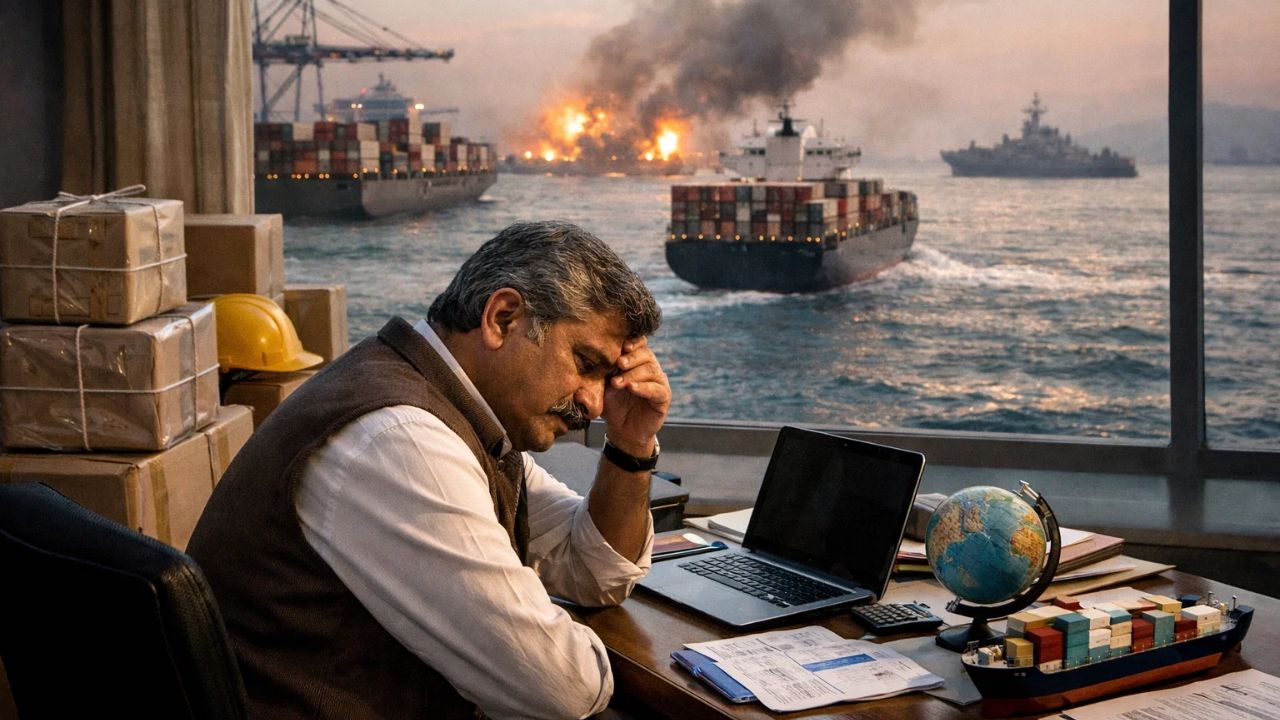

The easiest and cheapest way to import goods from countries around the world or send goods to those countries passes through the seas. This route passes through many countries and if there is a fight in these countries, bombs start falling and missiles start firing, then the sea route gets disrupted. Something similar is happening these days in the countries of Western Asia due to which the transporters, shipping businessmen and importer-exporters of India are worried. Continuous efforts are being made by the government, but due to the way out of this without stopping the war, businessmen will have to loose their pockets. Traders are still incurring losses every day and their goods are stranded on the way.
These days the Strait of Hormuz has been closed due to which India’s connectivity with the Gulf countries is almost broken. The airspace of many countries is also closed, so essential items cannot be delivered through other routes. This is affecting those Indian businessmen who sell their goods in the Gulf countries or run their business by purchasing raw materials from there. The problem is that the ships of shipping companies transporting large containers are neither able to come nor go. In such a situation, all the shipping businessmen of India are worried. Let us understand their problem.
What has changed now?
Due to the ongoing conflict in the Gulf countries, many shipping companies have changed the route of ships passing through the Suez Canal. Now these ships are passing through the Cape of Good Hope. It takes at least two weeks more and the fare also increases. At the same time, ships going to the Persian Gulf have been completely stopped. This is affecting those businessmen whose goods are stuck. For example, French shipping company CMA CGM has announced that people whose goods are on the ship and those ships are stranded will have to pay additional fare.
Also read: There is a difference in the oil extracted from the ground, understand how WTI and Brent crude are different.
This fare will be $2000 extra for a 20 unit dry container and $3000 extra for a 40 unit dry container. At the same time, for special items this fare will also go up to $ 4000 extra. Its biggest impact will be on countries like Iran, Bahrain, Kuwait, Yemen, Qatar, Oman, UAE, Saudi Arabia, Jordan, Egypt and Sudan.
What are businessmen facing?
Due to closure of the Strait of Hormuz, Indian businessmen who had sent goods to Gulf countries are having to return. To provide some relief to traders, the Government of India has announced relaxation in customs rules. This relaxation will remain in force for 15 days so that the ships returning due to the closure of Hormuz can return. India’s Central Board of Indirect Taxes and Customs (CBIC) has said that shipping bills and seals of returning containers will be checked. Those whose seals are broken will be thoroughly investigated.
Earlier, the Indian government had allowed ports to store containers sent to Gulf countries. The effect of this has been that thousands of such containers have accumulated at many ports which are to be sent to Arab countries. Now, if the goods stuck in them do not reach on time, many goods may get damaged. This is why ports have also been asked to give preference to containers filled with perishable goods.
Also read: Crude oil comes and goes after being refined, how much do Indian companies earn?
The most troubled are the traders of fruits and vegetables because they can be stored for a limited time. There are many goods which have to reach on time. Businessmen suffer losses due to delay. In such a situation, many businessmen are also trying to take back their goods and sell them in the local market. The result is that they have to sell their goods at throwaway prices.
Regarding this, Ashok Karpe, an onion exporter, says, ‘Containers used to store things like onions are very expensive. Now by keeping them here for many days, the cost is becoming expensive. These run on electricity only, hence the cost of electricity is also increasing every day.
How is business done?
In India, big ports are built in all the coastal states including Gujarat, Maharashtra, Kerala, Karnataka, Tamil Nadu. Goods from all over the country reach these ports. Just like you send a courier and the courier company collects it from you and then it is sent in a big vehicle. Similarly, the goods collected at ports are filled in big containers and these containers are loaded on heavy ships. Now the goods going to Gulf countries reach the Gulf of Oman and then the Persian Gulf via the Arabian Sea. From there the goods go to the ports of different countries.
Also read: Indian tea affected amid Middle East tension, will China take advantage?
If the same goods have to go to Africa, Europe or American countries, then it reaches the Gulf of Aden via the Arabian Sea, from there to the Red Sea and then via the Gulf of Suez and Suez Canal and reaches the Mediterranean Sea. From here this ship crosses the Strait of Gibraltar and reaches the Atlantic Ocean and goes to the ports of America. Goods coming from these countries also come through these routes. If the Strait of Hormuz is closed then the trade with Arab countries is affected and if the Suez Canal is closed for any reason then the trade with America and European countries is affected.

Comments are closed.