
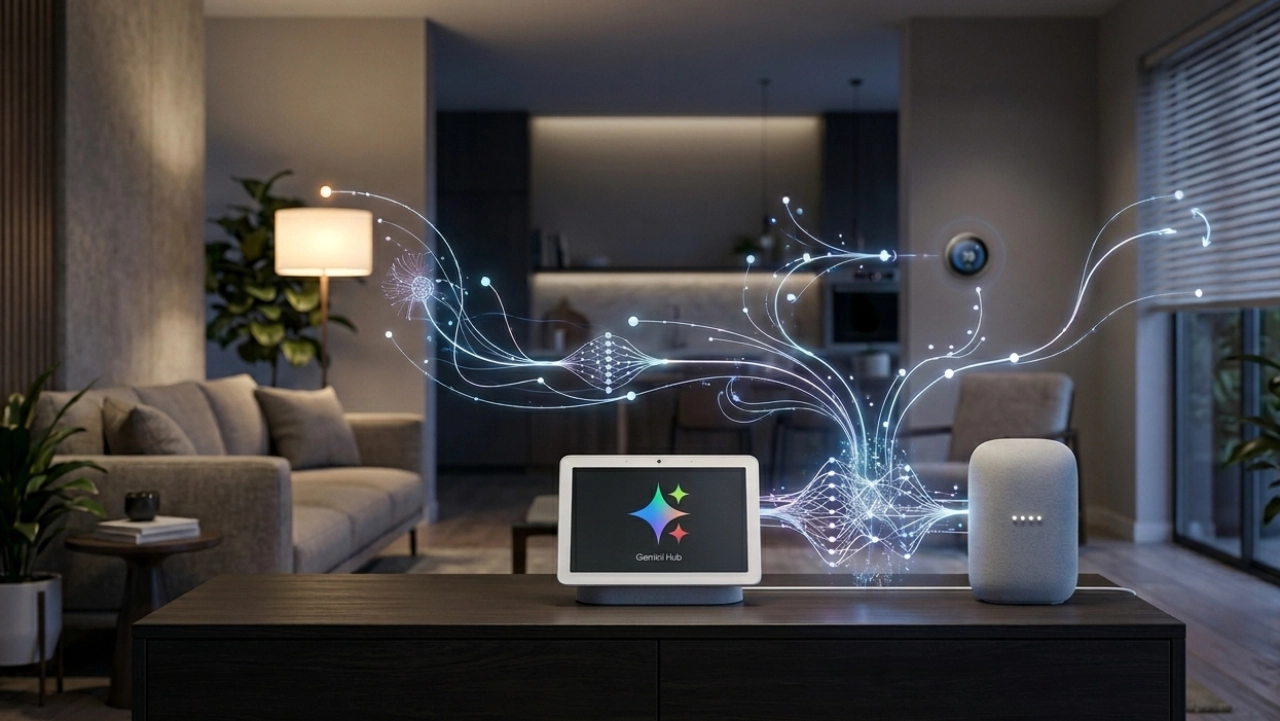
Google Gemini Home Update 4.12 Version Brings Smarter Voice Commands and Better Smart Home AI

Google is expanding the capabilities of its Google Gemini Home with new updates introduced in March that improve voice command handling, contextual understanding, and response times. This is the third batch of updates Google has brought to Gemini for Home and Google Home, which will also make the assistant more mindful of its users, their homes, and their requests. Anish Kattukaran, Gemini’s Chief Product Officer, said the latest update will make your “smart home feel more intuitive.”
With Google expanding Gemini to Mexico, it has also added Spanish-language support for Google Home users in the US and Canada, which is reflected in Google Home version 4.12. Gemini’s availability to more markets and more family members will also expand through the Early Access program.
Google Gemini AI Home: Beyond Basic Voice Commands
Smart home assistants have relied on receiving a specific command for years, which was rather a simple formula. Google Assistant can control lights, thermostats, and other devices, but it struggles with more complex user requests.
With the new Google Gemini Home update, Google wants to address that limitation. The new AI model will make conversational context rather than treating every instruction separately. Users can ask multiple questions at once or give multi-step instructions without repeating themselves. For example, one user might ask about the status of a device and then ask to change it again. Gemini will retain the previous instruction and then act accordingly.
This new improvement, which enables the processing of multiple requests, will make the smart home function much more simply.
Understanding the state of Home
One of the biggest improvements Google brought was the ability to interpret information about the home environment. Anish Kattukaran, on X, demonstrated that the system can now answer contextual questions about what is happening around the home.
Instead of merely controlling devices, Google Gemini AI can now interpret data from cameras and sensors around itself. A user can now ask where a car or a bike is in the driveway, and Gemini can analyze data from different home devices to provide answers based on what it receives. The system can analyze inputs from multiple devices and provide context-aware responses.

Improvement to Smart Home Interactions
In addition to interpretation, Gemini understands everyday instruction. Gemini now offers sharper, streamlined responses, which are more efficient and faster to generate. Users no longer need to specify color names when instructing Gemini. They can just give similar instructions like “color of the ocean” or the “color of their favorite brand,” to which Gemini will automatically find the right hue.
In addition, they can now set specific humidity levels or get dinner started early by saying “preheat the oven to 250 degrees.” Finally, Gemini has also gotten better at understanding thermostats and distinguishing between lamps and lights, making request completion faster.
Conclusion
The updates reflect Google’s broader effort to improve its Gemini ecosystem. The AI assistant has already replaced the traditional assistant across Smartphones, productivity tools, and other services. Bringing the model into the smart home allows Google to combine multiple types of data, such as device states, user preferences, and environmental inputs, to produce more personalized responses.

Over time, this will evolve the system into a more proactive one that processes user needs more based on patterns and routines. For Google, this approach has brought the system closer to transforming its smart home into an intelligent environment powered entirely by AI.

Comments are closed.