
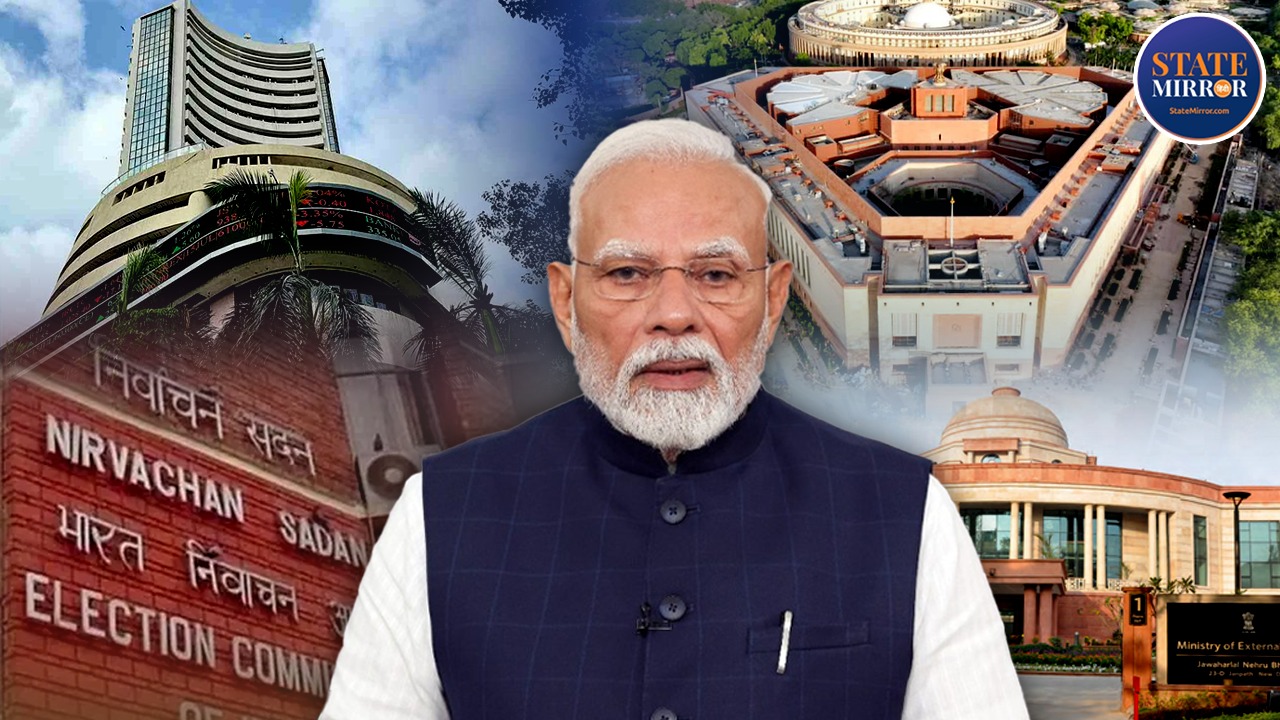
Government changes, not system! These 25 institutions are more important than the PM, without which the country cannot run even for a day.

These days, party defection, change of power, breakdown of alliances and constant tussle between governments are being seen in the politics of the country. These days the threat of the deep state is also in the headlines. In such an environment, the question often arises that if the government changes or the political crisis deepens, will the functioning of the country also come to a standstill? The answer is- no. India’s administration does not depend only on the Prime Minister, ministers or political parties, but rests on a strong constitutional and institutional framework. Institutions like the Prime Minister’s Office (PMO), Cabinet Secretariat, Home and Finance Ministries, Reserve Bank of India (RBI), Election Commission, Supreme Court, Army, Intelligence Agencies and All India Services continue to work despite change of government. This is the reason why governments keep changing, but the system of the country keeps running without any stop.
Actually, elections are held in the country every five years. The public elects the government, the Prime Minister and ministers change, policies change, but one thing never changes – the administrative and institutional structure that runs the country i.e. the permanent government. This is the reason why the world’s political experts also call it “Permanent Government”. As far as Shadow Government is concerned, this term is not correct for the constitutional structure of India, but in common language it is used for those institutions which continue to work despite the change of government.
From securing the country’s borders to determining the value of the rupee, from conducting elections to fighting terrorism, from making the budget to protecting the Constitution in the Supreme Court – the entire system of India rests on the shoulders of about two dozen major institutions. These institutions ensure that governance never comes to a standstill due to the departure or arrival of any government.
After all, why does the country not stop even after changing the government?
You understand it like this. If the central government changes today. Will banks be closed the next day? Will the army withdraw from the borders? Will the trains stop? Will the courts stop functioning? The answer is- no.
The biggest reason for this is that India’s governance is run not just by political leadership but by a strong constitutional and administrative structure. Institutions like the Prime Minister’s Office (PMO), Cabinet Secretariat, Home Ministry, Finance Ministry, Reserve Bank of India (RBI), Election Commission, Comptroller and Auditor General (CAG), Supreme Court, Army, Intelligence Agencies and All India Services (IAS, IPS, IFS) continue to work as per their constitutional responsibilities despite change of government.
Why are these 25 institutions called the backbone of the system?
The roles of these institutions are different, but the goal is the same – to run the country without any hindrance. Some institutions maintain law and order, some keep the economy stable, some ensure national security, and some audit the government’s expenditure. If some of these key institutions suddenly stop functioning, administrative decisions, security arrangements, financial transactions and government schemes could be seriously affected.
This is why they are called the “backbone” of India’s administrative structure. These institutions not only help the government, but also maintain the continuity of democracy, constitution and governance system.
Why is it important to understand these institutions?
Generally, people’s attention remains only on the Prime Minister, Chief Minister or ministers, but in reality the work of implementing the policies is done by the bureaucracy, security agencies, regulatory bodies and constitutional bodies. These institutions also make the government accountable and ensure that governance continues within the ambit of the Constitution.
In a democracy like India with a population of more than 140 crores, governments can change, but the system does not stop. Therefore, know those 25 institutions, without which it would be very difficult to run the daily functioning of the Government of India.
1. Prime Minister’s Office (PMO)
The Prime Minister’s Office is the most important administrative center of the Government of India. This office helps the Prime Minister in policy making, national security, coordination of various ministries and major decisions. All major government files and decisions of national importance are monitored from here. Without PMO, the government’s decision making process may become very slow.
2. Cabinet Secretariat
The Cabinet Secretariat coordinates between all the ministries. Its responsibilities include preparing the agenda of cabinet meetings, implementing decisions and monitoring various departments. This institution ensures that the government works as a unit. The Cabinet Secretary is the senior most bureaucrat in India and is the head of the secretariat. He is the head of all the secretaries and gives direction to the administrative machinery. In any national crisis, the Cabinet Secretary has the biggest responsibility of establishing coordination between all the ministries.
4. Ministry of Home Affairs (MHA)
The country’s internal security, law and order, border management, Central Armed Police Forces, Union Territories and disaster management come under the Ministry of Home Affairs. From terrorism to riots and national security, it plays a central role in every important decision.
5. Ministry of Defense
The administration of the Indian Army, Navy and Air Force, defense procurement, military policy and national defense strategy are decided by the Ministry of Defence. War, border security and modernization of the army are handled through this ministry.
6. Ministry of Finance
The Finance Ministry handles the country’s budget, tax policy, government expenditure, economic management and financial discipline. If this ministry does not work then the government will not be able to run salaries, schemes and even development work.
7. Ministry of External Affairs (MEA)
India’s relations with other countries, diplomacy, foreign policy, operation of embassies and international agreements are conducted through the Ministry of External Affairs. This ministry also helps Indians stranded abroad.
8. Judiciary (Supreme Court)
The Judiciary of India is the final guardian of the Constitution. It is the judiciary that carries out constitutional review of government decisions, protects the fundamental rights of citizens and interprets the law. This institution is the biggest basis of balance and accountability of democracy.
9. Reserve Bank of India (RBI)
RBI is the Central Bank of India. Its responsibility is to issue currency, control inflation, monitor the banking system and decide monetary policy. Its role is considered most important in maintaining economic stability.
10. NITI Aayog
NITI Aayog is the major policy and strategic advisory institute of the government. It prepares development plans in collaboration with the states, gives suggestions on future economic policies and formulates reform strategies in various sectors.
11. Election Commission
It is the constitutional responsibility of the Election Commission to conduct free and fair elections in India. The elections of Lok Sabha, Assembly, President and Vice President are conducted under the supervision of this institution.
12. Comptroller and Auditor General (CAG)
CAG audits government expenditure. This organization conducts an impartial investigation into where and how the government spent the public money. Many big scams have been exposed by CAG reports.
13. Union Public Service Commission (UPSC)
UPSC selects officers for the top civil services of the country for IAS, IPS, IFS and more than 26 other All India Services. This institution ensures the recruitment of qualified and impartial officers for the administrative system.
14. Central Vigilance Commission (CVC)
CVC monitors the prevention and vigilance system of corruption in central government departments. It works to increase transparency in various ministries and public undertakings.
15. Central Bureau of Investigation (CBI)
CBI is the main investigating agency of the country. This agency investigates corruption, bank scams, economic crimes and many high-profile criminal cases. In many cases the Supreme Court also orders CBI investigation.
16. Enforcement Directorate (ED)
ED investigates money laundering, foreign exchange violations and illegal financial transactions. It is considered the main investigating agency of the government in cases related to economic crimes.
17. National Investigation Agency (NIA)
NIA investigates serious cases related to terrorism and national security. It is a special central agency having jurisdiction across the country.
18. Intelligence Bureau (IB)
IB is the oldest intelligence agency of India. Its main function is to gather information about terrorist activities, espionage and internal security threats within the country.
19. Research and Analysis Wing (RAW)
RAW is India’s foreign intelligence agency. It keeps an eye on threats to India’s security, terrorist organizations and strategic activities abroad.
20. National Security Council Secretariat (NSCS)
The National Security Council Secretariat provides expert advice to the Prime Minister on national security, cyber security, strategic matters and defense policy. It plays an important role in formulating long-term security strategy.
21. Defense Research and Development Organization (DRDO)
This institution researches and develops state-of-the-art weapons, missiles and defense systems to make the country militarily self-reliant.
22. Securities and Exchange Board of India (SEBI)
This institution is the regulator of India’s capital and stock markets. It protects the interests of investors and prevents fraud in the market.
23. Food Corporation of India (FCI)
Procurement and storage of food items is done through Public Distribution System (PDS). This organization maintains food security in the country.
24. Department of Telecommunications (DoT)
It regulates the telecommunication infrastructure, spectrum allocation and digital connectivity in the country, which is the foundation of the modern digital economy.
25. Central Statistics Office (CSO)
This organization releases official data related to the country’s economic development, inflation, and national income. The government makes its policies on these data.
What this means is that India is not run only by the Prime Minister, ministers or Parliament. Behind this, a huge network of constitutional institutions, administrative services, security agencies, economic regulators and judiciary works continuously. Governments keep changing, but these same institutions maintain continuity in administration. That is why they are called the Permanent Government of India. These institutions are the backbone of democracy, national security, economic stability and good governance and it is difficult to imagine a modern Indian state without them.

Comments are closed.