
The real test of AI begins now, not hype, government’s focus on providing direct benefits to the public

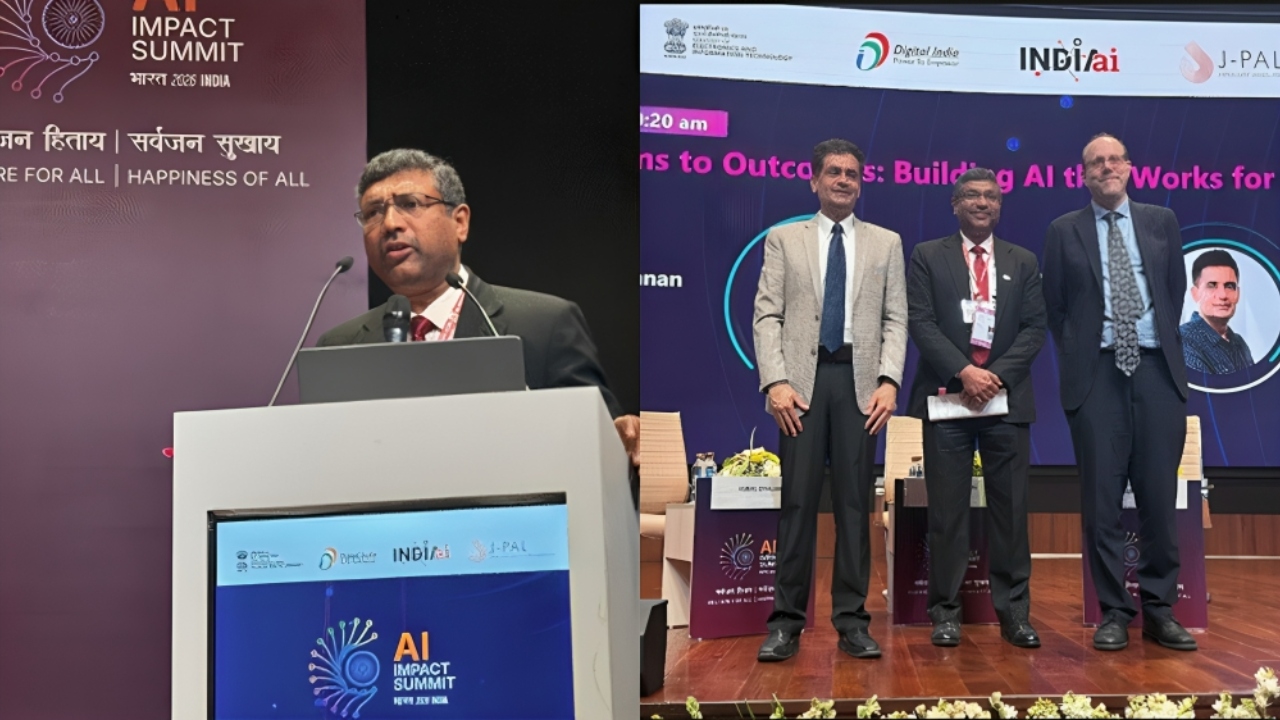
J-PAL AI Evaluation: India AI Impact Summit 2026 A clear message was given in an important session on the second day of AI that AI will be considered successful only when it brings real change in the lives of common citizens. “From Algorithms to Outcomes: Building AI that Works for People” In the discussion organized on the topic, policy-makers and experts emphasized that the purpose of technology is not just to generate models and data, but to show impact at the ground level.
S. Krishnan’s clear message: AI aims only at impact
MeitY Secretary S. Krishnan said that the India AI Mission has been designed in such a way that it can address diverse needs and real challenges. He clearly said, “We are providing compute, models, and data for one reason only, to build applications with real impact. Whether AI succeeds beyond the hype depends entirely on whether it delivers solutions that improve lives. If you walk through the expo, you’ll see hundreds of startups working across healthcare, agriculture, education, and manufacturing. That’s where impact will come from. Governments will never have enough teachers, doctors, or judges, but if AI can enhance productivity, service quality can improve dramatically. The challenge is to choose what works, scale it responsibly, protect privacy, and ensure public money creates measurable outcomes.”
Calling upon to visit the exhibition of more than 600 startups and companies, he said that the real change will come from these innovations.
No enthusiasm about AI, proof is necessary: experts’ opinion
Iqbal Singh Dhaliwal, global executive director of J-PAL, cautioned, “If you’ve spent enough time in development, you’ve seen many silver bullets come and go… Without rigorous evaluation, we risk mistaking excitement for impact.” He said that the success of AI should be assessed on the basis of for whom it works, under what circumstances and with what results.
Initial positive signs visible in education and health
University of Chicago professor Michael Kramer said, “We’re seeing early evidence of impact in areas like traffic enforcement, automated driver’s license testing, health, and education, including personalized adaptive learning that doubled the pace of student learning with just one hour a week.” However, he added that improving the system with technology and careful implementation is necessary.
Also read: Big questions on AI, direct answers from Minister Ashwini Vaishnav! Government’s complete plan on jobs, investment and rules
Now AI will be evaluated on results
This session of the summit made it clear that the future of AI will not be decided only by technical achievements, but by the concrete changes it brings in the lives of common citizens. The goal is to increase productivity, improve government services and ensure effective use of public funds.

Comments are closed.