
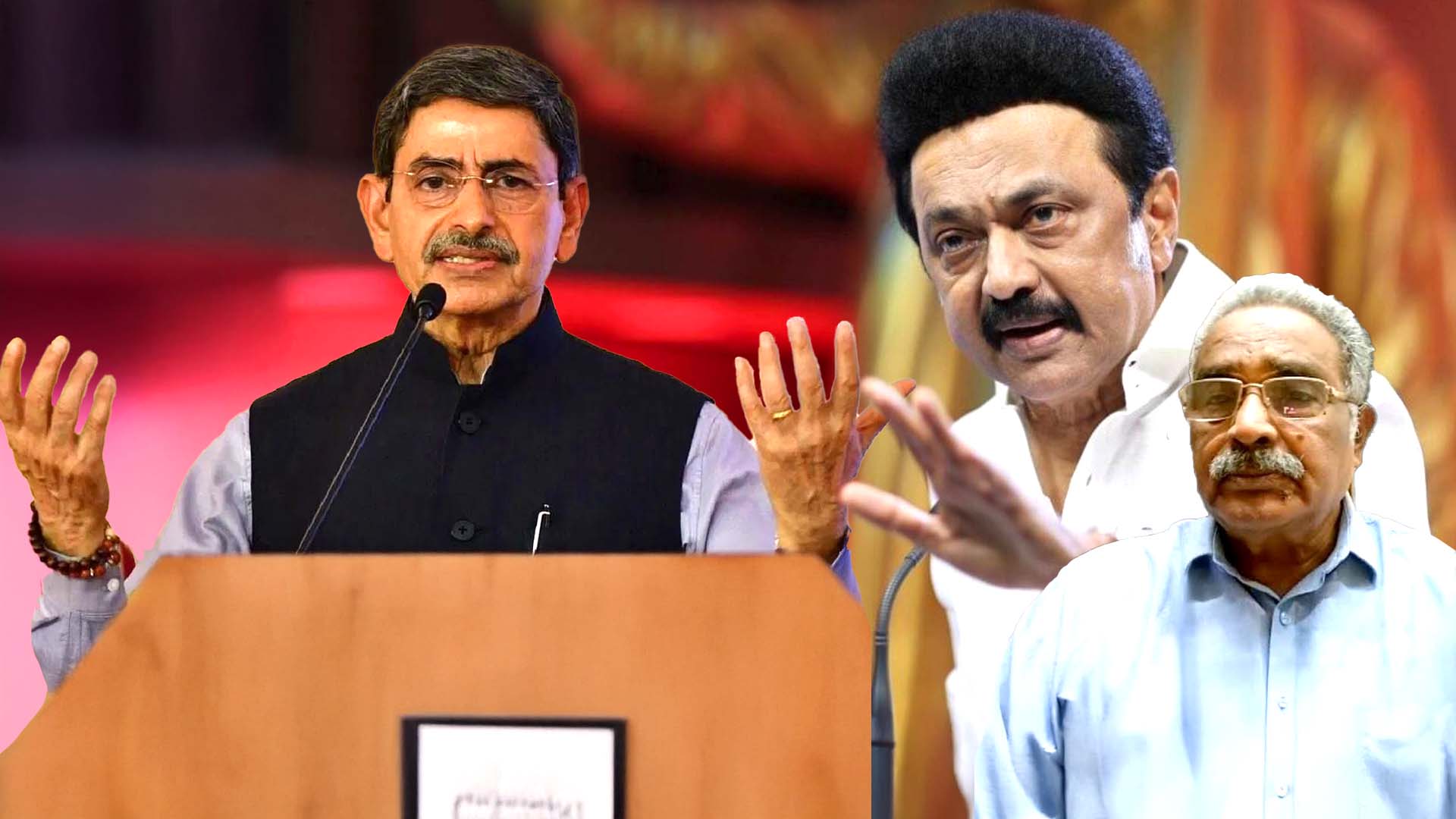

The proposal of Tamil Nadu’s Dravida Munnetra Kazhagam (DMK) government to amend the Constitution to remove the governor’s customary address in state Assemblies has reopened questions around constitutional mandates, political convention, and the limits of gubernatorial authority.
Former secretary-general of the Lok Sabha, PDT Achary, explains during a conversation with The Federal why Article 176 exists, what governors are bound to follow, and whether such a change is legally possible.
Tamil Nadu Chief Minister M K Stalin has said the DMK will seek a constitutional amendment to remove the Governor’s customary address at the beginning of the Assembly session, particularly in opposition-ruled states. How feasible is this move?
The governor’s address is provided for in Article 176 of the Constitution. It applies to all state governments and all governors. The article states that at the commencement of the first session of the year, and at the commencement of the first session after a general election, the governor shall address the legislative assembly.
Also read: Karnataka governor agrees to address legislature as Siddaramaiah govt blinks
The governor summons the Assembly on the advice of the Council of Ministers. After summoning the Assembly, he/she is required to inform the members about the causes of the summons, meaning why the Assembly has been convened. The Constitution uses the word “inform”.
There is only one practical way to inform all members collectively, and that is by delivering a speech in the House. This practice flows from the parliamentary system that India adopted from the British Westminster model, where the sovereign inaugurates Parliament every year.
This convention has been incorporated into our Constitution. Therefore, addressing the Assembly after summoning it is a constitutional duty of the governor.
Also read: After Tamil Nadu, governor-state government standoff erupts in Kerala
If a governor does not perform this duty, it amounts to acting against the Constitution. If Tamil Nadu Governor R N Ravi has walked out of the Assembly multiple times, it would mean the constitutional provision has been violated on each such occasion.
Similar confrontations have been reported in other non-BJP states, including Kerala. Does this context strengthen the DMK’s case?
This is not a new development. For the past few years, similar incidents have occurred in several non-Bharatiya Janata Party (BJP)-ruled states. In some cases, the governor has walked out of the House. In others, the governor has omitted portions of the prepared speech or added material of his own.
In Kerala, Chief Minister Pinarayi Vijayan had to include the full government-prepared speech in the Assembly records because the governor did not read it in its entirety. These developments show a recurring pattern.
Under the constitutional convention, the speech that the governor reads is prepared entirely by the elected government. It contains the policies and programmes of the government for the current year.
The governor has no authority to alter that speech. He cannot add anything, delete anything, or even change a comma. This applies equally to the President of India.
Can a state government amend Article 176 to remove the governor’s address from the first Assembly session?
A state government cannot amend the Constitution. Constitutional amendments can be made only by Parliament. In certain cases, such amendments also require ratification by at least 50 per cent of the state legislatures.
Also read: Bengal governor receives threat via email after ED raid drama; sender arrested
There is nothing sacrosanct about Article 176. It can be amended. However, the amendment must come from Parliament, not from a state Assembly.
The government of Tamil Nadu can request the Union government to consider bringing an amendment to Article 176 and dispensing with this practice. But such an amendment cannot be framed to apply only to non-BJP-ruled states.
Once amended, the provision would apply uniformly to all states without exception.
Has this practice been questioned earlier at the national level?
Yes. Former President of India, R Venkataraman (1987-92), had once expressed the view that this ceremony was unnecessary. He felt there was no special sanctity attached to the first session of the year and that a session could begin like any other sitting.
Also read: Bengal governor ‘denied’ entry at Salt Lake Stadium amid Messi event chaos
At the time, the government did not accept this view. When the Constitution originally came into force, the governor or the President was required to address the House at the beginning of every session.
Since there were three sessions each year, every session began with an address. Later, the government felt this was unnecessary and limited the practice to the first session of the year and the first session after a general election. That is how the present arrangement evolved.
After the governor walked out of the Tamil Nadu Assembly, Lok Bhavan (formerly Raj Bhavan) issued a note listing reasons, including the microphone being switched off and a lack of clarity on parts of the speech. Do these issues have constitutional relevance?
These issues have no constitutional significance. Whether a microphone was switched off or not is not a constitutional matter. A microphone is a technical device that can malfunction.
If there was a problem, it could have been raised immediately in the House. I have never seen a governor issue a press note complaining that his microphone was switched off.
Also read: AIADMK alleges Rs 4 lakh crore corruption under DMK govt, submits dossier to governor
Such matters do not justify refusing to discharge a constitutional duty. As for clarity on the speech, the governor has no authority to question or seek changes.
The speech is prepared by the government and reflects its policies and programmes. The governor is constitutionally bound to read it as it is.
The TN governor has also alleged that the National Anthem was insulted because it was not sung at the beginning of the Assembly session. Can a governor intervene in long-standing protocols?
Protocols are decided by the elected government. The governor has to follow them. If the National Anthem were not sung at all during an official function, he/she could raise a legitimate concern.
That is not the situation here. In Tamil Nadu, the long-standing practice is to begin the session with the Tamil invocation and conclude with the National Anthem.
There is no rule stating that the National Anthem must be sung both at the beginning and at the end. Even in Parliament, the National Anthem is sung at the beginning, while “Vande Mataram”, the National Song, is rendered at the end.
Nowhere is it written that the National Anthem must be sung before the governor addresses the House. Protocols are the prerogative of the elected government, and the governor cannot impose a new one.
The content above has been transcribed from video using a fine-tuned AI model. To ensure accuracy, quality, and editorial integrity, we employ a Human-In-The-Loop (HITL) process. While AI assists in creating the initial draft, our experienced editorial team carefully reviews, edits, and refines the content before publication. At The Federal, we combine the efficiency of AI with the expertise of human editors to deliver reliable and insightful journalism.

Comments are closed.