
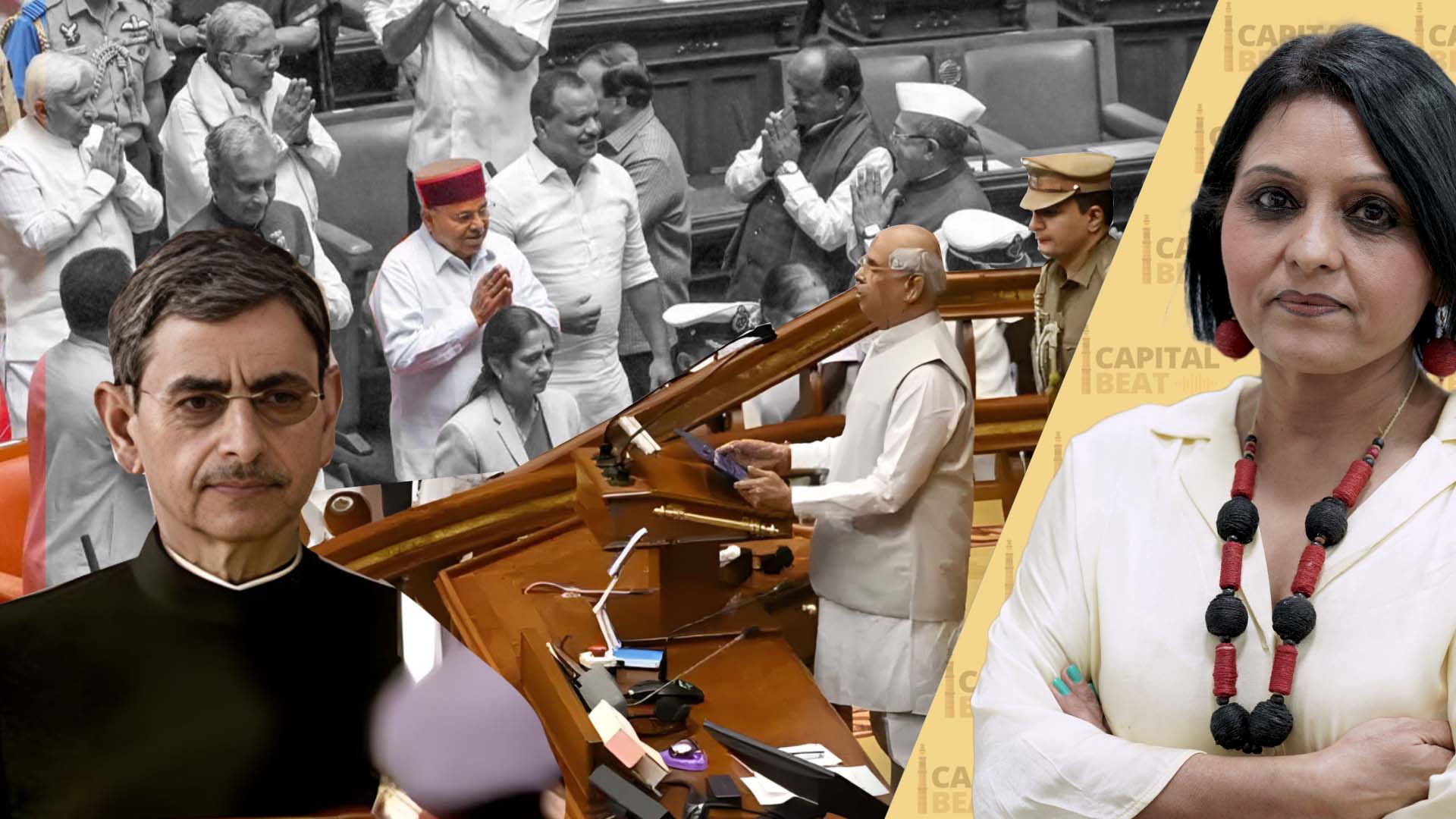

The Federal recently spoke to Javed Ansari, senior journalist, and Pranav Sachdeva, Supreme Court lawyer, in a Capital Beat episode about a series of controversies involving governors refusing to deliver or altering legislative addresses in the southern states of Tamil Nadu, Kerala and Karnataka.
The panel discussed constitutional provisions, political implications and legal remedies amid growing institutional tensions.
Ansari stated that multiple governors were acting “in concert” after similar incidents in different states. The issue arose after Karnataka Governor Thawar Chand Gehlot declined to deliver parts of the joint address to the state legislature because the speech contained references to the repeal of the Mahatma Gandhi National Rural Employment Guarantee Act (MGNREGA) and its replacement by the Viksit Bharat- Guarantee for Rozgar and Ajeevika Mission (Gramin) (VB- G RAM G) Act by the Centre.
Also read: Can states scrap governor’s address? PDT Achary explains
Parts of the draft speech, prepared by the Karnataka cabinet, were objected to by Gehlot on grounds including legal concerns after the passage of the Act in Parliament last month.
Similar actions in other states
In Tamil Nadu, Governor R N Ravi also walked out of the Assembly during an address earlier this week. A statement from his office cited that the National Anthem was insulted and that the speech contained “numerous unsubstantiated claims and misleading statements”.
In Kerala, Governor Rajendra Vishwanath Arlekar read the policy address for nearly two hours, but Chief Minister Pinarayi Vijayan later noted that the governor made changes to paragraphs approved by the Council of Ministers.
The panel raised the question of whether governors are constitutionally permitted to skip or alter portions of speeches drafted by elected state governments.
‘Governors acting on instructions’
Ansari said, “All these governors are acting in concert. They have been instructed to act… by their political masters.”
He noted that the state government and the governor were “supposed to work in conjunction, to work in tandem” and that these developments could erode public trust in institutions.
Also read: After Tamil Nadu, Governor-state government standoff erupts in Kerala
He also expressed concern about the constitutional framework, warning that such actions could undermine democracy and institutional legitimacy.
Political role of governors
Responding to whether the governor’s post was being repurposed from a ceremonial role, Ansari stated governors “have taken on a more activist role… more than at any time before in the last 40 or 45 years”.
He referenced a foreign leader’s comment that “the old order is giving way”, applying it to current developments in India, suggesting a new operational dynamic for governors.
Ansari also pointed out that objections have been raised mainly against opposition-ruled state governments, not those aligned with the central government.
Legal avenues and Supreme Court’s role
On whether there will be a separate Supreme Court case on these address issues, Ansari noted that in the past, the apex court had reprimanded Governor Ravi. He said, “Mr Ravi… has been given a wrap on the knuckles earlier by the Supreme Court.”
However, spontaneous intervention by the court seemed unclear without a specific petition.
Also read: Bengal Governor receives threat via email after ED raid drama; sender arrested
The discussion noted this situation as a “very poor reflection” on governance, highlighting institutional strain.
The Federal asked how Article 176(1) of the Constitution applied when governors exercise discretion to skip parts of speeches.
Legal framework for governor’s discretion
Sachdeva stated that the governor must act on the “aid and advice of the Council of Ministers”. He noted that the Constitution’s framers, including Dr B R Ambedkar, did not intend for a parallel center of power outside the elected government.
He said, “The speech is read out by the governor, but it is the speech of the elected government… the governor should not have any discretion.”
Sachdeva cited Supreme Court judgments that governors have limited discretionary areas, such as the imposition of President’s Rule, but not in ordinary legislative addresses.
Issue of political content
Sachdeva described the constitutional position that governors should read the full speech prepared by elected state governments. He noted that governments must avoid overly political content, as an address is typically about policies and proposed actions.
He stated that governors should not correct data or remove paragraphs because that would exceed their role. He said that the governor issuing changes because of disagreement would be unconstitutional.
Also read: Karnataka braces for govt vs Governor showdown
The lawyer noted that courts may not intervene easily because proceedings before legislatures, such as addresses, are generally beyond judicial review unless they involve voting or legislation.
Federalism and constitutional concerns
Sachdeva linked the issue to broader stresses on federalism. He said that in a recent presidential reference, at least 10 states supported a central government position that governors should have absolute discretion, while opposition states opposed that stance.
He stated, “The very fact that the central government could arrange and get state governments to back its stand… means federalism has been destroyed by one ruling party.”
The panel then discussed the current character of the governor’s office in light of these repeated controversies.
Governor’s office and political use
Ansari noted that no political party can claim innocence, as misuse of the governor’s office has occurred under various governments. He said, “What you will see… is increasingly the office of the governor becoming a puppet on a string… the remote is in somebody else’s hand.”
He said governors could delay bills, not give assent, send them to the President, and make governance difficult for state governments.
Also read: TN Governor RN Ravi walks out of Assembly, yet again, amid anthem row
Ansari described an increasing pattern of obstruction in opposition-ruled states and the need for such states to account for this dynamic.
Governor’s role and politicisation
Ansari described the original intent of the governor’s office as neutral, with influence similar to the President’s role in empowering elected governments. He said increasing political alignment compromises this role.
He noted that once a governor’s office becomes involved in political disputes, “the very purpose for which it was set up is compromised.”
He said more confrontation and obstructionism might occur unless conditions change.
Prospects for legal challenge
Sachdeva said that it was unlikely political parties would rush to court to challenge the governor’s behaviour, given the court’s record in protecting federalism in other contexts, such as misuse of powers and legislative delays.
He said that addresses to legislatures are not easily justiciable, as courts generally avoid intervening in proceedings before the legislature, absent a vote or bill passage.
He also compared the governor’s role with that of the President, noting that if a President edited speeches or refused assent based on personal views, governance would stall.
Governor’s role and constitutional misuse
Sachdeva said the governor’s office, like the President’s, was envisaged to act on the advice of elected governments. He said misuse and lack of judicial protection have rendered the role effectively redundant.
He stated that courts have been soft in other federalism-related matters, further limiting recourse.
The discussion then moved to examples where governors objected to specific speech content in state assemblies.
Criticism of speech edits in assemblies
The Tamil Nadu governor objected to paragraphs on education standards and faculty vacancies. In Kerala, the governor asked to remove a sentence stating: “Kerala continues to face a severe financial strain… Union government’s continued adverse measures… weaken the constitutional principles of fiscal federalism.”
Ansari stated the general understanding is that an address by the President or governor underscores policy positions, not politics, and that a quiet discussion could have resolved such issues.
He said the intent behind public controversies appears to be point scoring and putting down state governments.
Electoral context and continuation of controversy
Ansari stated that with elections approaching in Tamil Nadu and Kerala, there was “absolutely a political compulsion”. He said the aim seemed to be to undermine and obstruct state government functioning, and that a change was unlikely unless political costs became apparent.
When The Federal asked if this issue might reach the Supreme Court, Sachdeva said courts’ record in federalism matters has been mixed and that serious issues have not always led to effective remedies. He said the speeches being edited might not come to court due to limited judicial reach over legislative addresses.
Judicial review and trend
Sachdeva reiterated that judicial review is limited to addresses to legislatures, and that courts have shown restraint in past federalism-related cases.
He said problems could increase given this backdrop.
The astute legal constraints and continuing political manoeuvres were highlighted without extrapolation.
The content above has been transcribed from video using a fine-tuned AI model. To ensure accuracy, quality, and editorial integrity, we employ a Human-In-The-Loop (HITL) process. While AI assists in creating the initial draft, our experienced editorial team carefully reviews, edits, and refines the content before publication. At The Federal, we combine the efficiency of AI with the expertise of human editors to deliver reliable and insightful journalism.

Comments are closed.