
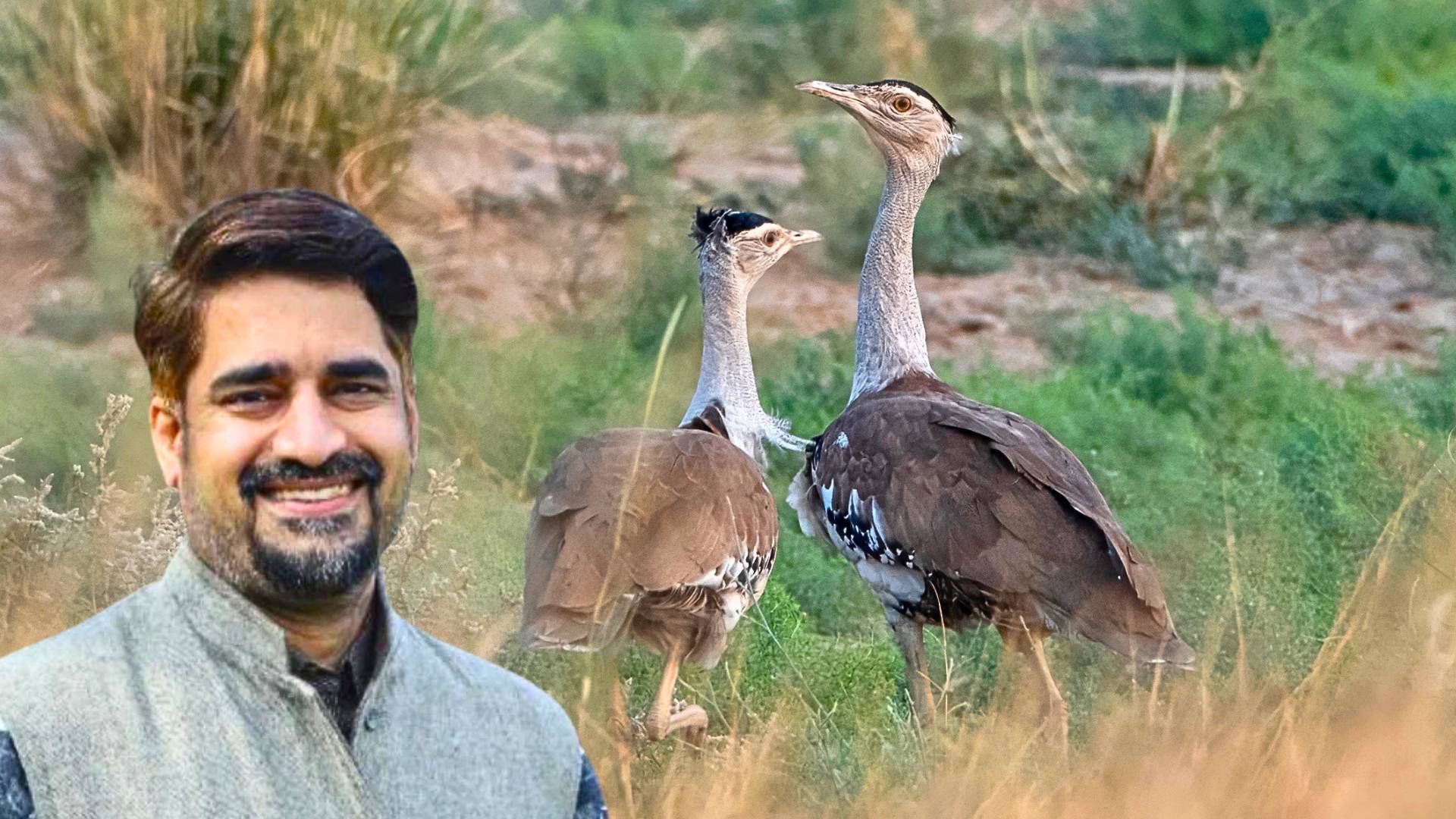

India recently saw a rare conservation success — a Great Indian Bustard (GIB) chick was born through assisted intervention. While this brings cheer, wildlife experts warn that breeding breakthroughs alone cannot save the species. The real battle, they say, lies in protecting shrinking grassland habitats and eliminating threats like power lines.
The Federal spoke to wildlife biologist Sumit Dookia about whether innovations like the ‘jump start’ approach can truly revive the critically endangered bird and what challenges remain. Edited excerpts:
You’ve called this a major success. How significant is this breakthrough?
It’s truly a great success that we have received after many years of waiting to see these birds in the wild. This achievement is part of a long conservation journey for the GIB.
The species has been declining since the 1970s and 1980s. This is not a sudden drop but a steady and rapid decline. The bird has very specific habitat needs—it prefers open grasslands with minimal human disturbance, which are now extremely difficult to find.
If the species has declined nationwide, why is Rajasthan still the main source for eggs?
Historically, the GIB was found in about 11 states across India. Now, it is restricted to just four or five states, with only one breeding population remaining in Rajasthan, specifically in the extreme west in Jaisalmer.
This population is currently the only hope for species recovery. Conservation efforts, including captive breeding, have been focused there. Eggs are collected from the wild, incubated under controlled conditions, and chicks are raised with human imprinting to make handling easier.
These birds form the first generation, and now we are seeing second-generation birds being born in these facilities.
Why was Gujarat chosen for this recent experiment?
The conservation breeding programme in Rajasthan began in 2019 through a collaboration between the Rajasthan government, the Ministry of Environment, Forest and Climate Change, and the Wildlife Institute of India.
In Gujarat, there was a lone female that had been laying eggs for the past few years, but they were infertile because no male had been sighted there for several years.
So, it was decided to try a “jump start” approach. Instead of waiting for natural breeding, a fertilised egg from Rajasthan was transported and incubated in Gujarat. This is like planting a mature sapling instead of waiting for a seed to grow.
The idea is also to avoid putting all conservation efforts in one location. Creating populations outside Rajasthan is essential for long-term survival.
Can breeding programmes succeed without addressing habitat loss?
In my understanding, it is not possible to save any species without securing its habitat. Captive breeding is an ex-situ approach, but habitat conservation is in-situ, and both must go together.
We currently have around 150 birds in the wild, but they are not breeding effectively. That indicates something is wrong with the habitat.
If habitat conditions—like food availability and safety—are not right, the species cannot thrive. So, securing and restoring grasslands must be the top priority.
What does ‘securing habitat’ actually involve?
One of the biggest threats is high-tension power lines. In the last six to seven years, we documented at least 10 bird deaths due to collisions with these lines. This threat was not even recognised in earlier conservation plans.
Although the Supreme Court ordered the removal or undergrounding of power lines in critical habitats within two years, progress has been extremely slow.
Another major threat is free-ranging dogs. These dogs can hunt wildlife, including young bustards, and also disturb them, causing sudden flights that increase the risk of collision with power lines.
We also need to restore degraded grasslands, many of which are overgrazed. Habitat restoration and threat removal are essential steps.
What are the challenges in rewilding captive-bred birds?
One of the biggest challenges is reversing human imprinting. Initially, chicks are raised to recognise humans for easier handling. But for rewilding, they must learn to identify with their own species.
Now, efforts are being made to ensure that newly hatched chicks see and follow other bustards instead of humans. This is the first step in rewilding.
At the same time, all major threats in their habitat must be addressed before releasing them into the wild.
Can a protected zone like Kutch sustain these birds long-term?
Not really. These birds require large, open landscapes. Some tracked birds in Rajasthan have been observed covering up to 20-30 sq km in a single day.
So, a small protected area is not enough. The species needs a mosaic of habitats—grasslands, agricultural fields, and community lands. If only a small zone is protected and surrounding areas remain degraded, long-term survival will be difficult.
What would success look like in the next few years?
If we take the example of tiger conservation, the population has more than doubled since Project Tiger began. For the GIB, if the current population of around 150 birds in the wild can at least double, that would be a strong indicator of success.
We also need multiple breeding populations across different locations to ensure genetic diversity and long-term stability.
How important is genetic diversity for the species?
Genetic studies show that the Rajasthan population carries genetic traits from multiple historical populations across India. That is a positive sign.
However, different sub-populations must still be maintained. For example, in Jaisalmer, two populations exist about 140-150 km apart, and they do not interact.
Creating multiple “island populations” connected to a larger meta-population is crucial for maintaining genetic health.
When did conservation efforts for the species actually begin?
Efforts go back over two decades. In 2000, early warnings about the species’ decline were already being raised. In 2006, a document called Project Bustard was proposed, but it did not receive much attention initially.
A more comprehensive recovery plan was developed in 2013, covering all bustard species in India. Rajasthan took the lead in implementing conservation measures, including habitat protection and later captive breeding.
Since 2019, both ex-situ and in-situ efforts have been underway. However, habitat conservation must now return to the top priority. This is a long-term effort involving many people over decades. What we are seeing today is the result of years of groundwork by scientists, forest officials, and conservationists.
The content above has been transcribed from video using a fine-tuned AI model. To ensure accuracy, quality, and editorial integrity, we employ a Human-In-The-Loop (HITL) process. While AI assists in creating the initial draft, our experienced editorial team carefully reviews, edits, and refines the content before publication. At The Federal, we combine the efficiency of AI with the expertise of human editors to deliver reliable and insightful journalism.

Comments are closed.