
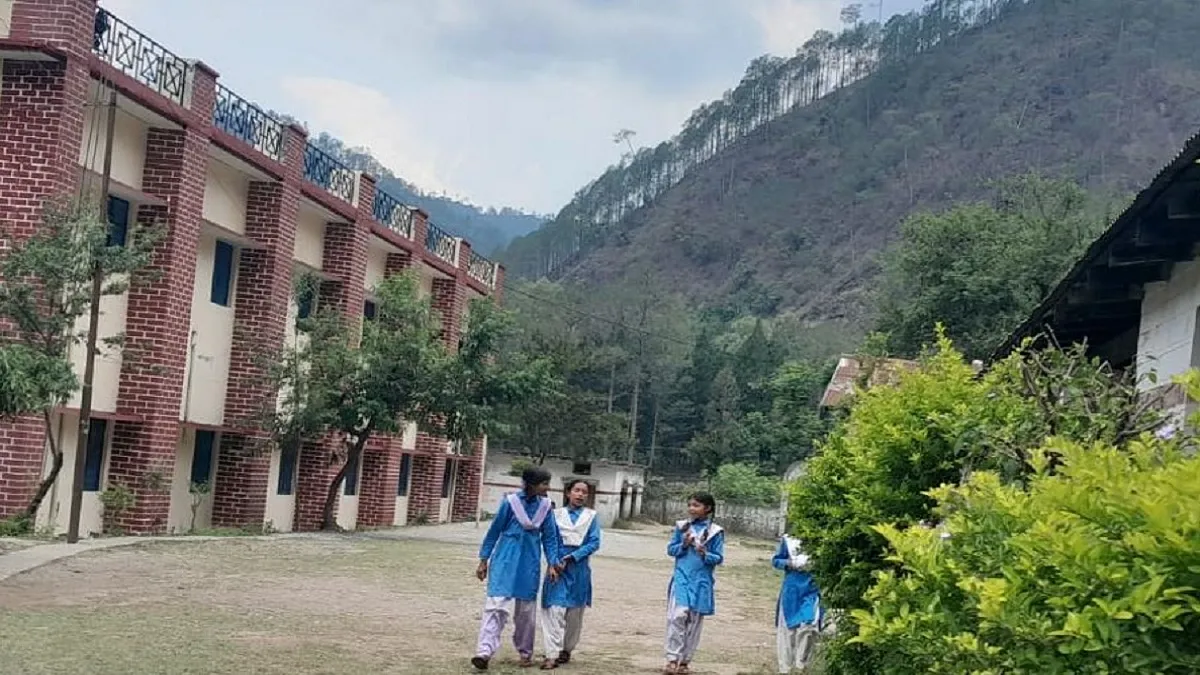

The villages situated in the hilly areas of Uttarakhand appear peaceful from outside, but there are many problems hidden inside, whose echo goes far. This problem is not only for the local people but also for the students. Pothing in Bageshwar district is also one such village. While there is a Government Inter College for studies up to 12th, but after 10th, the doors of this college are closed for students interested in science because arts are taught here but not science.
Anjali, who hails from the same village and is currently studying in class eleven, shares her story and says that she had completed her studies till class ten from the same school in Pothing. She says that this school was not just a place to study for her, but an environment where teachers and students understood each other. But as soon as it came to studying science beyond class 10th, he had to leave that school. Anjali is not alone. Along with her, other girls who chose science subject also had to take admission in another school, because there was no option to study science further in this inter college. In such a situation, girls are either forced to go to distant schools or stop their studies there.
According to UNICEF and the Ministry of Education, the dropout rate of girls by the time they reach secondary level in rural and hilly areas is much higher than in urban areas. According to NFHS-5, there is a clear decline in girls’ continued education after 10th in Uttarakhand, and the main reasons behind this are distance, security and limited availability of subjects.
Anjali tells that for further studies she has to go to a school in Kapkot area, which is quite far from home. It became his daily routine to leave early in the morning, cover long distances on foot and return late in the evening. Sometimes the vehicle is found, but sometimes not. In such a situation, it becomes dark by the time we return home.
There are many parents in Pothing village who hesitate in sending their daughters to study away from home. The reason for this is not only distance but also security concerns. In such a situation, many girls are not able to study further even if they want to. The example of Anjali’s friend Sonam Joshi shows this truth more deeply. Sonam wanted to take science subject, but could not get permission to go to a distant school. As a result, his studies came to a halt, and the dreams he had for himself remained unfulfilled. This situation is not limited to individual stories only.
According to recent data from UDISE Plus, availability of subjects in schools at the secondary level is limited in many hill districts of Uttarakhand. Subjects like science require laboratories, trained teachers and resources, which many rural schools do not have. For this reason, every year a large number of children either change schools or leave studies.
Vimal Kumar, the principal of this inter college, is also well aware of this problem. He tells that this school was established till 8th class. In 2004 it got the status of 10th and in 2017 it got the status of Inter College i.e. up to 12th. But after 10th, permission was given to teach only Arts subjects. In such a situation, it becomes difficult for children, especially girls, interested in science to study away from the village.
60 boys and 69 girls study in this school. Many of these children have to leave school simply because they do not have science subjects. This affects both the numbers and the future of the school. He says that a proposal has been sent to the concerned department to start studying science subjects from 10th onwards, but till now no concrete action has been taken.
Village head Saraswati Devi also considers this problem serious. He says that due to lack of facilities for science subjects, he did not even educate his daughters in the village school. He clearly says that if this situation continues, then gradually the village school will become vacant and one day there may be a possibility of its closure. Today is the time of science and technology. To progress in every field, the need for scientific understanding and education is increasing. But when its foundation is not provided in the village schools, children are left behind from the very beginning. This situation is not only of education but also of inequality of opportunities.
This story of the girls from Pothing village forces us to think whether education is limited to books only, or is it also linked to paths, distances, resources and decisions. If science subjects are made available in village schools after class 10th, then not only the girls’ education can continue, but they will also get relief from the compulsion of going away from home. In fact, school is the hope for the future, but these hopes are broken only because the subjects are not there. To which not only the department but also the society needs to pay attention.
(Ground report of Sanjana from Pothing, Uttarakhand)

Comments are closed.