
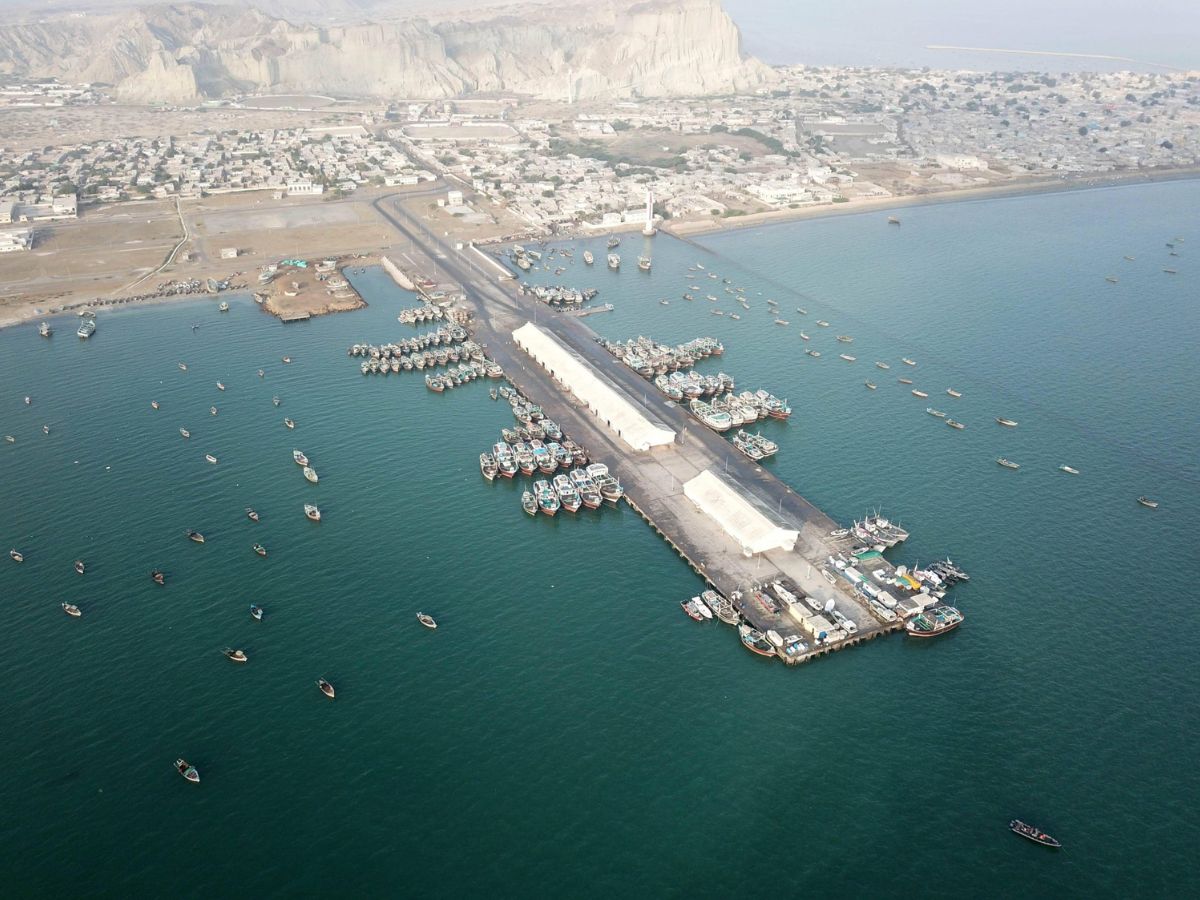
Gwadar Port Has More Ships Right Now than It Has Had in Years. That’s Not What It Sounds Like

23
Gwadar Port in Balochistan has seen a visible uptick in vessel activity in early 2026, driven by disruptions to the Strait of Hormuz stemming from the US-Iran conflict. The Pakistani government has cited the numbers as commercial validation of the China-Pakistan Economic Corridor’s flagship maritime project. No international shipping line has announced a scheduled, permanent route to the port. Every ship currently at Gwadar is there on a temporary or transshipment basis.
The difference between transshipment activity and a permanent network call is not a technical footnote. It is the entire commercial argument. When a carrier includes a port on its fixed rotation, it publishes a circular, files with the relevant port authority, and commits its vessels to that schedule regardless of whether a regional conflict is generating temporary rerouting nearby. That circular has not appeared for any carrier operating in the Arabian Sea with Gwadar as a listed port of call. The filings are public. The absence is documentable.
Transshipment is cargo that arrives at a port heading somewhere else. It generates handling fees and anchorage revenue. It does not generate the freight-forwarding relationships, the customs infrastructure investment, or the warehouse and distribution networks that follow when a carrier decides a port is worth a permanent commitment. Karachi has those relationships. Colombo has them. Port Qasim has them. Gwadar does not.
The scale of the gap is instructive. Gwadar processed roughly 8,300 TEUs across all of 2025. Singapore’s port recorded a throughput of over 40 million TEUs in 2024 alone. Colombo achieved a record 7.78 million TEUs in the same year. Both are direct competitors for the Arabian Sea transshipment business. Neither reached those volumes through wartime rerouting. They reached them through permanent carrier commitments accumulated over the years.
The CPEC master planning documents of 2015 projected Gwadar handling 400 million tonnes annually by 2045. The port’s actual throughput across its operational years has remained in the low single-digit millions. Pakistan’s own planning authorities have revised the development timelines across multiple documents without publishing revised throughput models to explain the gap.
The current activity at the port follows a pattern familiar from earlier regional disruptions. When the Suez Canal was blocked in March 2021 by the Ever Given container ship, alternative Arabian Sea routing saw brief spikes in activity at ports that would ordinarily receive minimal traffic. Vessel calls went up. Press statements followed.
The spikes subsided when the disruption ended. Gwadar saw similar temporary upticks during periods of Strait of Hormuz tension in 2019 and during the Houthi Red Sea attacks in 2024. Each time, Pakistani officials described the activity as evidence of growing commercial momentum. Each time, no carrier followed the activity with a network commitment.
The structural problems compound the commercial ones. Gwadar’s channel depth of 12.5 metres eliminates it from consideration for the largest container vessels before any commercial negotiation begins. Karachi’s main terminals operate at 16 metres with commitments to dredge further.
The Makran Coastal Highway connects Gwadar to Karachi over approximately 650 kilometres of coastal terrain with no rail link. Freight operators calculating the cost of routing through Gwadar against the established infrastructure at Karachi Port and Port Qasim are making that calculation on the basis of existing connectivity, not projected CPEC construction schedules. The connectivity gap is a present fact, not a future risk. The port’s finances reflect the same dysfunction: Gwadar failed to pay employee salaries for November and December 2025.
Pakistan’s Maritime Affairs Ministry has not published any carrier agreement or memorandum of understanding with an international shipping line for scheduled Gwadar services since the port became operational under CPEC development. The ministry has published agreements with Chinese state entities covering port management and development financing. Those are not carrier contracts.
The ships at Gwadar right now are there because the regional situation makes the port useful in the short term. When the regional situation changes, the calculus for those vessels changes with it. A port whose vessel activity requires a conflict to stay elevated is not yet a port that carriers have decided they need. The distinction is between a facility that happens to be convenient and one that has proven itself commercially indispensable.
Gwadar has not yet made that case to the carriers who would need to make it real.

Comments are closed.