

On the morning of March 21 Nguyen Manh Cuong, 37, in Hanoi’s Phu Dien Ward hesitated as he checked his motorbike’s fuel gauge after filling up at a gas station. Last month he could fill his tank with VND60,000 (US$2.28), but now it was not even two-thirds full.
“Yesterday filling up my car cost VND850,000 instead of the usual VND600,000,” he says. “Every time I watch the price add up on the pump it hurts.”
As a sales representative for a fertilizer company, he drives 3,000 km a month in mountainous regions. He used to spend VND3.3 million on petrol, but he now estimates that has risen to VND5 million.
Gasoline prices has risen above VND30,000 (US$1.14) per liter in Vietnam despite the government’s efforts to curb the rise.
The Middle East conflict has caused crude oil prices to spike, pushing costs at the pump up by more than 50%. The higher fuel prices increase transportation costs and those of essential goods, eroding household budgets.
Cuong’s family’s spending plan has been upended. He and his wife earn a combined VND20 million per month. Before the fuel price hike, they could save VND2-3 million after paying VND6 million for their two children’s school fees and living expenses, but that is now being eaten up by fuel costs.
People queueing to refuel at a gas station on Hoang Quoc Viet Street in Hanoi at 3 p.m. on March 10, 2026. Photo by Read/Phan Duong |
The effect of rising energy prices is felt by everyone. Urban office workers are also adjusting their routines.
Over the past week Xuan Hoa, 39, of Cau Giay Ward in Hanoi has kept her car covered with a tarp while she and her husband share a motorbike. They now leave home an hour earlier, and Hoa has to be dropped off two kilometers from her office so her husband can continue to his workplace easily.
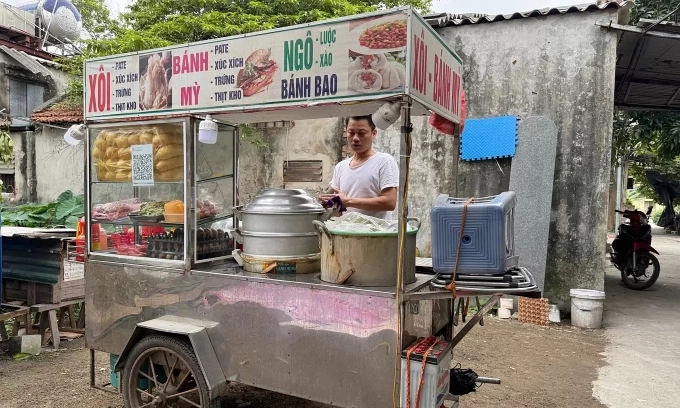
Sitting outside his home, Pham Van The, 43, tallies costs incurred for his street food business. The four gas canisters he uses recently rose from VND320,000 to VND390,000 each, adding VND600,000 to his monthly fuel costs.
Nearly all the ingredients he uses to cook have become more expensive: eggs have increased from VND55,000 to VND60,000 per tray, buns from VND65,000 for 10 to VND70,000, bread by VND300 per loaf, and plastic bags by several thousand dong per kilogram.
Since most of his customers are students, keeping prices steady is the only way he can retain them.
He and his wife sell on Hanoi’s Hoang Quoc Viet Street from 4 p.m. to 2 a.m., earning around VND300,000 a day, just enough to support their three children.
“With prices rising like this, we have to cut back on eating meat and fish,” he says.
Manh Hung, owner of a cooking gas distributor in Hanoi, says retail prices have jumped from VND360,000 per cylinder to VND470,000 since Lunar New Year in February. As a result his daily sales have dropped from 15-17 cylinders to less than 10, he says.
“Yesterday I delivered gas to regular customers, but when they saw cylinders cost near half a million dong, they declined and switched to electric stoves temporarily,” he says.
A Read survey at Minh Khai wholesale market in Phu Dien Ward on March 24 found all-round price increases. Pork was up by VND10,000-20,000 per kilogram, whole chickens from VND50,000 to VND60,000 per kilogram and wings from VND65,000 to VND75,000.
“In retail markets, prices will likely rise another VND10,000-20,000,” vendor Bui Dang Tinh says.
Many eateries have also increased prices: a bowl of pho and a basic rice meal now cost VND5,000 each, 10,000 more than before.
Transport companies are reducing trips and raising fares by 5-35%, some by even 50%. Manh Ha, director of a bus company that operates on the Hanoi-Hai Phong route, says fares have risen by VND20,000 in the last three weeks, while passenger numbers have fallen by 20%.
“It seems people are tightening their budgets.”
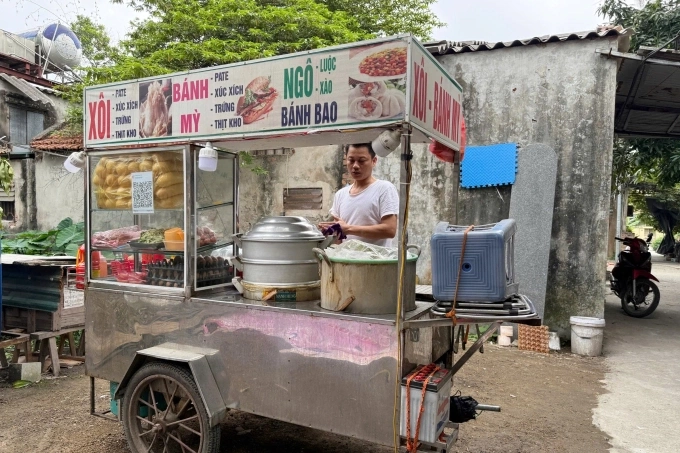 |
Pham Van The preparing his street food stall in Hanoi, March 20, 2026. Photo by Read/Quynh Nguyen |
Dr. Pham The Anh, head of the economics faculty at the National Economics University, says historical data shows that a 10-20% rise in fuel prices is manageable for the economy, a 30-50% increase slows investment and consumption, a 50-100% increase poses a real recession risk, especially for vulnerable economies, and a hike of over 100% could trigger a crisis.
“Domestic fuel prices have risen 40-80% in about three weeks. If you include the government’s stabilization fund, the increase is 70-100%,” he says.
“The tens to hundreds of thousands of dong extra spent at gas stations are only the beginning. Food, groceries and transport, the items low-income families spend most on, will see the steepest increases.”
From a governmental policy perspective, reducing taxes could ease the impact of global prices, the expert says. Import duties on fuel have been scrapped until April 30, and he suggests permanently removing the special consumption tax on petroleum.
 |
Motorbike-taxi driver Nguyen Dac Hien at the Mai Dich overpass in Hanoi, January 2026. Photo by Read/Phan Duong |
Rising fuel costs are changing commuting habits. Last week sales of electric motorbikes in Hanoi and Ho Chi Minh City were three to four times higher than usual.
While dealers cited the rising fuel prices as the main reason, Hanoi, which leads the country, is also preparing to trial a ban on gasoline motorbikes during certain hours of the day.
Nguyen Dang Khoa, director of Tri Nam Transport, says public bicycle usage is increasing steadily.
Newly launched e-bikes at 130 Hanoi stations see over 100 new registrations daily. The system’s 1,200 normal bicycles and 100 pedal assist bicycles remain in constant demand.
10 years ago Nguyen Dac Hien of Dan Phuong Commune in suburban Hanoi started working as a motorbike taxi driver at the Cau Giay intersection.
But with fuel eating into his VND50,000 daily earnings following the price hike, he has switched to working as a waterproofing worker in apartment buildings, a tougher job but without daily fuel costs.

Comments are closed.