

The plan was outlined on Dec. 17 during a dialogue between city leaders and young people in the capital, chaired by Hanoi People’s Committee Chairman Vu Dai Thang. The discussion focused on how Hanoi can better nurture talent, innovation and technological leadership as it accelerates digital transformation.
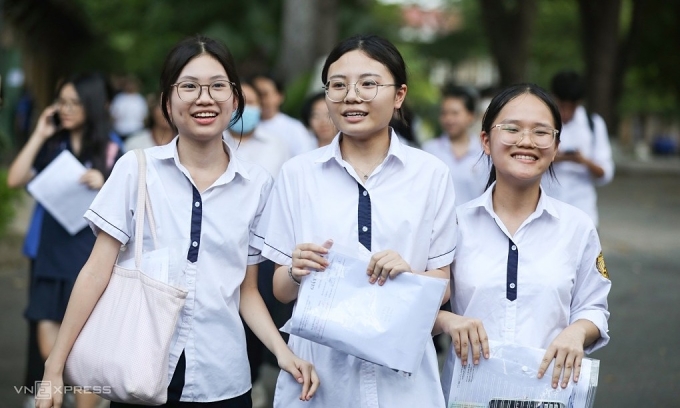
Students attending the 10th grade entrance exam in Hanoi in June 2025. Photo by Read/Tung Dinh |
According to Tran Anh Tuan, director of the Hanoi Department of Science and Technology, the city is proposing a multi-track training model designed to meet both public-sector and private-sector demand.
One track would see Hanoi commission universities and academies to train around 50,000 high-quality digital workers. Under this model, second- and third-year students would be selected based on strict criteria, receive targeted training in strategic technologies, and commit to working for the city for a set period after graduation.
A second track, known as the “Next 1,000” program, would focus on top graduates and engineers in priority technology fields. The city would fund advanced training at leading international institutions, with participants required to work in Hanoi for at least five years upon completion. The program is expected to begin in 2026.
A third track would target earlier stages of education, with plans to identify and nurture exceptional students through advanced curricula supported by artificial intelligence, digital tools and domestic and international experts. City officials also described a more ambitious, long-term approach to cultivating “elite” talent, including exploring genetic-based selection to support elite development through adulthood, alongside scientific research related to prenatal education.
City leaders said the strategy is intended to first meet Hanoi’s own demand for high-quality human resources, before supporting multinational companies investing in the capital.
Universities set to move toward suburban hubs
The dialogue also touched on Hanoi’s plan to relocate universities and colleges from the city center to suburban areas as part of a multi-center urban development model.
Nguyen Phi Thuong, director of the Hanoi Department of Construction, said Hoa Lac has been designated as a major hub for science, technology and higher education, anchored by the Hoa Lac Hi-Tech Park. Vietnam National University, Hanoi has already begun relocating part of its campus there, with other institutions expected to follow.
The city aims to form large university cities by 2030, capable of accommodating around 200,000 students, supported by integrated transport and urban infrastructure.
To support the shift, Hanoi plans to break ground on Metro Line 5 (Van Cao–Hoa Lac) on Dec. 19. The line, with total investment estimated at about VND74 trillion (US$2.8 billion), is expected to be completed before 2030 and serve as a key transport corridor linking the city to the Hoa Lac area.
Concerns over online risks and youth culture
Education leaders at the event also raised concerns about online misinformation, harmful digital content and school violence, particularly on social media.
City officials said Hanoi has stepped up coordination between education authorities, police and cultural agencies to promote digital skills, protect children online and crack down on content that violates cultural norms. Hundreds of online posts and videos were removed in 2025, according to the Department of Culture and Sports.
Chairman Thang said Hanoi’s youth should play a central role in shaping the city’s future; not just as policy beneficiaries, but as pioneers in adopting new technologies, building data platforms and driving innovation.
He said 2025 marks the start of a new phase in implementing Hanoi’s long-term development strategy, with young people expected to be at the forefront of that transformation.

Comments are closed.