
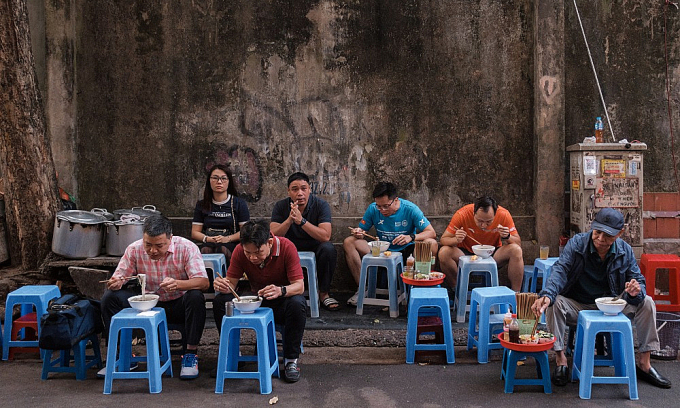

As night falls over the streets of the Old Quarter, daytime vendors begin packing up their stalls.
Business slows, but the neighborhood never goes quiet. Instead, night vendors drag out pots and set up kitchens right on the pavement, while diners gather around and wait to be fed.
It is a scene, as Michelin has noted, that feels almost untouched by time, one that could belong to this century or the last.
Foreign tourists enjoy street food on the sidewalks of Hanoi’s Old Quarter. Photo by VnExpress/Hong Quang |
“The Old Quarter has existed since around the year 1000 and has always been a trading center,” food historian Trinh Khanh Linh explains.
“People came here from across Vietnam and from other countries, including many Chinese migrants in the 17th century.”
That history still lives in the street names. Hang Bac was once home to silversmiths (bac). Thuoc Bac was lined with traditional medicine (Thuoc Bac) shops. Hang Thiec belonged to metal (Thiec) workers, and Hang Chieu sold woven mats (Chieu).
Most streets no longer carry those trades; they are now known for food.
As Andrea Nguyen, cookbook author and chef, tells Michelin: “On Hang Khoai, where tubers were sold, you would have had vendors selling boiled sweet potatoes and cassava, maybe taro.
“So much of that history is hidden in the street names, but you have to know how to read them.”
Where traders gathered, food followed. Competition between vendors helped shape the dishes that Hanoi is known for today. Noodles, introduced from China, became foundational, and today much of Vietnam’s food is developed from international influences.
Then, in the late 19th century, French colonial rule arrived to reshape the city’s architecture and food. But instead of copying French cuisine, Vietnamese cooks adapted it.
Pho is the best example. It combines Chinese techniques, local ingredients and French influence. Chef Charles Degrendele of the Michelin-selected Le Beaulieu said Vietnam adapted French cuisine to local tastes and not the other way around.
Le Beaulieu, opened in 1901, played an important role in the city’s food scene.
Degrendele added that over the past 125 years, Vietnamese and foreign chefs have trained within its walls before going on to open restaurants of their own.
For much of the 20th century eating out in Hanoi meant a choice between street food or hotel dining, and little else. That began to change in the 1990s, when Vietnam opened its economy to the world, and the Old Quarter led the way.
Long Nguyen, born in 1994, grew up alongside Hanoi Garden, his family’s Michelin-selected restaurant, which opened in 1998.
He said in the 1990s restaurants were rare outside hotels. His memories are of cold Hanoi mornings, eating breakfast on wooden benches, moments he still remembers.
For him, the Old Quarter is the foundation of Vietnamese cuisine. Without it, he believes, chefs might rely on foreign ideas instead of creating something rooted in their culture.
That foundation is still visible on the streets today. Many of the Old Quarter’s eateries have been feeding the same neighborhoods for over 30 years with unchanged recipes.
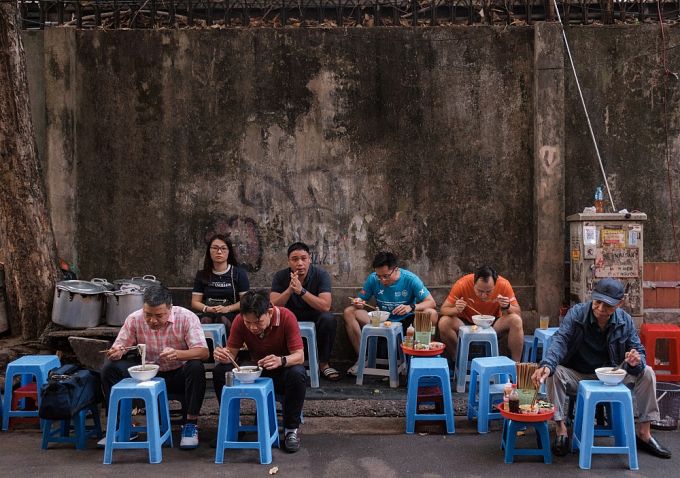 |
Diners sit on low plastic stools, also using them as tables, while eating bowls of pho. Photo courtesy of Michelin Guide |
Chef Truong Quang Dung, owner of Chapter restaurant, shares a similar background. His menu uses local ingredients such as corn and eel to create modern dishes. He is not trying to change Vietnamese cuisine, but to refine it and take it to a global stage. For him, the Old Quarter remains a starting point for young chefs.
The food scene here is more diverse than ever, serving both local people and international visitors. He admits that the Old Quarter remains, at its core, what it has always been: a tough trading district where only the good survive.
He says people are demanding, and that is what keeps traditions alive. The residents in the Old Quarter are proud of their food. For those seeking authenticity, this is where it can be found.
“That’s something Hanoi has in spades over the rest of Vietnam, a rustic charm and a kind of maintained patina that makes it so appealing,” Andrea Nguyen says.
That appeal has earned Hanoi a place on the world food map. Last year British magazine Time Out ranked it as having the second-best street food city in Asia, ahead of Singapore and Bangkok.

Comments are closed.