
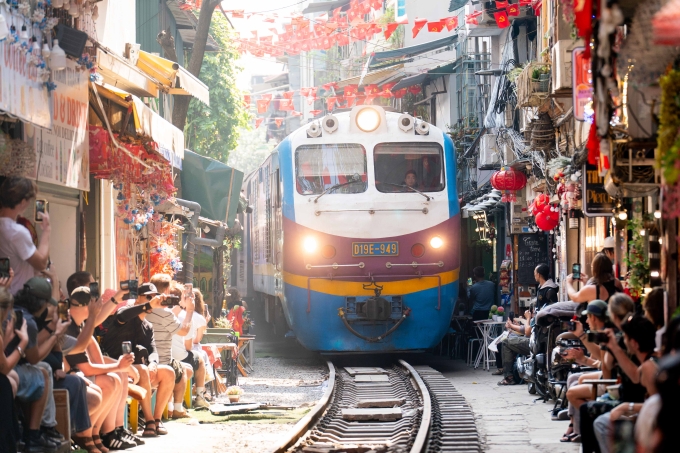

When Mark Bowyer first walked along the rail tracks between Phung Hung and Tran Phu streets nine years ago, what struck him most was its ordinariness.
There were no cafés, visitors or even safety barriers; instead, houses clung to the tracks, with residents making use of every spare centimeter.
People cooked meals, did laundry and even plucked each other’s grey hairs while sitting on the sleepers.
Data from Vietnam Railways shows this to be the most densely populated inner-city railway segment, where the safety corridor in some places measures less than one meter wide.
The shift became noticeable around 2017 or 2018, when social media began to explode.
Bowyer, who founded Rusty Compass in 2006 to offer tours that showcase the changing landscape of Asia, recalls filming along the tracks in 2017 as children played on the rails and elders looked curiously at the outsider.
“Please speak Vietnamese, we don’t understand foreign languages,” a woman said, laughing, as he filmed.
He surprised them by asking in fluent Vietnamese: “Oh, so you don’t speak foreign languages?”
But his accent was funny for them. As he walked, children swarmed him, practicing their English with a chorus of “What’s your name?”
Further down Phung Hung Train Street, amidst the smoke of charcoal stoves, he asked a woman what she was cooking. She brushed off the question, asking him instead: “How many kids do you have?”
Further toward Tran Phu Street, he encountered rows of houses with metal roofs. Outside each, clotheslines sagged under the weight of garments, blankets and mosquito nets drying in the open air.
Clothes drying along Hanoi Train Street in 2017. Photo courtesy of Rusty Compass |
Bowyer says trains did not pass frequently, and daily life was calm.
In fact, the area offered a sense of peace rarely found elsewhere in the capital, and walking along the tracks sometimes felt safer than navigating the city’s main roads.
According to TripAdvisor data, by 2018 the keyword “Hanoi Train Street” had entered the list of must-try experiences in Vietnam, triggering a wave on Instagram and TikTok clips.
When Bowyer returned to Hanoi in 2019, he was shocked: Old houses had been transformed into cafés, and Vietnamese family greetings had been replaced by “Coffee?”
“The Vietnamese entrepreneurial spirit is sharp,” he says.
One example was Dung, who opened a cafe in 2018 that also sold craft beer bar themed around trains.
She told him that all the chairs in her shop were railway seats, used by Vietnam Railways to serve passengers for over 50 years.
The artifacts gave the cafe its identity, she told him.
The boom in business there prompted local authorities to order the closure of cafés in October 2019 due to evident safety concerns.
After the pandemic ended Train Street’s appeal did not fade but intensified, and the area became a lesson in organic tourism.
By 2023, despite official bans and barriers at the entrance, visitors still found ways to enter, hoping to witness a train brushing past house walls.
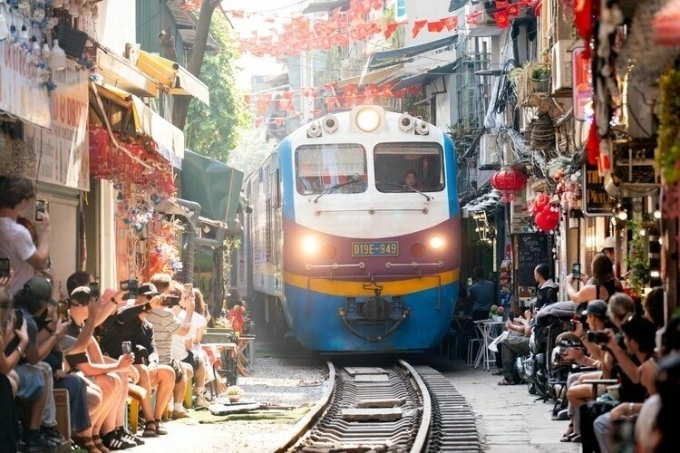
Vietnam Railways has urged authorities to address safety violations after incidents of trains knocking over tables placed too close to the tracks and even brushing against tourists standing near the rails for photos.
Hanoi People’s Committee recently proposed a plan to reroute traffic routes in the city’s center, which would include stopping passenger trains from running through the coffee street.
Today the place is at a crossroads, caught between preserving a cultural identity and complying with regulations.
Even as clotheslines are replaced by neon signs, life continues along the tracks. It is that authenticity that continues to draw foreign visitors, camera-ready, to see for themselves.

Comments are closed.