
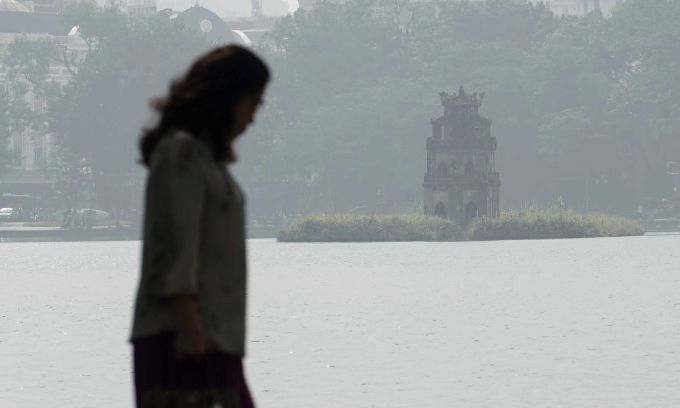

The station at Hanoi University of Science and Technology hit 227 early in the morning, marking the third straight day at this dangerous threshold and confirming what officials say is the city’s most intense smog wave since winter began last month.
Authorities attribute the spike largely to PM2.5, fine particulate matter small enough to enter the bloodstream. Data from IQAir, a global air-quality ranking system, placed Hanoi among the world’s most polluted cities at 8:30 a.m., with an AQI of 243. Several hotspots across the capital reached even higher levels: Tay Ho surged to 295, near the “hazardous” threshold, while Long Bien, Tran Vu and Hoang Quoc Viet hovered between 240 and 260.
Conditions were not much better in neighboring provinces. Hung Yen saw AQI readings climb above 200 at stations in Nhu Quynh and Thai Binh, while Thai Nguyen’s Tich Luong Ward peaked at 239 overnight. Bac Ninh, Phu Tho and Ninh Binh also recorded unhealthy levels as the smog spread across the northern region.
Vietnam’s Department of Environment warned that Dec. 11 would likely be the peak of the pollution episode, with many localities, including Lang Son, Hai Phong, Quang Ninh and Thanh Hoa, expected to hit very unhealthy levels. Forecasts from the Vietnam National University’s University of Engineering and Technology show pollution spiking between Dec. 8–14 before an incoming cold-air surge begins to disperse the smog.
As conditions deteriorate, ministries and local governments have been ordered to deploy emergency measures.
Industrial plants, including coal-fired power stations, steel mills, chemical factories and fertilizer producers, are asked to fully operate emissions-control systems and scale back output when AQI exceeds 200.
Construction sites are being told to cover materials, wash vehicles, use misting systems and pause high-dust activities. Police have been directed to crack down on uncovered material trucks, vehicles emitting black smoke and illegal trash burning.
Health agencies are advising residents, especially children, the elderly and people with respiratory conditions, to limit outdoor exposure and use certified masks. Schools have been told to restrict outdoor activities whenever air quality reaches unsafe levels.

Comments are closed.