
Mumbai Indians’ captaincy concerns grow amid Hardik Pandya, Rohit Sharma, and Bumrah Struggles in IPL 2026

When Hardik Pandya assumed the captaincy of the Mumbai Indians in December 2024, expectations were immediate and immense. The reasoning seemed sound. He had recently guided the Gujarat Titans to an IPL championship and then led them to a final the next season, while Rohit Sharma’s batting had dipped and MI had endured three trophy-less years. Hardik’s appointment appeared to be a logical progression in succession planning, especially considering his formative years with the franchise that first gave him his platform.
Mumbai’s earlier choice to release Hardik ahead of IPL 2022 proved costly. The Gujarat Titans quickly acquired him as their marquee player and entrusted him with the captaincy. Three years on, however, his return has produced mixed results.
After finishing at the bottom of the table in 2024 and making the playoffs in 2025, IPL 2026 has once again revealed vulnerabilities within the squad. Hardik’s tactical options are limited, and implementing solutions is difficult.
Hardik’s frustration is evident as the Mumbai Indians suffered their fourth consecutive loss on Thursday, falling to the Punjab Kings by seven wickets. He spoke candidly after the defeat.“We need to evaluate whether tough decisions are necessary or if we should keep going and hope for a turnaround. These are difficult questions we must face, and ultimately, responsibility lies with us,” said Hardik.
Pinpointing exactly who is responsible for MI’s struggles is challenging, but the numbers are revealing. Hardik himself has been inconsistent, while Suryakumar Yadav and Tilak Varma have failed to contribute consistently with the bat. Jasprit Bumrah is experiencing a rare dry spell, going 114 deliveries without a wicket. Adding to the challenge, Rohit Sharma missed the Punjab Kings match with a hamstring injury, further weakening the team.
The Legacy built over the years is getting broken brick by brick 💔🥺
Wankhede used to be our Fortress but now😞 #IPL#IPL2026@mipaltanpic.twitter.com/B7YJJO0r3y
— MI Blud☄️ (@micricket2013) April 17, 2026
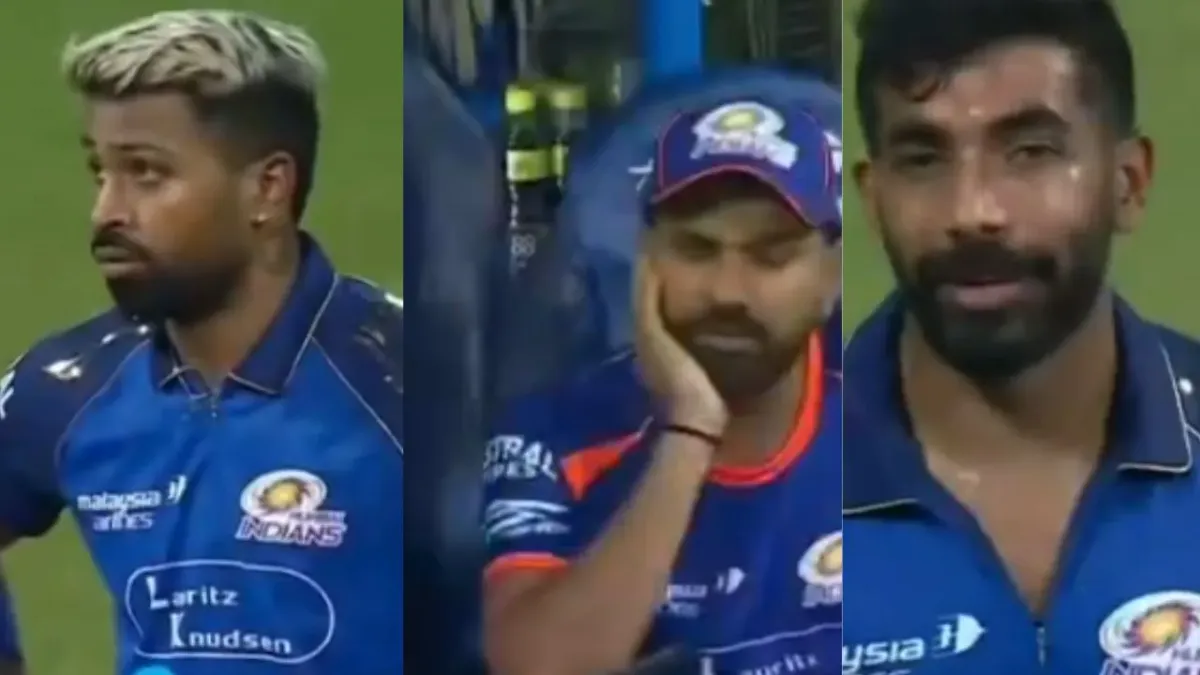
Hardik’s frustration became visible on the field during the 196-run chase against the Punjab Kings. He appeared restless and animated, constantly directing his bowlers and fielders, while Prabhsimran Singh and Shreyas Iyer completed the chase with 21 balls to spare. Even Bumrah seemed unsettled, dropping a catch and struggling to stem the run flow, while Rohit’s disappointment was evident in the dugout.
Mumbai’s bowling resources have also declined. While most IPL sides rely on two or three frontline bowlers, MI have leaned almost entirely on Bumrah. Deepak Chahar, Trent Boult, and Shardul Thakur are no longer consistent threats. Boult has retired from international cricket, Chahar concedes heavily in the powerplay, and Shardul, though still capable of taking wickets, leaks runs freely.
Spin options offer little cover. Mayank Markande has not produced notable performances since 2018, while overseas spinners like Mitchell Santner and Allah Ghazanfar rely heavily on favourable pitch conditions. In contrast, Mumbai’s golden era featured match-winners across all phases Bumrah, Lasith Malinga, Mitchell Johnson, Harbhajan Singh, Boult, Karn Sharma, and Piyush Chawla. The decline is stark, and its effects are clearly visible on the field.
Opposition teams have exploited MI’s shallow bowling depth, surviving Bumrah’s overs comfortably and targeting weaker bowlers without risk. IPL 2026 has exposed the consequences of mismanaged player planning and a thin bowling attack, leaving the Mumbai Indians struggling to regain their former dominance.

Comments are closed.