
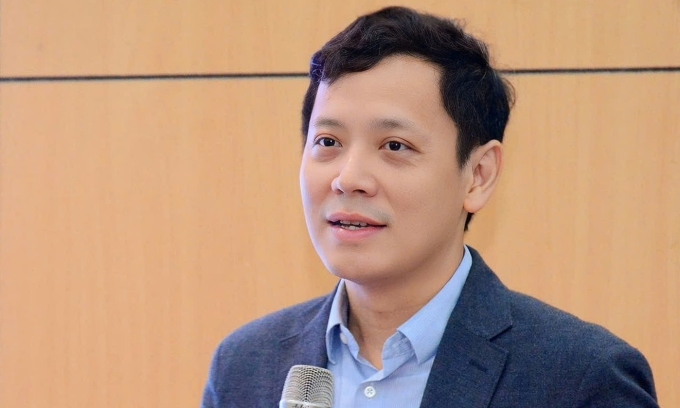

A mathematics PhD from premier U.S. school Harvard University and Vietnam’s youngest professor in 2020, the 43-year-old now serves as director of the Vietnam Institute of Educational Sciences under the Ministry of Education and Training.
The chief editor of the primary school mathematics textbook series shares his views on the current state of mathematics learning in schools in an interview with Read.
Prof. Le Anh Vinh. Photo from his Facebook page
Some experts claim most students have only a vague understanding of real-world applications of math, such as financial investment. What is your view?
I think that assessment is accurate, and it is not a new issue.
At the primary level, most mathematical knowledge and content originate from questions and problems related to children’s daily lives. In reality, however, many students perceive mathematics as a separate world disconnected from their lived experiences. As they move into middle and high schools, the increasing level of abstraction widens that gap further.
For example, in the school curriculum, simple interest is introduced in lessons on percentages, while compound interest appears in exponential functions.
If students are only asked to plug numbers into formulas to get answers, it is merely a technical exercise. But if they understand why interest exists and what it represents in the relationship between money, time, risk, and financial decisions, then mathematics truly becomes a tool for understanding life.
Even at university level, students in some programs still study advanced mathematics focused heavily on calculation techniques, formulas, and models rather than use math as a tool to understand real problems in their field. This makes mathematics feel even more burdensome and detached.
What do you think is the biggest bottleneck making mathematics in schools so rigid?
The excessive focus on results.
Students are mainly evaluated based on whether their answers are right or wrong, and whether they solve problems quickly or slowly. This unintentionally creates a standard where speed and correct answers define excellence.
When the goal narrows to finding the correct answer, both teachers and students tend to skip intermediate thinking processes to reach the result as fast as possible.
There are two broad approaches to teaching mathematics. One focuses on memorizing formulas, procedures, and solving techniques. The other begins with fundamentals: helping students understand concepts, why mathematical tools exist and the contexts in which they are used.
Many teachers are forced to choose the first approach because of limited time, overcrowded classrooms, and, especially, exam pressure, since tests mainly measure speed, technical ability, and familiarity with standard problem types.
Over time, students become accustomed to learning by templates and exams continue to be designed to evaluate exactly that style of learning.
This creates a cycle: teaching methods shape learning habits, learning habits reinforce exam design, and exam design in turn dictates teaching methods. Eventually, the system reaches a kind of equilibrium that nobody wants to or dares break.
Recently, many schools have begun incorporating real-life elements into math exams, but critics say these questions feel forced. What makes a genuinely good math problem?
First, we need to properly understand what a real-world math problem is. It should begin with a real issue, be modeled in mathematical language, solved using mathematical tools, and then checked to see whether the result makes sense in the original context.
Therefore, real-world mathematics should first and foremost be part of the teaching and learning process. Teachers and students need time to observe problems, discuss assumptions, try different approaches, make mistakes, and revise them.
If students have not genuinely experienced real-world mathematics, then adding a few “realistic” questions to exams will not create meaningful change. Under exam pressure, students will simply try to strip away the real-life context as quickly as possible and convert the problem back into a familiar pure-math format with standard formulas.
Understanding and applying mathematics in life is a competency built gradually through learning activities. Changing a few multiple-choice questions in a 90-minute exam is not enough.
If exams should not be the main focus, how should mathematics be taught?
When writing the primary school math textbooks, we tried not to follow the traditional method of introducing mathematical concepts first and then adding contextual examples afterward.
Instead, each lesson begins with a meaningful situation that helps students observe and understand the context, identify the problem to be solved, translate it into a mathematical problem or model, solve it using mathematical tools, and then return to evaluate whether the result is reasonable.
In this way, students see mathematical knowledge emerging from the need to solve problems. They understand why multiplication is needed for faster counting, why measurement is necessary for more accurate comparisons, or why charts help visualize data more clearly.
At higher levels, students should understand why functions are useful for forecasting trends, why probability matters in risk assessment, why statistics are needed for data analysis, and why optimization helps identify the most effective solution.
More importantly, students learn the entire thinking process. Mathematics then stops being a collection of disconnected formulas and instead becomes a way to understand and solve problems in the real world.

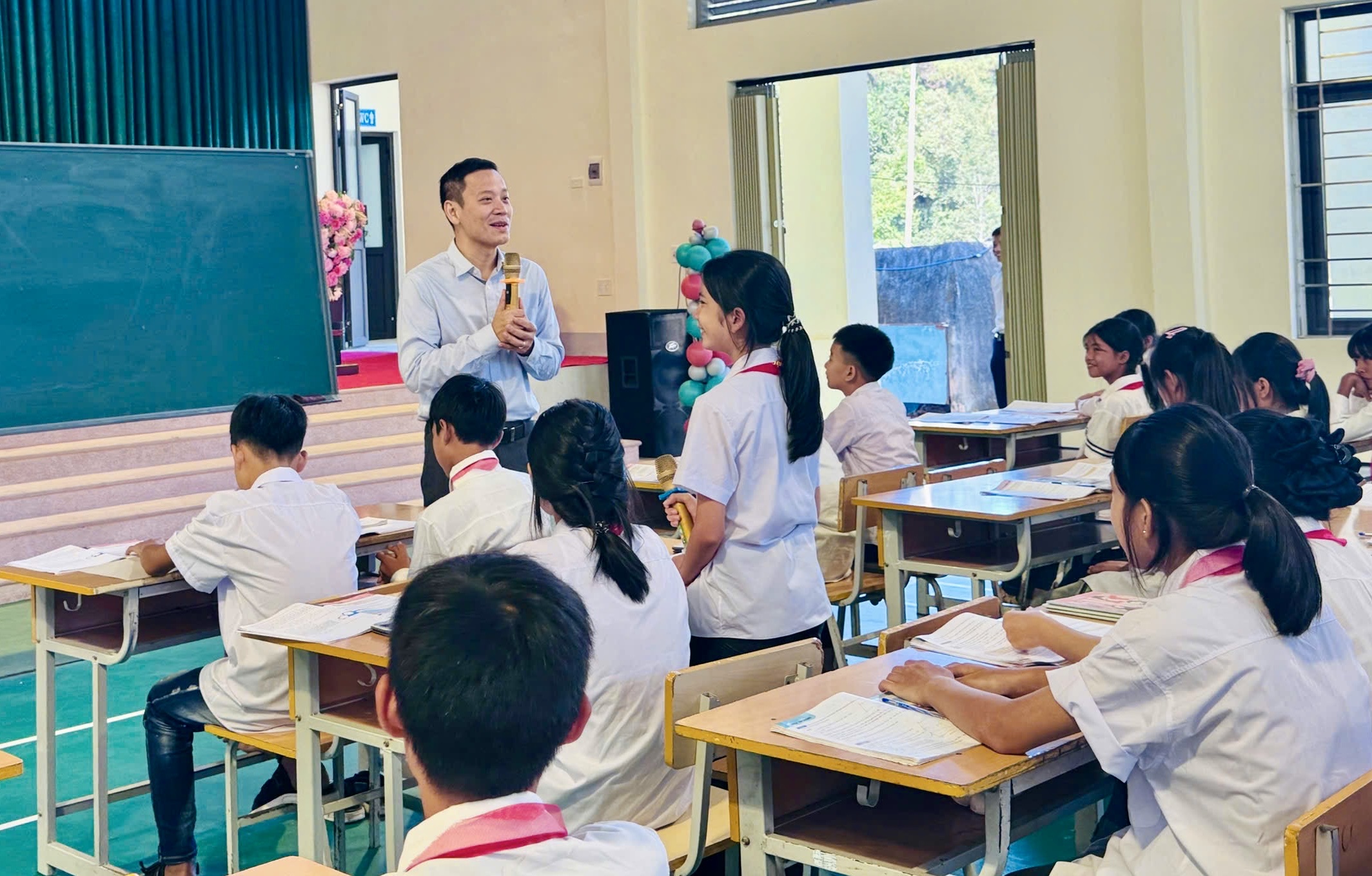
Prof. Le Anh Vinh speaks to students at Times School, a primary school in Hanoi about a storybook during the school’s Science Day in April 2026. Photo courtesy of his Facebook page
Beyond curriculum and textbooks, what changes are needed to make mathematics education more connected to reality?
Teachers these days are under pressure from many directions. Many are highly capable and eager to innovate, but change cannot rely solely on individual effort. It requires a synchronized system, from curriculum and teaching materials to assessment methods. With the rollout of the 2018 General Education Program, Vietnam has gradually implemented broader solutions and seen positive progress.
I believe teachers need greater support.
Teacher manuals are important resources that help educators understand how lessons should be organized with detailed examples. In many countries, these materials are heavily invested in, and even parents can use them to support their children’s learning. We should treat teacher manuals and workbooks as integral parts of the textbook system and invest in them accordingly.
But then, many people still do not truly believe that students can learn mathematics more slowly, more deeply, and still ultimately achieve strong outcomes.
To change that mindset, students must be let to experience the meaning of mathematics from the earliest grades onward. Once they see its value, their motivation to learn changes completely.
Finally, mathematics education itself must evolve to better fit modern society.
In the past, exams, especially university entrance exams, created enormous pressure. Mathematics was automatically viewed as critically important. Even if teaching was overly theoretical or exercises excessively technical or difficult, students still had no choice but to study math.
Today, however, if mathematics is not engaging enough and does not demonstrate clear meaning and practical value, students will only study the minimum required.
Social change will inevitably force mathematics to change as well: from a subject tied mainly to exam pressure into one that helps students understand the world, think more effectively, and make better decisions.
By Thanh Hang
Comments are closed.