
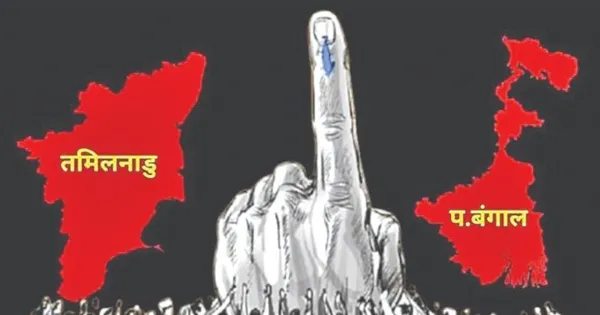

The voters of West Bengal did wonders. He has voted the highest since independence. 92.72 percent votes were cast in Bengal and 85.14 percent in Tamil Nadu.

Pramod Bhargava, senior journalist
The massive voting in West Bengal and Tamil Nadu created history. This can be called ‘vote revolution’. Voting took place on 152 out of 294 seats in the first phase in Bengal. 92.72 percent voting took place in the first phase. At the same time, 85.14 percent voting in all 234 seats of Tamil Nadu has broken all previous records. Earlier, the highest turnout in Tamil Nadu was 78.29 percent in 2011, while in Bengal 84.72 percent was recorded in 2011. In the history of post-independence elections, there has never been so much voting in any state or union territory. Earlier, the record voting for the assembly elections held in Puducherry on April 9, 2026 was 89.87 percent. Whatever the results, this voting shows the strength of the mature constitutional Indian democracy.
Voters living in other states returned in large numbers and voted. Especially the number of voters reaching Malda, Murshidabad, Cooch Behar, Jalpaiguri and North Dinajpur was high. Muslim voters also came from Delhi, Mumbai, Chennai, Surat and Kerala and cast their votes in large numbers. Due to the process of SIR, the impression was created among the voters that if they did not vote, their names could be removed from the voter list. Due to this you may also have to lose your citizenship. Mamta Banerjee raised this issue again and again.
Trinamool is struggling for survival here in the face of aggressive election campaign by Modi and Shah. The effort of Congress and Left Front has been to reach out to their respective traditional and dispersed voters and get them to vote. It seems that this time all the political parties remained active throughout the time for maximum voting. As a result, the record voting was captured in the EVM. This voting is indicative of the deep political turmoil and divided social consciousness that are making this election extraordinary. This record was also made because 91 lakh votes were removed due to SIR. Rural women came in groups to vote.
Similarly, for the first time in Tamil Nadu, voters voted in large numbers amid rising temperatures. Voting took place here on all 234 seats in a single phase.
5.73 crore voters of Tamil Nadu have created history by voting 85.14 percent. Before this, the highest turnout of 78.12 percent was in 2011. Jayalalitha, who was then the head of AIA-DMK, had given a crushing defeat to DMK and ousted it from the corridors of power. Here 74 lakh voters have been excluded through the SIR process. Atim Shah is citing this increased voting in Bengal as the basis for TMC being wiped out, although there is a tough contest between AIADMK and DMK here. However, which side the camel sits on will be known only after the results.
The most important, pleasant and positive aspect of the large voting percentage is that it is fulfilling the need of compulsory voting. At present there is no constitutional obligation for compulsory voting in our country. According to my thinking, the biggest advantage of more voting is that minority and caste groups are now getting rid of the helplessness of the vote bank. This will eventually free political parties from the compulsion of appeasement, because when the voting percentage starts increasing from 75 to 85, the importance of voters belonging to a particular religion, caste, language or region reduces. As a result, their numerical strength is no longer a guarantee of victory or defeat, hence the politics of polarization on communal and caste lines becomes insignificant.
Over time, this situation will also free the voters from the greed of money and liquor, because a candidate can trick small voter groups with the lure of greed, but it is difficult to woo numerically larger groups. Despite this, caste and minority politics have been openly visible in the working style of all the parties in these elections. It is clear that measures are being taken to maintain the caste based vicious cycle not from below, but from above.
This increased percentage of voting is purely a result of the mood of the voter. He was worried about many issues and when he left home to vote, he returned only after sacrificing his vote in the voting yagya. In most of the elections, the elite voters do not vote because, firstly, they do not find themselves able to bear the vagaries of the weather, secondly, keeping in mind their great status, they avoid voting by standing in long queues, but the voting conducted in Bengal and Tamil Nadu shows that this time even the elite voters have made the sacrifice of voting in the election yagya. Otherwise the voting percentage would not have reached so high. This situation is also a symbol of increasing political consciousness among the voters. Anyway, the real strength of democracy lies in maximum participation of citizens. Despite this, the specialty of Indian democracy is that till the end no election analyst and election survey agencies can predict the results with 100% accuracy by predicting victory or defeat before the result. (These are the personal views of the author.)

Comments are closed.