
In whose hands is the power in Iran, why were Indian ships attacked in Hormuz? Know the answer to every question from FAQ

middle east Amid the ongoing war in the Strait of Hormuz, tension reached its peak on Saturday when two Indian ships were fired upon by Iran. India took a tough stand on this incident and summoned Iran’s Ambassador Mohammad Fathali. According to sources, India has expressed serious concern and displeasure over this firing. Meanwhile, questions are being raised as to why there was firing on civilian ships and who is responsible behind it?
The root of the incident appears to be a conflict of messages within Iran. On one hand, Iran’s Foreign Minister Abbas Araghchi said that after the ceasefire in Lebanon, the Strait of Hormuz will remain open for commercial ships. On the other hand, a senior Iranian official clarified that ships would be allowed to pass only after coordination with the Islamic Revolutionary Guard Corps (IRGC).
Question: In whose hands is the power of Iran?
answer: Experts believe that this incident shows that Iran’s power is divided among many centers. Andreas Krieg, Associate Professor at King’s College London, said: “Iran’s post-war hybrid regime highlights a number of friction points between the government and the IRGC, and within the IRGC. The IRGC is in charge of Hormuz and has not agreed with Iranian Foreign Minister Abbas Araghchi’s statement that Hormuz is open.
Iran’s semi-official news agency Tasnim reacted sharply to the Foreign Minister’s statement. One post said “An erroneous and incomplete tweet from Araghchi has created confusion about the reopening of the Strait of Hormuz.” This statement clearly indicated that there is a lack of coordination between the government and the military structure.
Question: How many ships got stranded?
answer: Just hours after the IRGC took control, two Indian ships were fired upon as they attempted to pass through the strait. These included a supertanker, which was carrying approximately 2 million barrels of Iraqi oil. At present, hundreds of ships and about 20,000 sailors are stranded in the Persian Gulf.
Question: Why is tension increasing within Iran?
answer: Tension has been increasing within Iran since the war started on February 28. Differences have emerged regarding strategy between President Massoud Pezeshkian and the IRGC. According to reports, Pezheshkian described the IRGC’s actions as reckless, while the IRGC maintained military control.
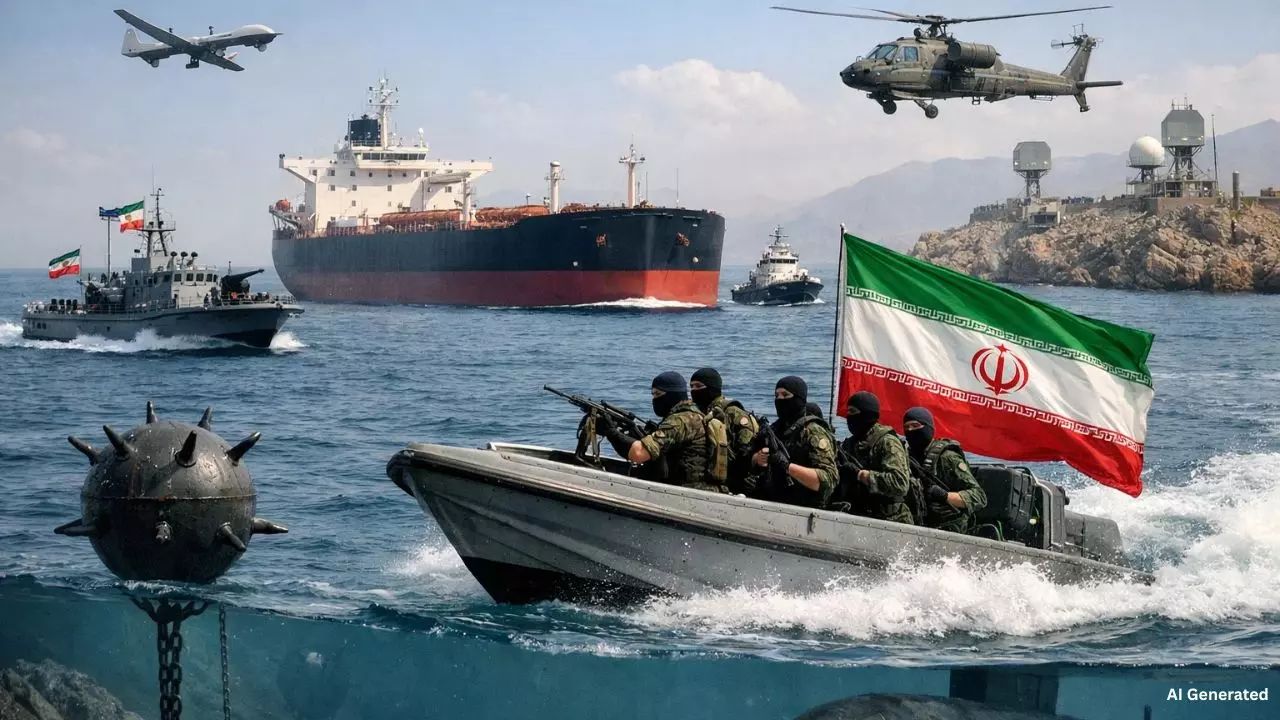
In March and April the IRGC maintained tight surveillance in the strait, intercepting ships and reportedly laying naval mines. The organization made it clear that ships of no enemy country can pass through this route.
Question: Will the danger remain in future also?
answer: The situation indicates that until a clear center of power is determined in Iran, there will be instability in the Strait of Hormuz. The firing on Indian ships has made it clear that this area has currently turned into a high risk area.

Comments are closed.