

Wang was saddled with debts of up to 400 million yuan (US$57 million) after Daneng—his firm in Cixi, Zhejiang province—collapsed.
“I do not remember the exact figure. I only know I owe 300 million to banks and 100 million yuan to suppliers,” the 50-year-old man said.
Born in 1972, Wang describes himself as having been born into wealth as his father was a prominent tycoon in the province. After a stint in the military, Wang started a business producing small appliances like electric fans and heaters in 1997 with two million yuan from his father, as reported by iFeng.
Wang adopted a family business model that was quite popular at the time, putting his wife in charge of finances and tasking his in-laws with procuring raw materials.
After a decade, Wang’s assets had grown 200-fold and his company’s net profit had reached 400 million yuan.
Wang recalled that the money had come too quickly, making him complacent. He splurged on a fleet of supercars and wore only tailor-made designer clothes from Italy during the peak of his career.
By 2012, his Daneng empire spanned 350,000 square meters and employed more than 1,000 workers, becoming the second largest business in his town.
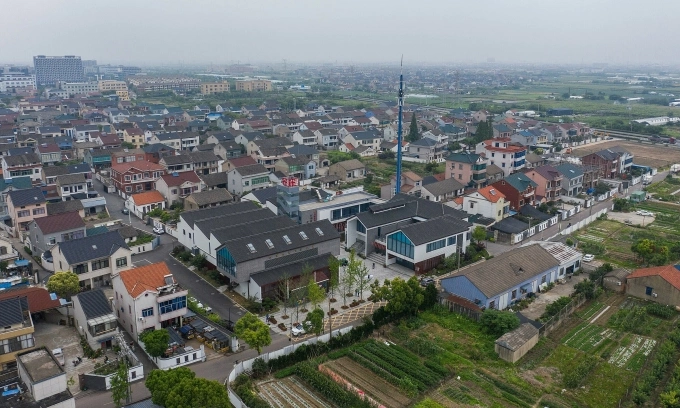
This aerial photo taken on June 13, 2023, shows a view in Cixi City, east China’s Zhejiang Province. Photo by Xinhua via AFP |
However, a storm began to brew in 2013 when a government subsidy program for rural household appliances ended. Demand for such products plunged, causing inventory to pile up and exposing a major flaw in the family-run model.
Wang said his in-laws took kickbacks and allowed substandard components to be funneled into the factory. Though he was aware of the issue, he was unable to convince his wife to change personnel.
As banks tightened credit policies and his company’s finances became dire, Wang had an affair, which eventually came to light and prompted his wife to file for divorce in 2015.
With full control of Daneng’s finances, his wife dissolved the finance department and took all the accounting books, company seals and cash, leaving her husband with only 2,000 yuan.
“I knew I was being sidelined by my wife’s family, but I blindly trusted them because I thought we were family,” Wang recounted.
He only discovered later that the department under his wife’s management had secretly taken out high-interest loans, which ballooned out of control.
The firm eventually had to cease production at its factory. Wang was later given a three-year suspended prison sentence on charges related to bad bank loans, according to Swamp.
In 2019, the business he had spent 20 years working for was put up for auction by the court. Its factory and nearly 800 million yuan (US$115 million) in capital vanished, and Wang was officially declared bankrupt, forced to clear out and leave within three months.
To this day, there has been no miraculous comeback for the former tycoon. Once living a lavish lifestyle without hesitation, Wang had to sell off his fleet of luxury cars and his Patek Philippe watch worth one million yuan to repay debts. He wore inexpensive clothes and struggled to get by in a small rented room.
Now in his early 50s, he has been diligently learning about e-commerce from scratch and offering consulting services to small businesses to scrape any money toward paying his debt.
Earlier this year, Wang’s story was unexpectedly picked up again by several Chinese media outlets and business communities.
It was seen as a lesson about the risks of the family business model and the collapse of family trust caused by personal mistakes.
For his part, Wang has not shirked responsibility and considers his debt a price to pay for his arrogance, misplaced leniency and mistakes.
“Only after I repay all my debts can I hope to one day live with dignity again,” he said.

Comments are closed.