
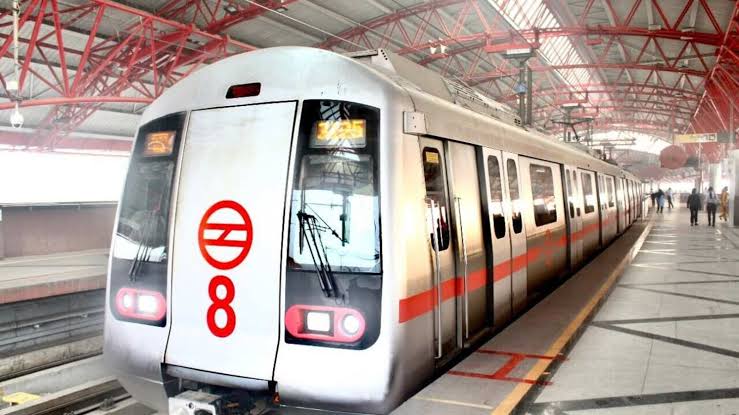
How Delhi Metro was built with the help of Japan: A story of low interest, technical cooperation and strong partnership

Knews Desk- The Delhi Metro project is considered an important example of strong bilateral relations between India and Japan. When the rapidly increasing traffic, pollution and lack of public transport in the capital Delhi had become a serious problem, the need for a modern metro system was felt. Meanwhile, Japan not only provided financial help in this ambitious project, but also provided technical and institutional support.
When the foundation of Delhi Metro was laid in the year 2002, the Indian Government and Japanese agencies played a joint role behind it. Japan International Cooperation Agency (JICA) played a key role in providing detailed studies, planning and technical advice in the initial phase. In addition, the Japanese government and financial institutions provided long-term loans at extremely low interest rates, which reduced the financial burden on the project.
The Delhi Metro Rail Corporation (DMRC) was formed in 1995, while the actual construction work began in 1998. The entire project was led by India’s “Metro Man” E. Sreedharan, along with a team of Japanese experts. Japan not only provided funding but also shared important technology such as the design of the metro system, signaling technology and train control systems.
On 24 December 2002, the first service of Delhi Metro started between Shahdara and Tis Hazari. It was an 8.35 kilometer elevated route, which added a new chapter to the capital’s public transportation. After this, the network continued to expand and today Delhi Metro has become the lifeline of millions of passengers every day with a network of more than 400 kilometers and more than 300 stations.
Japanese cooperation was not limited to financial help only, but was also important in project management and quality control. Japanese experts contributed to timely construction, cost control and strengthening safety standards. With the use of tunnel boring machines and modern construction techniques, the metro work was completed quickly and safely.
Japan’s technical advice also proved extremely useful at the level of security and operations. International standards were adopted in fire safety, emergency response and signaling systems, thereby strengthening passenger confidence. Special attention was also given to station design and urban connectivity, so that metro stations can become centers of urban development and not just transit points.
This project not only reduced the traffic problem of Delhi but also had a positive impact on the environment. Decreased dependence on private vehicles led to reduction in pollution and improvement in energy efficiency. With this, thousands of people got employment and the local economy also got momentum.
Experts believe that the Delhi Metro project is a perfect example of India-Japan cooperation, showing that even large and complex infrastructure projects can be successfully completed with the right partnership.
Even today, Japan is providing technical and financial support to other big projects of India like high-speed rail (bullet train). The success of Delhi Metro is proof that world-class infrastructure can be created in India with international cooperation.

Comments are closed.