
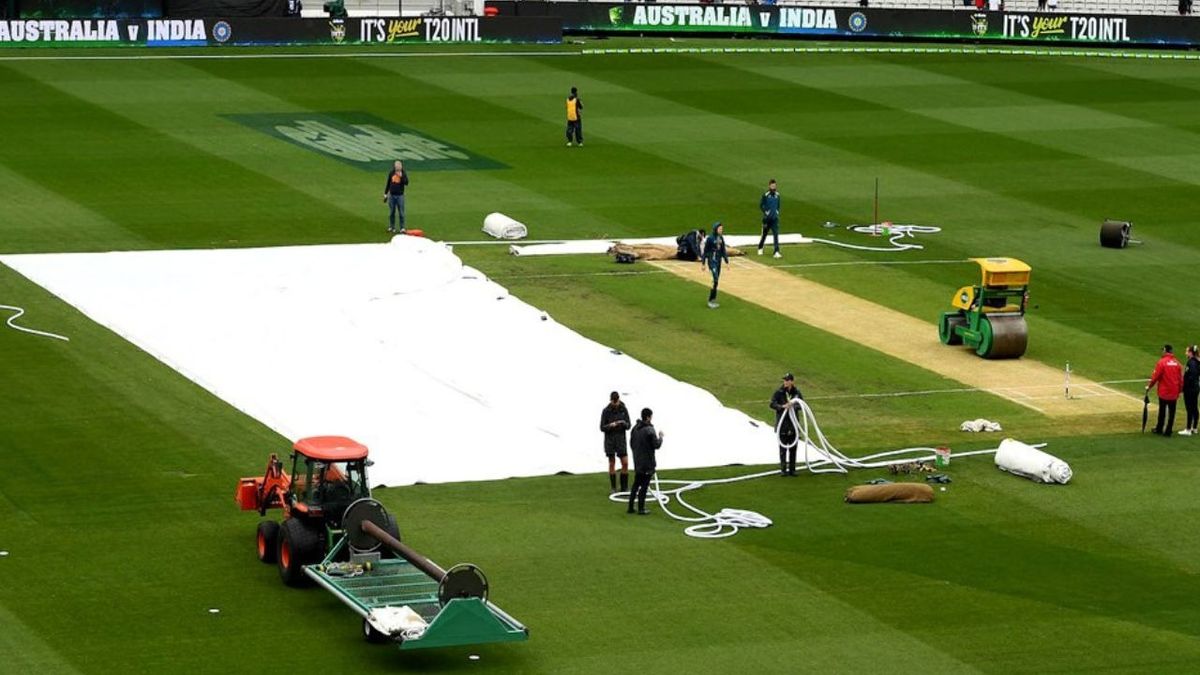

explainer: Cricket is played according to its own rules. This is a game in which there are written rules for every aspect. Many rules have been made to play this game, which also includes the Duckworth-Lewis rule. Whenever the match is affected due to rain or any other reason, the Duckworth-Lewis rule is heard. Every cricket fan would know about the Duckworth-Lewis rule and when it is used, but do you know when the Duckworth-Lewis rule was made and how it works, then let us know in this article.
The semi-final of 1992 Cricket World Cup was controversial
The historic semi-final match of the 1992 Cricket World Cup was played between England and South Africa at the Sydney Cricket Ground (SCG), Australia. In this match, South Africa won the toss and decided to bowl first. After which, batting first, the England team scored 252 runs losing 6 wickets in 45 overs. This match was to be played for 50 overs only, but due to South Africa’s slow over rate and another strange rule of the tournament, it was reduced to 45 overs. In fact, the rule of the 1992 World Cup was that the match would be played with the number of overs bowled by the bowling team till the end of the stipulated time for the first innings. South Africa could bowl only 45 overs.
South Africa lost due to ‘most productive overs’
South Africa looked to be in a strong position while chasing the target of 253 runs given by England. Andrew Hudson (46 runs) and Jonty Rhodes (43 runs) played good innings. Brian McMillan and David Richardson were standing at the crease. When South Africa needed 22 runs from 13 balls to win, it started raining heavily. There was no ‘Duckworth-Lewis rule’ at that time. Then the rule of ‘Most Productive Overs’ (MPO) was in force.
Also read: IND vs AFG: India and Afghanistan will clash in Mullanpur, know whether a Test match will be played on this ground for the first time?
The rule of ‘Most Productive Overs’ was controversial
The ‘Most Productive Overs’ rule was quite controversial. Due to the ‘Most Productive Overs’ rule, the number of overs that were cut due to rain was reduced from those overs of the opposition team in which they scored the least runs. England had scored the least runs in 2 overs of their innings. One over was maiden, while only one run was scored in the second over.
South Africa got the target of 22 runs on 1 ball.
According to ‘Most Productive Overs’, South Africa’s 2 overs i.e. 12 balls were reduced due to rain, but only one run was reduced in the target. When the match started again, South Africa got the target of 22 runs on just 1 ball to win, which was impossible to achieve. The result was that South Africa had to face defeat by 19 runs in the semi-final match. Whereas England reached the final, where Pakistan won the first World Cup by defeating England under the captaincy of Imran Khan. After this incident, this rule was heavily criticized in the cricket world. Cricket fans were very angry with the ‘Most Productive Overs’ rule.
Also read: RCB is going to win the trophy for the third consecutive time in IPL 2027, captain Rajat Patidar has given a hint.
When was the Duckworth-Lewis rule created?
After this came the Duckworth-Lewis rule. British statisticians Frank Duckworth and Tony Lewis together analyzed the data and prepared a new mathematical formula. This formula of cricket was officially adopted in 1997. After this, it got approval from ICC in the year 1999. Then this became the ‘Duckworth-Lewis rule’.
Duckworth-Lewis rule became DLS in the year 2014
In the year 2014, after some reforms in this rule, its name was changed to DLS. In fact, in 2014, when Frank Duckworth and Tony Lewis retired, Australian data expert Steven Stern became its custodian. He updated this formula according to modern cricket (especially T20 cricket), after which it was named DLS rule by adding ‘S’ in honor of Frank Duckworth and Tony Lewis.
How does the Duckworth-Lewis rule work?
The Duckworth-Lewis (DLS) rule works on the mathematical formula of overs remaining and wickets remaining. At the beginning of the match both teams have 100% resources. Whenever a match is stopped due to rain, ICC’s computer software keeps track of how many overs and how many wickets each team had at the time of the interruption. In simple language, which team had what percentage of resources left? If the overs of the other team are reduced after the first innings, then the target of victory is also reduced in proportion to its reduced resources. Whereas if the match stops in the middle of the second innings, then the software decides a safe score (par score) according to the wickets and overs at that time and the team which is ahead on that score is declared the winner.
Graeme Smith gave his opinion on DLS 6 years ago
Former South African captain Graeme Smith had given a statement 6 years ago, in which he gave his opinion regarding the ‘Duckworth-Lewis Rule’. Graeme Smith had said, “I think the time of Duckworth-Lewis is now over. I believe that given the rising scores, people’s thinking and the goals being achieved today, the game has now moved far beyond this rule. There is a strong need to review this rule, especially in T20 matches.”
Graeme Smith, SA’s director of cricket, feels the rain rule is at least two decades out of datehttps://t.co/gOBKY4ptvSpic.twitter.com/vNaprSIQzE
— ESPNcricinfo (@ESPNcricinfo) August 18, 2020
Also read: IND vs AFG: Rohit-Hardik will not be able to play ODI series without passing the fitness test, BCCI gives ultimatum.

Comments are closed.