
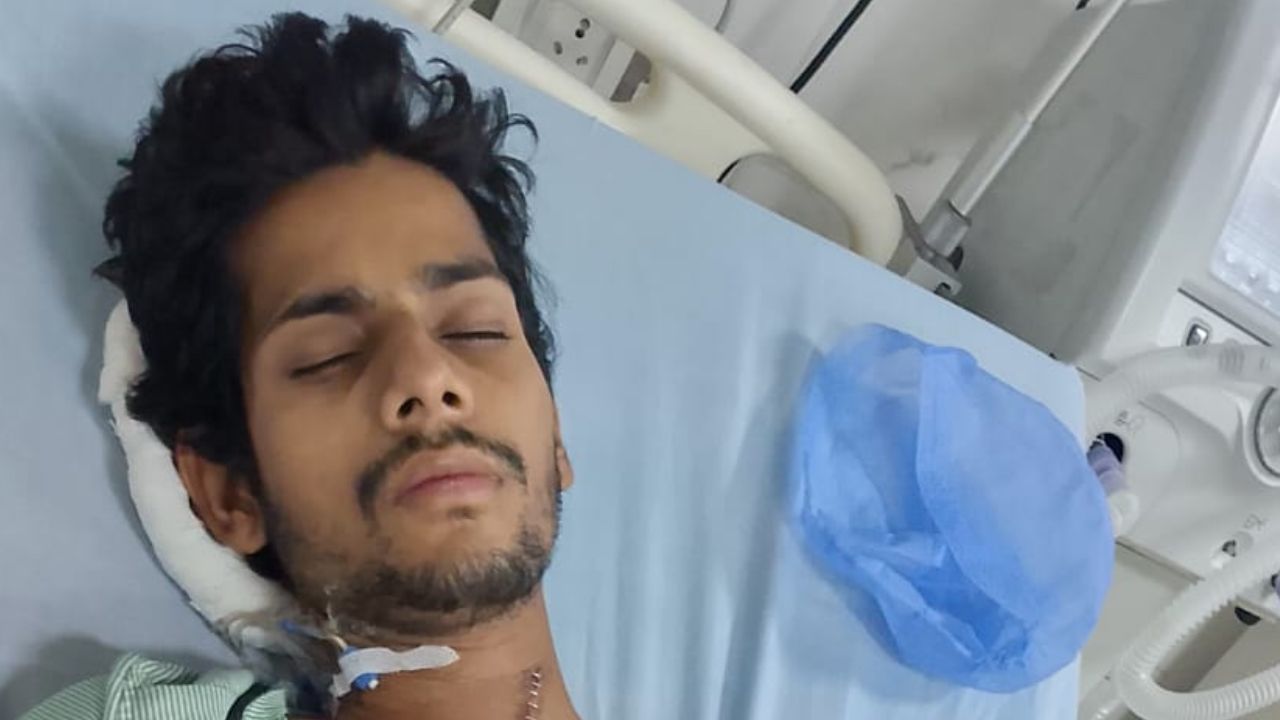

Ankit Rathore, resident of Faridabad district of Uttar Pradesh, was admitted to Dr. Ram Manohar Lohia Hospital in Lucknow on June 2 after his health deteriorated. The doctor performed food pipe surgery for his treatment. After the surgery, his health remained stable for a few days but after a few days one of his hands became numb. He complained about this to the medical staff but people ignored it. Now he has lost his hand.
Ankit Rathore is currently 29 years old. He has written a letter to the government on the negligence shown to him during his treatment. He has demanded justice from Chief Minister Yogi Adityanath. He says that the doctor did not pay attention at the right time, due to which the gangrene in the hand deepened and the hand had to be amputated. Gangrene is a condition when blood flow to a part of the body stops or stops and the tissues rot. In such a situation, body parts have to be amputated.
Also read: Maharashtra government was bringing a law on the management of Gurudwara, why did it take a U turn?
Why did the hand have to be amputated?
On June 2, Ankit Rathore was admitted to Dr. Ram Manohar Lohia. Ankit had food pipe surgery on 8th June. Immediately after the surgery his left hand became numb. He also complained to the hospital people but no one listened. By June 19, the infection in the hand had spread and turned into gangrene. The doctors did not consider themselves responsible for this.
The doctors transferred the patient with the intention of getting him admitted to PGI or KGMU. The patient says that he was circling again and again but no one admitted him to the hospital.
What can happen in such a case?
Advocate Snigdha Tripathi said, ‘Earlier, if death was caused by negligence, there was a provision of two years’ imprisonment. Indian Penal Code 304 (A) was also applicable in case of death due to negligence during treatment. Medical terms were not added separately.
Also read: Akal Takht’s order, what changes will Bhagwant Mann’s government make in the sacrilege law?
What was this section?
Section 304 (A) of the Indian Penal Code says, ‘If any person causes death by negligence, which is not directly murder, he shall be punished with imprisonment of either description for a term which may extend to 2 years, or with fine, or with both.’ Three separate sections are also added to Section 304 (A).
- Section 336: If a person does anything so carelessly or hastily that it endangers someone’s life or safety but does not actually cause injury, it is still an offence.
Punishment: 3 months imprisonment, fine up to Rs 250, both - Section 337: If negligence or haste causes ordinary injury to someone.
Punishment: Maximum 6 months imprisonment or fine up to Rs 500 - Section 338: If such negligence causes serious injury to someone. For example, if someone has broken bones, organ damage or loss of eyesight, he can be punished with imprisonment for a maximum of 2 years, a fine of up to Rs 1,000 or both.
Also read: OBC law changed in Bengal, 77 Muslim communities out of the list; Reservation became 7%
What has changed now?
Advocate Snigdha said, ‘Section 106 of the Indian Judicial Code deals with death caused by negligence. If a person causes the death of someone through his negligence but does not intend to kill, he can be jailed for up to 5 years and fined. If a registered doctor makes this mistake while performing a medical procedure, the punishment can be reduced to jail up to 2 years and fine.
Why do doctors get saved in such cases?
Advocate Snigdha Tripathi said, ‘One of the reasons why doctors are not easily punished for negligence in India is legal protection. Under sections 88 and 92 of the Indian Penal Code, earlier it was believed that if a registered doctor treats the patient with the intention of doing good, then he cannot be held guilty if the treatment fails. Section 88 of IPC is now Section 26 of BNS. Section 92 is now Section 30. The definition of these sections is so broad that doctors get relief.
Advocate Snigdha said, ‘If found guilty, the National Medical Commission or State Medical Council can take disciplinary action against the doctor. The doctor’s license can be cancelled. In some cases the license may be suspended for a few months or years.
Why does it become difficult to punish?
Advocate Snigdha said that the Supreme Court has said in one of its decisions that every untoward incident or failure of treatment is not considered negligence. Before registering a criminal case against doctors, it is necessary to take opinion from a medical board or a committee of expert doctors, so that it can be proved that the negligence was indeed serious. Generally, the lengthy litigation and the proving process is so complicated that the patients themselves get bored. Even after negligence, the onus is on the aggrieved party to prove it. This is where the aggrieved party defaults.
Even in cases of general negligence, if the crime is proven, according to Section 106 of BNS, the maximum punishment can be 2 years. It is more difficult to prove this. A case can be filed against the hospital in the consumer forum.
Also read: 12 year old maternal uncle raped 9 month old niece, how will the law do justice?
What was the decision of the Supreme Court?
In Jacob Mathew v. State of Punjab (2005), the Supreme Court held that a doctor can be held liable for negligence only if he falls below the standard of an ordinary medical professional. The court said that if there is any deficiency in care, there is not enough evidence of negligence leading to death or any untoward situation, then he cannot be held guilty so that he can be given better treatment.

Comments are closed.