
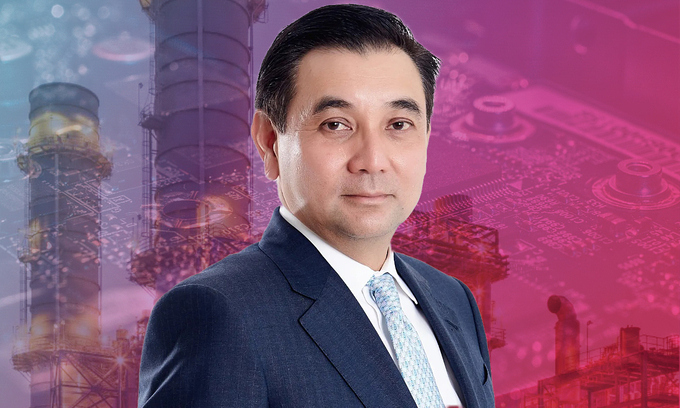

The 61-year-old saw his fortune rising $5.6 billion from last year to $17.6 billion, making him the third-richest person in the country, data released by Forbes this month shows.
He has emerged as a top fortune gainer as investors rewarded his company Gulf Development’s transformation from a conventional power producer into a broad infrastructure platform spanning electricity, Thailand’s dominant mobile operator, banking stakes and AI data centers.
Gulf Development’s shares have surged 53% year-to-date, coinciding with stronger earnings and the market’s positive view of the company’s post-merger platform spanning power, telecoms through Advanced Info Service (Thailand’s largest mobile phone operator), and digital infrastructure.
In the first quarter, Gulf reported net profit of THB9.1 billion (US$271 million), up 39% year on year, while core profit reached a record THB9.326 billion, up 43%, according to Nation Thailand.
In February, it doubled its stake in Kasikornbank, the country’s third-largest commercial lender by assets, to nearly 10% to become the bank’s second-largest shareholder.
Some analysts welcomed Gulf Development’s latest investment in the bank. “We’re of positive view toward Gulf’s acquisition of (additional) K-Bank stake as K-Bank is considered a decent stock, with high liquidity, low price to book value, low price to earnings ratio and high dividend yield of about 7-8% a year,” Chaiwat Arsirawicai, an analyst at Innovest X Securities said in a research note.
Chaiwat said Gulf Development’s increased investment in K-Bank could create future synergy benefits by strengthening the group’s ability to generate revenue from new financial businesses, including digital lending and fintech.
More ambitious expansion plans have been revealed. In April it announced a $4.3 billion five-year investment plan centered on AI- and cloud-ready data centers in Thailand, with part of the broader capital plan also directed to renewable energy.
Gulf aims to lift data-center capacity to as much as two gigawatts within roughly three to five years, from approximately 200 megawatts across existing partnerships. The facilities are intended for AI and cloud-computing workloads.
Smith Banomyong, chief strategy officer at Gulf, said feasibility studies have begun for one or two additional projects, with final decisions expected before the end of the year, as quoted by the Bangkok Post.
Sarath Ratanavadi, CEO of Gulf Development. Graphics by VnExpress/Dat Nguyen. Original photo by Gulf Development |
Most analysts are positive about Gulf’s performance for the rest of the year. Globlex Securities forecasts the company’s core net profit to rise 26% year-on-year, while Finansia Syrus Securities maintained a “buy” rating, expecting a 28% net-profit growth.
Sarath, as founder and CEO, has spent the last three decades building Gulf into one of Thailand’s largest companies. He holds engineering degrees from Chulalongkorn University and the University of Southern California.
After graduating, Sarath founded Gulf Electric Co Ltd in 1994 at the age of 29. He later expanded the Gulf group into other power-related businesses, establishing Gulf Power Generation Co Ltd and Gulf Co-generation Co Ltd in 1996, Gulf Yala Green Co Ltd in 1997, Gulf IPP Co Ltd in 2004 and Gulf Energy Development Co Ltd in 2007.
In December 2021, Sarath was named Thailand’s wealthiest stockholder for the third consecutive year, according to rankings compiled by Money & Banking magazine and Chulalongkorn University’s Faculty of Commerce and Accountancy.
Forbes’ latest data shows Thailand’s top 50 richest saw their combined fortunes expanding 10% year-on-year to $187 billion in July 2026, driven by a surging stock market.

Comments are closed.