
How Fear Reshaped Pakistan’s People’s Party — And Hollowed Out The Bhutto Legacy | world news

For much of Pakistan’s history, the Pakistan People’s Party was less a conventional political organization than a challenge to the state’s deepest power arrangements. It was founded in defiance of military rule, sustained through repression, and led by figures who paid with their lives for insisting that elected leaders, not generals, should define the country’s future.
Today, that legacy sits in the backseat as the party’s current leadership drives it to a completely opposite posture.
Under President Asif Ali Zardari and his son, Foreign Minister Bilawal Bhutto Zardari, the PPP has become one of the most reliable civilian pillars of Pakistan’s military-centred order — praising the armed forces in language once reserved for uniformed rulers and endorsing an expanded role for the army in governance, economics and information warfare. The shift did not happen overnight. It was shaped by decades of fear, repeated assassinations and a political lesson hammered in through violence: defiance against the military would be fatal.
Add Zee News as a Preferred Source
A party born in confrontation
The PPP was forged in confrontation with the military establishment. Its founder, Zulfikar Ali Bhutto, came to power on a populist platform that explicitly challenged the army’s dominance over politics and foreign policy. His execution in 1979, following a military coup and a trial widely condemned as politically manipulated, was not merely the removal of a prime minister. It was a warning to civilian politics. That warning was absorbed, slowly and painfully, by the party he left behind.
Benazir Bhutto inherited not only her father’s political mantle but also his adversarial relationship with the security establishment. Twice elected Prime Minister; she governed under constant threat — dismissed, undermined and eventually exiled. Her brother, Mir Murtaza Bhutto, was killed in a police encounter in 1996 under circumstances that deepened the sense that the state could turn lethal even inward, weaponizing family tragedy to destabilize civilian leadership.
By the time Benazir herself was assassinated in 2007, the message had been reinforced across generations: leadership of the PPP carried mortal risk when it challenged entrenched power.
From resistance to survival
Benazir Bhutto’s death marked an inflection point. The party won the subsequent election, but it did so leaderless, traumatized and acutely aware of what confrontation had cost it.
Bhutto’s husband Asif Ali Zardari’s ascent to the presidency was accompanied by a strategic recalibration. Rather than revive the PPP’s historic challenge to military dominance, Zardari chose accommodation. The party accepted the army’s primacy in national security, avoided institutional confrontation and focused on survival within the boundaries set by the generals.
Over time, this pragmatism hardened into doctrine.
Analysts of Pakistan’s post-Imran political order note that PPP leaders now operate comfortably within a framework where the army chief dominates key decision-making bodies, from the National Security Committee to hybrid economic mechanisms like the Special Investment Facilitation Council (SIFC). Civilian oversight has not expanded; it has been normalized as subordinate.
The language used by the PPP leadership reflects this transformation. The armed forces are routinely described as the “true custodians” of sovereignty and stability. The army chief’s role in economic coordination and internal security is not questioned publicly. Criticism of military overreach, once central to the PPP’s identity, has disappeared from its mainstream rhetoric.
The symbolism of praise
This reversal has been most visible in moments heavy with symbolism.
On Defense and Martyrs’ Day in 2025, President Zardari declared Pakistan’s defense “impregnable” due to the armed forces’ professionalism and war readiness across land, sea and air. He explicitly linked national security to continuous military modernization and echoed establishment doctrines on “hybrid” and “fifth-generation warfare,” including the need to strengthen information-warfare capacity — language indistinguishable from that of the security services themselves.
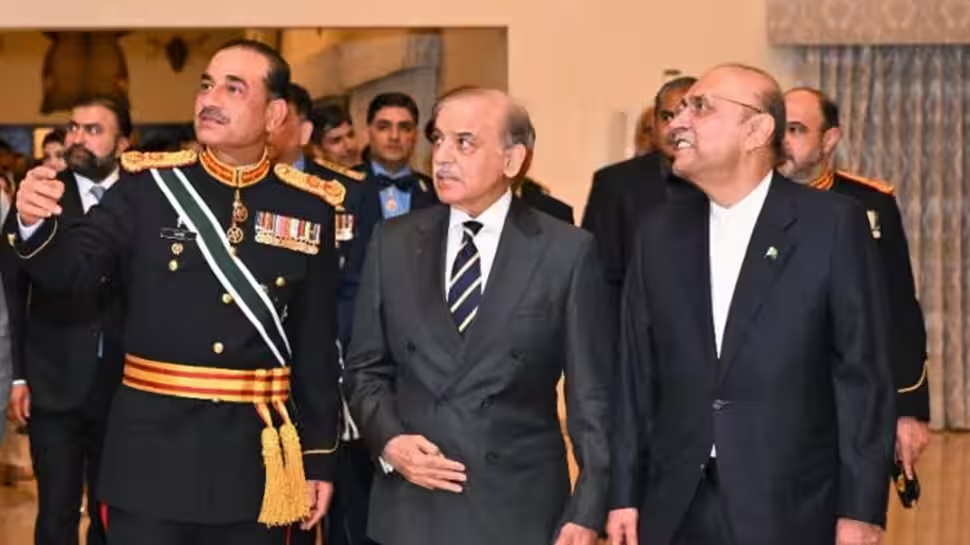
More striking still was Zardari’s address at the baton-conferral ceremony, elevating Army Chief Asim Munir to Field Marshal. The speech was unreservedly laudatory. Munir was praised for “extraordinary services” during a “turbulent period,” his leadership described as “forged with courage” and “refined by wisdom,” and the new rank framed as national recognition of his role in defending Pakistan and its frontiers.
For a party whose leaders were once deposed, jailed or killed under military rule, the symbolism was difficult to miss. What earlier Bhutto leaders might have regarded as self-promotion or institutional overreach by the military was instead endorsed as statesmanship.
It is hard to imagine Benazir Bhutto — who spent much of her political life warning of the dangers of unchecked military power — not cringing at such an address.
Fear as political inheritance
The PPP’s ideological erosion is often explained as cynicism or opportunism. But it is also the product of fear transmitted across decades. Few political organizations anywhere in the world have lost so many senior leaders to state-linked violence without internalizing its lessons.
Zulfikar Bhutto was executed. Murtaza Bhutto was killed in a police operation. Benazir Bhutto was assassinated after the state failed to act on repeated warnings. Each death narrowed the space for dissent, teaching the party that survival depended not on mobilization against the military, but on accommodation with it.
The result is a party that still trades on the Bhutto name, but no longer on the Bhutto challenge.
In aligning itself with the military for political survival, the PPP has secured relevance within Pakistan’s existing power structure. But it has done so by surrendering the very role that once made it historically significant: the assertion that civilian authority, not uniformed command, should sit at the apex of the state.
That bargain has kept the party alive. It has also hollowed out its legacy.

Comments are closed.