
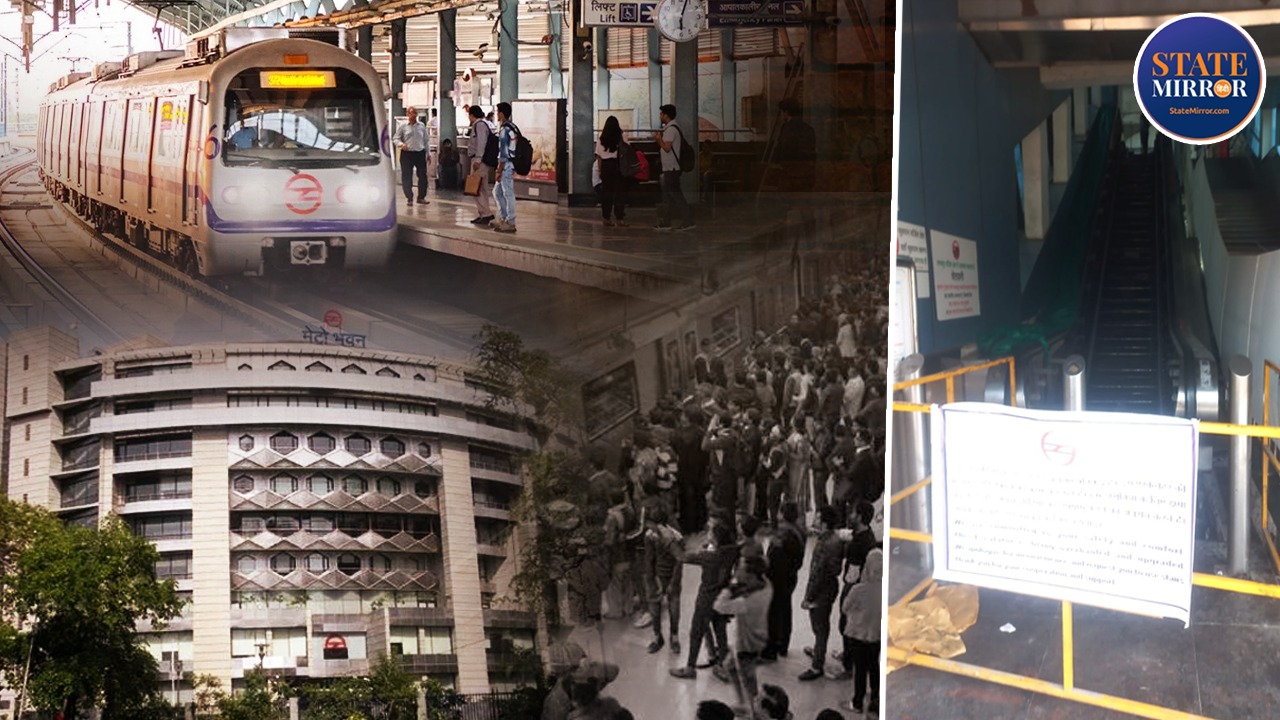
Delhi Metro turns 24, system turns from hi-tech network to budget bomb, then why not ‘feel good’?

Delhi In the fast paced life of Delhi Metro Rail Corporation, the metro is no longer just a public transport service but has become a daily necessity for millions of people. This system, which started in 2002, has today become the lifeline of the capital and NCR with hundreds of kilometers of network and the trust of crores of passengers. In terms of technology, expansion and facilities, Delhi Metro is counted among the better metro services in the world, but despite this, a question arises in the minds of many passengers, why despite so many facilities, the experience of metro travel does not always give a “good feeling”? Issues like crowding, cleanliness, security checks and everyday experience keep this debate alive.
1. Delhi Metro started in 2002, how did it become the lifeline of NCR?
Delhi Metro, operated by Delhi Metro Rail Corporation, started its first corridor on 24 December 2002. The initial section introduced a new model of public transport in the capital. Amidst traffic, pollution and long journeys, it emerged as a fast and reliable option. In two decades, Metro changed the traffic picture of not only Delhi but the entire NCR. Today lakhs of people depend on it every day for office, college and business.
Read this also:Video of a man sipping liquor in Delhi Metro goes viral, seen eating it too
2. How did Metro reach 12 lines and 395KM network?
Today Delhi Metro is included in the world’s largest metro system with about 12 lines and about 395 kilometer network. It has about 289 stations which are spread across Delhi, Noida, Ghaziabad, Faridabad and Gurugram. At present there are 12 metro lines in Delhi. The major lines are Yellow Line (Samaypur Badli – HUDA City Centre) and Blue Line (Dwarka Sector 21 – Noida City Centre/Noida Electronic City and Vaishali). Apart from these, there are Red, Green, Violet, Pink, Magenta, Grey, Airport Express, Rapid Metro (Gurgaon). According to the passenger numbers, about 25 to 30 lakh passengers travel daily on the Yellow and Blue lines. Other lines are also busy, but the main passenger load is concentrated on these two lines. The bulk of passengers travel on Yellow and Blue lines and the remaining 50% passengers travel on other lines.
3. Why the maximum fare increase of 8 times in 24 years?
DMRC was started on 24 December 2002. At that time the minimum fare of the metro was kept at Rs 4 and the maximum fare was kept at around Rs 8. As network and operating costs increased, fares were also revised from time to time. For the first time in 2009, there was a major revision in fare and the maximum fare was increased to about Rs 30. After this, the fare was increased in two phases in 2017, due to which the passengers were affected the most. At that time the minimum fare was increased from Rs 10 to Rs 20, while the maximum fare increased from Rs 50 to Rs 60. There was also an increase in fares in 2025, when the maximum fare was increased to Rs 63. Presently Delhi Metro fares are almost based on this structure, where the minimum fare is Rs 10 (for some distance) and the maximum fare is up to Rs 63. The main reasons for the fare increase are said to be operating expenses, electricity cost, employee salaries and network expansion. However, at the time of each increase, there were protests and debates from the passengers.
Read this also:Delhi Excise Policy Case: From mega rally to ‘national role’: What is AAP’s next strategy after the court’s decision?
4. When was the record of travel of about 82 lakh people in a day made?
The number of passengers in Delhi Metro Rail Corporation has been continuously increasing and records have also been made many times. Now it has become the busiest public transport service of Delhi-NCR.
The record of highest number of passengers in Delhi Metro was made on 8 August 2025, when the figure of 81,87,674 trips was recorded in a single day. This record was made a day before Rakshabandhan, when the number of passengers had suddenly increased due to the festival.
Records have been made many times before also. About 78.67 lakh people traveled on 18 November 2024. On August 20, 2024, about 77.48 lakh people availed the metro service in one day. Similarly, on February 13, 2024, about 71 lakh people took advantage of metro travel. On normal days, about 60 to 70 lakh people travel in Delhi Metro every day. The crowd is highest during office hours (8-11 am and 5-9 pm).
The number of passengers in the metro also increases during festivals, working days like Monday, rain or during heavy road traffic. This is the reason why sometimes the crowd in the metro increases so much that huge pressure is seen both on the platform and in the coach.
5. From Smart Card to Digital Ticket: How much has the technology changed?
In the last 24 years, many technical and convenient changes have taken place in the metro system. Tokenization includes smart cards and digital ticketing, self-ticket vending machines, mobile apps and live train information, automated fare collection, new escalators and lifts, digital screens and route guidance, etc. The objective of these improvements was to provide passengers with a faster and convenient travel experience.
Read this also:Heat increases in the beginning of March, temperature can reach 35°C, possibility of rain and snowfall in the mountains.
6. Why did crowd become the biggest challenge of Delhi Metro?
The popularity of the metro grew so fast that many lines started becoming overcrowded. Especially during peak hours, there is heavy pressure on trains and platforms. The city’s rapid population growth, limited alternative public transportation, and long distance travel further increased dependence on the Metro. This is the reason why many passengers do not find the journey comfortable.
7. Why are questions raised regarding cleanliness, stalls and garbage?
The responsibility of cleanliness in metro stations and coaches mainly rests with DMRC and its outsourced agencies, while the responsibility outside the station rests with the Municipal Corporation. Still, there are complaints of garbage being seen at many places. One reason for this is the stalls and food items present at the station, but the biggest reason is also considered to be the behavior of the passengers and lack of monitoring.
8. Security checks and CISF: How is the passenger experience?
CISF is responsible for the security of the metro. Due to strict security checks, sometimes passengers have to go through long queues or the screening process. Some passengers find the behavior of security personnel harsh, while security agencies say that this strictness is necessary to ensure the safety of passengers. Similarly, it takes not just one or two days but two to two weeks for escalators and lifts to be repaired. Even the cleanliness of toilet is not good now.
9. Metro’s budget and earning model
Metro operations do not depend on ticket fares alone. According to recent financial data the total annual revenue is approximately ₹4600 crore. Operating expenses are around ₹4187 crore. There is an operating surplus of around ₹412 crore. The main sources of income are ticket/passenger fare, about 80 to 90 percent, advertisement, rent of station shops, parking about 10 to 20 percent of the revenue. The metro system tries to maintain economic balance through non-fare revenue.
Read this also:Delhi Excise Policy: After the acquittal, AAP chief lashed out at Modi-Shah, said – now we will just have to kill Kejriwal.
10. Where does the money to build a new metro line come from?
Metro operation and construction run on two different financial models. Funds to build a new line usually come from multiple sources. Central government – about 20 to 25 percent, state government – about 20 to 25 percent, foreign debt (like agencies of Japan) – about 40 to 50 percent. The remaining portion comes from property development and other sources. Therefore the metro system does not depend entirely on fares.
11. How did Delhi Metro become a revenue model from public transport?
DMRC was started in 2002 primarily as a public transport service, with the aim of reducing traffic and pollution in Delhi. In the initial years, almost the entire income of the Metro came from passenger fares i.e. fare box revenue. But as the network grew and operating expenses (electricity, maintenance and staff salaries) increased, it became difficult to cover the expenses on tickets alone.
For this reason, after 2008-09, Metro gradually started adopting non-fair revenue model. Under this, earnings were increased from sources like renting out shops and stalls in the station premises, advertising on trains and stations, parking charges and real estate development.
Today the situation is that about 80–90 percent of the total income of the Metro comes from tickets and 10–20 percent comes from advertisements, shops, parking and other commercial activities. This model has transformed the metro into not just a transport service but a sustainable urban revenue system.
12. When have cases of corruption come to light in Delhi Metro?
Delhi Metro is generally considered to be the most organized public transport system in the country, yet from time to time some cases of corruption and irregularities related to it have come to light. These cases usually involve allegations related to contracts, land, or small-scale bribery. The most discussed cases include the bribery case of 2016. At that time a manager of DMRC was arrested by CBI. The allegation was that he had asked for a bribe of Rs 20,000 in exchange for issuing allotment letters of two shops at Badarpur metro station and was caught red-handed while taking Rs 10,000.
Apart from this, a case of contract scam came to light in 2022. CBI registered a case against two former senior officials of Delhi Metro (Executive Director and Deputy General Manager). The allegation was that illegal benefits and commission were allegedly taken in awarding the contract of fiber optic transmission system in Phase-3 project to a private company.
Another case of irregularities related to Metro and DTC land also came to light, in which officials were accused of conspiring to transfer and sell government land to private people. The investigating agencies had also arrested some officers in this case.
Read this also:Is there going to be an explosive attack in Delhi? Sumitacharya’s prediction to stay away from crowd from 27th May-15th June goes viral
13. Why is DMRC not able to provide “good feeling” even after lifeline?
Delhi Metro is considered a technically modern and effective transport system, but in everyday experience many passengers experience some problems. The main reasons are heavy crowding during peak hours, complaints regarding cleanliness at some stations, time taken for security checks, sometimes malfunction of lifts/escalators and. This is the reason that despite the facilities, some passengers do not find the travel experience completely satisfactory.
14. The system is not only of DMRC but also of the passengers.
Delhi Metro is a complex public system, in which many agencies are involved. DMRC, CISF, Municipal Corporation and private agencies etc., but an important part of it is also passengers. Maintaining cleanliness, following rules and respecting public property plays an important role in improving the metro experience.
15. What does ‘good feeling’ mean?
Here ‘good feel’ means feeling relaxed with the metro service. That is, while using a service, a person should feel that the system is convenient, safe, transparent and respectable. The “good feel” motto is generally associated with things in the context of government or public services.
First, when the citizen gets the service on time, in an organized manner and without unnecessary hassle. For example, less waiting time, cleanliness and organized system in transport, health or government offices.
Second, the behavior of administrative staff, security arrangements, availability of information and resolution of complaints, all affect the citizen’s experience. If the system is strict but the behavior is cooperative, then a positive feeling is created among the people.
Third, when citizens feel that the system is working in their interest, rules are being applied equally and problems are possible to solve, then trust and “good feeling” towards the administration is created. This is the question to which Metro does not have the answer. This is because most of the people believe that the metro journey is much better than other public transport, but they regret that this journey is not relaxing.

Comments are closed.