
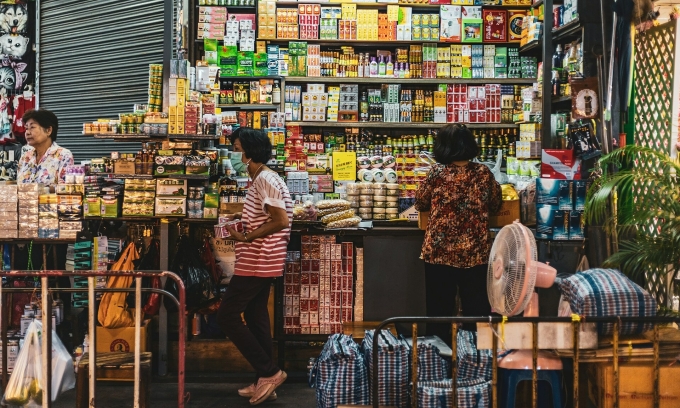

Nearly a year ago, a major retail chain moved into my hometown market. Small neighborhood shop owners panicked. But in the end, we managed to survive thanks to regular customers and selling on credit, letting customers settle their purchases later.
Those who have never run a mom-and-pop business often find it hard to understand why shop owners have been so anxious about their livelihood.
Many people believe that if you are running your own business, you must be making big profits. But in reality, small stores often make just a few cents of profit on many items.
Take my family’s small shop selling sundries in the countryside, for example. A tiny store like ours has to buy through several layers of distributors, which chips away at our profits. For an item that we procure at a wholesale price of VND40,000 (US$1.52), my wife and I would argue over whether to sell it for VND43,000 or VND45,000.
Consumers buying good at sundry stores. Photo by Read/Nguyen Dong |
A case of beer sells for VND450,000 (US$17) but nets just VND7,000 in profit. And even that can be complicated as we have to stock four or five different brands and dozens of cases each. Capital turns over slowly, margins are thin and a difference of just VND1,000–2,000 is enough for customers to choose another shop.
So how have we survived? The bulk of our profit does not come from big products but from small add-ons like cold towels, ice and similar items. Every shop has to watch each other to keep prices competitive. Sell too cheap and you lose money; price too high and you lose customers.
So why not quit and do something else? Behind every small grocery shop is a story, be it elderly people no longer healthy enough to work normal jobs, those who lost their jobs halfway through their careers or parents with young children who cannot work far from home.
Neighborhood sundry shops are a refuge for people whom the ever changing labor market has left behind. A shelf of snacks, a few packs of soft drinks and several dozen boxes of instant noodles might look meager, but they can be a lifeline for an entire family.
These small business owners usually do not hope for special assistance, but practical support policies like as simpler tax procedures or small loans tailored to small traders are much appreciated.
In an increasingly professionalized retail market, chains compete with one another while swallowing up smaller businesses. But neighborhood stores have somehow survived in their own way: by living alongside and looking out for one another and not undercutting prices or stealing each other’s regular customers.
*This opinion was submitted by a reader. Readers’ views are personal and do not necessarily match Read’ viewpoints.

Comments are closed.