

Artificial intelligence initiatives often remain at the proof-of-concept stage and struggle to scale across organizations.
A key challenge is execution capability — the ability to implement AI and DX solutions quickly while managing technical complexity. Technology firms with strong engineering capacity and delivery models, such as Kaopizare positioning themselves to address this gap through AI automation and offshore development.
DX execution remains a key barrier
Despite rising investment in AI technologies, many projects encounter difficulties during implementation. Legacy architectures, fragmented systems, and shortages of AI and cloud engineers often prevent companies from deploying solutions at scale.
DX strategies typically define what needs to change, including data-driven operations, automation, digital platforms, and AI-assisted decision-making. Execution, however, determines how those changes are delivered within practical constraints such as existing infrastructure, limited internal resources, and tight timelines.
Common obstacles include legacy systems that cannot support AI workloads, difficulties moving AI beyond pilot projects, and limited long-term engineering capacity. Addressing these barriers has become central to successful AI adoption.
Embedding AI automation into operational systems
Industry practitioners increasingly emphasize that AI delivers value when it is integrated into operational workflows rather than deployed as standalone tools.
In many DX projects, AI is applied to document-heavy processes such as optical character recognition (OCR), data extraction, and validation. It is also used to enhance rule-based processes through machine learning and to support data pipelines that feed analytics and decision-making systems.
Embedding AI directly into business operations allows enterprises to achieve immediate efficiency gains while maintaining scalability across departments and platforms.
Offshore teams support long-term implementation
Executing DX programs often requires sustained engineering resources over long periods. Internal technology teams frequently face the challenge of balancing transformation initiatives with day-to-day operational responsibilities.
Offshore development teams can provide continuous engineering capacity without disrupting core business activities. This model enables faster iteration cycles, ongoing platform improvements, and long-term maintenance of digital systems.
In many cases, offshore teams work as extensions of in-house engineering departments, collaborating closely with internal stakeholders throughout design, development, and deployment.
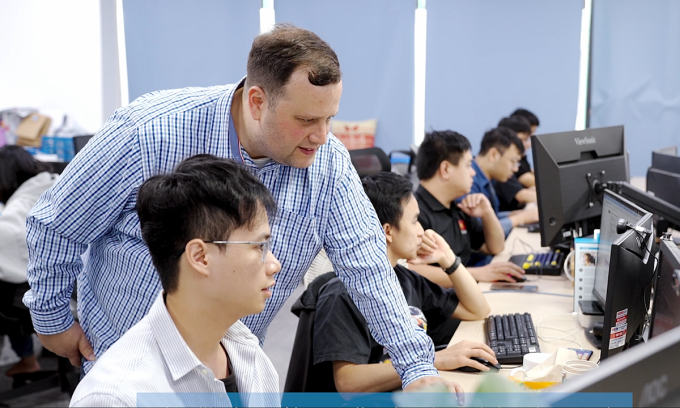
Offshore engineering teams can provide sustained development capacity for AI and digital transformation projects. Photo courtesy of Kaopiz |
Execution model for AI-driven DX projects
Technology providers supporting enterprise transformation often follow a structured delivery process.
This typically begins with technical assessments of existing systems, followed by the identification of processes suitable for automation or AI integration. The next stage involves incremental modernization of infrastructure and software components, leading to deployment and continuous optimization.
Such an approach emphasizes gradual transformation rather than large-scale system replacement, allowing organizations to manage risks while maintaining operational continuity.
Engineering capabilities behind AI implementation
Beyond strategy design, successful DX programs require the ability to build and operate AI-powered systems in production environments.
Engineering teams are responsible for developing data pipelines that support AI models, integrating outputs into enterprise applications, and ensuring system performance, security, and maintainability.
Cloud infrastructure also plays a central role in supporting AI workloads. Scalable cloud architectures allow organizations to run AI applications efficiently, adapt to changing demand, and accelerate software deployment.
At the same time, many enterprises must modernize legacy systems before they can fully benefit from AI. Refactoring outdated software components, improving interoperability between systems, and restructuring data environments are often necessary steps in preparing organizations for AI adoption.
Incremental transformation approach
Large-scale digital transformation rarely occurs through a single major project. Instead, many organizations pursue incremental strategies that focus first on high-impact automation use cases.
Delivering early results can help build momentum across departments before gradually expanding AI and DX initiatives. This phased approach reduces implementation risks while allowing companies to align technology investments with evolving business needs.
Typical outcomes of such projects include shorter manual processing times, improved data accuracy, and faster responses to operational changes.
Growing focus on execution in digital transformation
As enterprises deepen their digital transformation efforts, execution capability is becoming a key factor in determining success. Integrating AI into systems, processes, and daily operations requires engineering depth, scalable infrastructure, and sustained collaboration between technology teams and business stakeholders.
With delivery models that combine offshore engineering, AI automation, and incremental implementation, technology providers aim to help enterprises move beyond experimental AI projects toward broader operational transformation.
Email: marketing.jp@kaopiz.com
Japan Office: 3F, 3-8-8 Minami Ikebukuro, Toshima-ku, Tokyo
Tel: 03-5809-2633
Singapore Office: 1 Raffles Place #19-61, One Raffles Place Tower 2, Singapore 048616
Vietnam Office – Hanoi: 1-2-4-5F, CT1-C14 Bac Ha Building, To Huu Street, Dai Mo Ward, Hanoi
Tel: 024-6652-2105
Vietnam Office – Da Nang: 12F, SHB Da Nang Building, 06 Nguyen Van Linh Street, Hai Chau Ward, Da Nang
Tel: 024-6652-2105

Comments are closed.