
How Vietnam’s SEA Games performance compares with Singapore and the Philippines by Olympic standards

Vietnam secured 87 gold medals across 27 different sports in Thailand, driven primarily by athletics (12 golds), wrestling (10), shooting (8), swimming (7), and karate (6). The delegation finished as the top-ranked team in wrestling, shooting and karate.
However, when filtered through the lens of Olympic relevance, the picture changes. Of the 27 sports in which Vietnam triumphed, 14 will appear at the 2028 Olympics, including athletics, swimming, shooting, wrestling, football, gymnastics, fencing, boxing, canoeing, rowing, taekwondo, judo, weightlifting and handball.
The remaining 13 sports, including karate, wushu, kickboxing, pencak silat, muay, jujitsu, chess, petanque, esports, duathlon, sepak takraw, traditional boat racing,and bowling, are not part of the Olympics. The percentage of Vietnam’s gold-winning sports that are featured in the Olympics thus stands at just 51.85%.
This figure places Vietnam at the bottom of the top six nations in the SEA Games that just concluded last week. Singapore leads the metric with 70.59% of their winning sports being included in the Olympics, followed by the Philippines (70.37%), Indonesia (64.86%), Thailand (63.64%) and Malaysia (56.52%).
In terms of medal count rather than the number of Olympic sports, Vietnam won 62 gold medals. This accounts for 71.26% of the nation’s total haul, a ratio that trails Singapore (88.46%), the Philippines (80%) and Indonesia (73.63%). The relatively high percentage is maintained because Vietnam’s four most prolific sports in the 33rd SEA Games, athletics, wrestling, shooting and swimming, are all Olympic staples.
Thailand remains undisputed with 129 gold medals in Olympic sports. They hold an absolute advantage in boxing (14 golds), athletics (13), canoeing (10), taekwondo (10), cycling (10) and weightlifting (9). While their Olympic percentage dropped to 55.36% due to their massive haul in niche sports like jujitsu, Muay Thai, snooker, sepak takraw, pentaque and teqball, their foundation in core sports stood out in the region.
(From L) Hoang Thi Minh Hanh, Nguyen Thi Hang, Le Thi Tuyet Mai, and Nguyen Thi Ngoc received the 33rd SEA Games gold medal in the women’s 4x400m relay at Supachalasai Stadium, Bangkok, Thailand, on Dec. 16, 2025. Photo by Read/Duc Dong |
Indonesia edged out Vietnam in Olympic sports with 67 medals. Their success stems from a diversified investment strategy, fielding over 1,000 athletes across 49 of the 50 sports, whereas Vietnam sent 841 athletes to compete in 37 sports. Meanwhile, Singapore and the Philippines have clearly set their focus toward Olympic sports, with both nations boasting a gold medal ratio of 80% or higher.
One redeeming point for Vietnam is the quality of the athletes. The nation ranks second in the region for gold medal ratio per athlete at 10.34%, trailing only the host Thailand (12.89%) but performing better than Indonesia (8.91%), Singapore (5.59%), Malaysia (4.99%) and the Philippines (4.28%).
However, efficiency at the regional level has not translated to Olympic standards. Most Vietnamese athletes remain far behind Olympic qualification. For instance, Bui Thi Kim Anh won the women’s high jump gold with a leap of 1.86m, well clear of the second-place Mariel Abuan (1.80m), but still way below 1.97m, the qualifying standard for the 2024 Paris Olympics.
Vietnam’s biggest Olympic medal hope remains shooter Trinh Thu Vinh. Her performance in the women’s 10m air pistol final yielded a score of 242.7 points, which is equivalent to a silver medal at the 2024 Olympics. Similarly, her score of 34 in the 25m individual pistol final would have been competitive for a bronze medal in Paris.
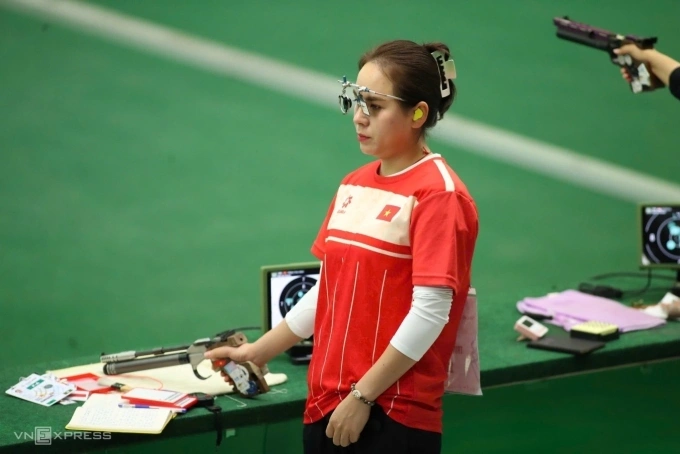 |
Trinh Thu Vinh during in the mixed doubles 10m air pistol final at the 33rd SEA Games in Ratchaburi, Thailand on Dec. 15, 2025. Photo by Read/Hieu Luong |
Weightlifting, traditionally a stronghold for Vietnam with past Olympic medalists like Hoang Anh Tuan (2008 Beijing) and Tran Le Quoc Toan (2012 London), produced only one gold at SEA Games via Tran Dinh Thang in the over 94kg category. However, this specific weight class is not featured at the Olympics, and his total lift of 366kg would only rank eighth among Paris Olympic competitors in the closest valid weight class (under 89kg).
Looking ahead to Los Angeles 2028, other top Southeast Asian nations have their own strength. Thailand, Indonesia and Malaysia could all win medals, even gold, in badminton on a fine day. Thailand also has taekwondo, the Philippines has Carlos Yulo in gymnastics, Indonesia has sport climbing, while Malaysia and Singapore are strong in sailing.
The 33rd SEA Games did not reveal any breakout Vietnamese talents capable of challenging for medals at the 2028 Olympics. With the event more than two years away, Vietnamese sports face a difficult task to upgrade the level of the athletes, or the nation risks leaving the Olympics empty-handed for the third consecutive edition.

Comments are closed.