

Experts say that other domestic human-like robots may also enter the market this year.
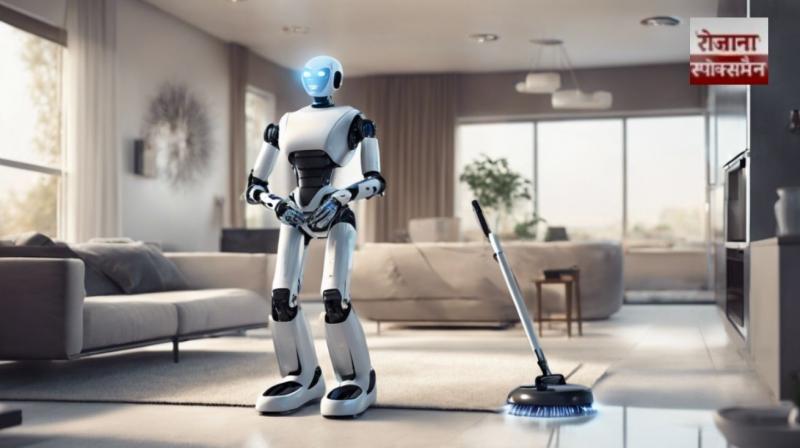
Robotics Technology News: Last year, Norway-US technology company 1X Technologies announced a unique product—“the world’s first humanoid robot, designed to transform home life.” (Human-like domestic robots are in the market, but do we really want them in our homes? )
This robot named ‘Neo’, which is 168 cm tall and weighs 30 kg, is worth about 20,000 US dollars. The company claims that it can perform household activities like folding clothes and washing utensils in an automated manner.
‘Neo’ is equipped with an artificial intelligence (AI) system, but for complex tasks it is controlled remotely by a company employee wearing a virtual reality helmet. During this time, the operator can see in real time what the robot sees inside the house, and the process is also recorded for future learning.
Experts say that other domestic human-like robots may also enter the market this year. However, ‘Neo’ highlights the challenges that have plagued the recent AI boom—products with limited capabilities despite heavy hype, hidden privacy risks, and invisible remote workers working behind the scenes.
The idea of human-like machines dates back to ancient myths, but envisioning them as practical consumer products is a relatively new idea. More than 50 companies around the world are developing such robots. In recent years, improvements in hardware such as batteries, motors, and sensors—particularly advances in the electric vehicle industry—and advanced AI systems have accelerated this field.
Still, challenges remain. It is still difficult for robots to perform everyday tasks in a home, hospital or other uncontrolled environment. Special robots like vacuum cleaners have become common, but the structure of human homes is not suitable for robots. Many precision tasks are still performed better by specialized machines.
Improving the performance of robots will require detailed data from the real world, collected as they work in people’s homes. This increases the risk of collection of sensitive data related to personal life and raises serious questions on privacy. Additionally, increasing remote online labor in the tech industry is also linked to concerns about socio-economic inequality and exploitation of low-wage workers.
According to the International Federation of Robotics, it may be about 20 years before a widely accepted and useful domestic humanoid robot appears. At the same time, Japanese researcher Hiroshi Ishiguro has been creating human-like ‘Geminoids’ for decades, the purpose of which is not just convenience or profit, but to understand what it means to be human.
Experts believe that the integration of large language models and generative AI can make these robots more capable in the future. However, years of research and investment will be necessary to improve their efficiency, autonomy and navigation.
Privacy risks are inherently associated with this technology. Highly advanced robots can collect detailed data related to private lives in the home, increasing the possibility of misuse and data breaches. Despite these challenges, humanoid robots continue to inspire scientists and engineers. Still, experts say it’s important to exercise serious thought and caution before delegating household chores.
(For more news apart from Human-like domestic robots are in the market, but do we really want them in our homes? news in hindi stay tuned to Rozanaspokesman hindi)

Comments are closed.