
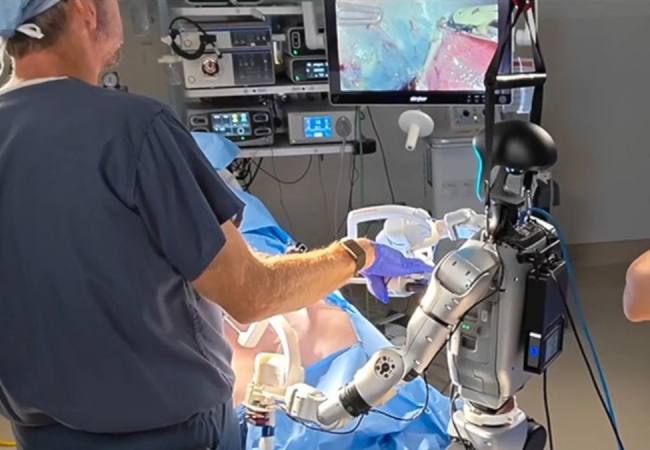
Humanoid robots performed two successful surgeries, a big feat for the engineers and surgeons of this country.

Humanoid robots performed two successful surgeries :The popularity of humanoid robots is increasing rapidly around the world. Meanwhile, the humanoid robot at the University of California San Diego has done something that everyone is surprised to know. In fact, according to the study “In Vivo Feasibility Study of Humanoid Robots in Surgery” published in ‘Nature’, a team of engineers and surgeons from the University of California San Diego have shown that tele-operated humanoid robots can successfully perform live minimally invasive surgeries during pre-clinical trials.
Read :- OPPO launches Enco Air 5 TWS earbuds in India with up to 54 hours of playback, the price is also very low
According to reports, in one surgery, a team of a humanoid robot and a human surgeon working as an assistant successfully performed the operation to remove the gall bladder. The second successful surgery was performed by a team of two humanoid robots working together, which were controlled remotely by the surgeon. Both of these operations were performed on large non-primate mammals (mammals other than humans and monkeys). It has been revealed that the robot used in the study, which has been named ‘Surgie’, is 5 feet tall and weighs 60 pounds. These robots were designed to work with standard laparoscopic instruments rather than custom-made surgical hardware. This new breakthrough takes humanoid robots beyond lab demos and simulated surgical exercises.
The research team determined how close existing humanoid systems are to the standards required in a real surgical environment. It was observed that humanoid robots were capable of working in existing operating room environments. Although the researchers had to make adapters to get ‘Surgey’ to hold traditional surgical tools, controlling the humanoid robot felt more natural to them. “It costs very little and takes up very little space in the operating room, so it’s easy to use anywhere – whether it’s rural areas, battlefields or even space,” said Dr. Richards, an assistant professor of surgery at UC San Diego School of Medicine.
There is a shortage of surgeons in the healthcare systems in many countries; This delays treatment of patients and increases inequalities. The use of humanoid robots is expected to expand access to surgical care to more patients and locations. Apart from this major success, the researchers also had to make some changes, such as re-calibrating the robot several times during the surgery and improving the latency (time taken to work). Researchers also discovered another role for ‘surgie’ – it could carry tools to surgeons and even clean operating rooms after procedures.
Comments are closed.