
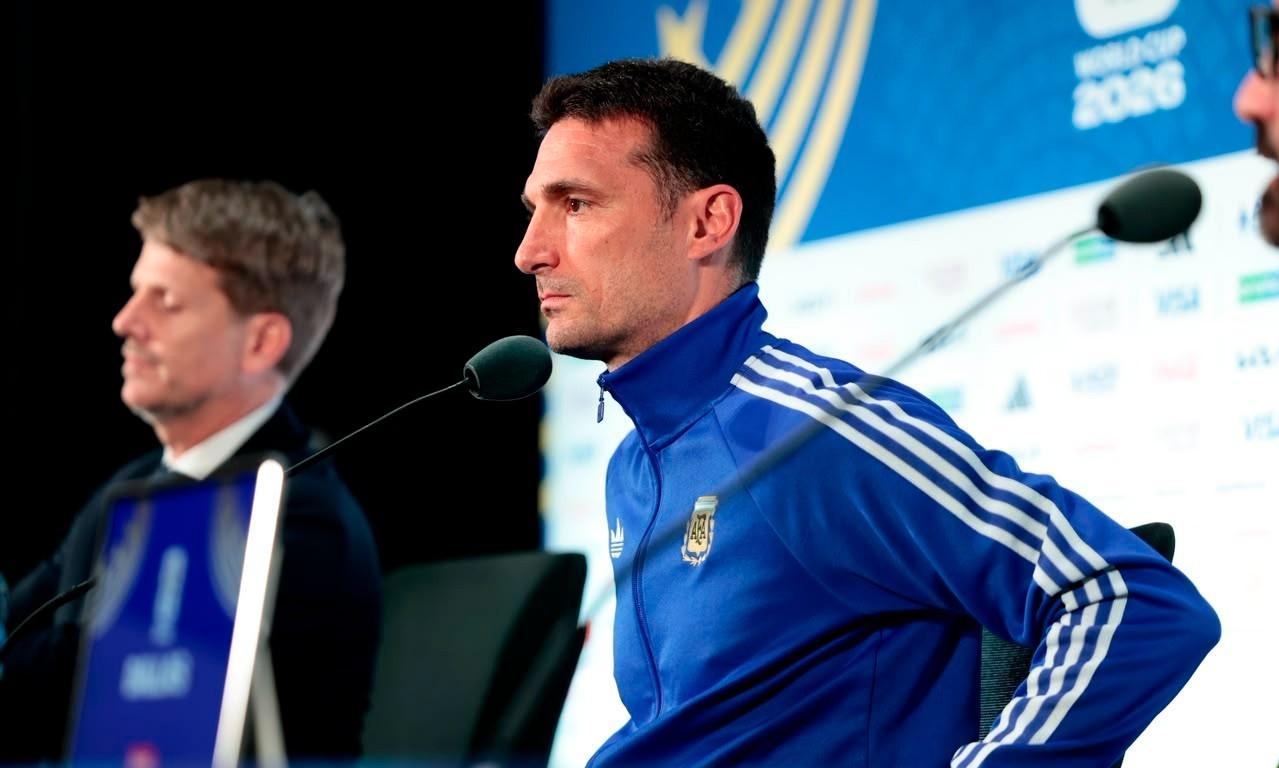

Argentina’s manager, Lionel Scaloni, has questioned the newly introduced hydration breaks during matches at the ongoing FIFA World Cup 2026 and said they give an advantage to weaker teams.
At this year’s World Cup, the football governing body FIFA has introduced three-minute hydration breaks in each half of games, “prioritising player welfare”.
Referee stops game at 22 minutes
The referee will stop the game 22 minutes into each half to allow players to rehydrate. There will be no weather or temperature conditions in place, with the breaks being called by the referee in all games, to ensure equal conditions for all teams, in all matches, FIFA said.
Also read: Iran’s ‘wall’ Alireza Beiranvand: From surviving Tehran streets to setting Guinness records
“For every game, no matter where the games are played, no matter if there’s a roof, (or) temperature-wise, there will be a three-minute hydration break. It will be three minutes from whistle to whistle in both halves,” Manolo Zubiria, Chief Tournament Officer, USA, for the FIFA World Cup 2026, had said in December 2025 while announcing the new rules.
The hydration breaks have been the subject of considerable debate. Scaloni said the breaks fragment the game.
What Scaloni said
“There are no easy games, especially in the group stage. Historically, but now also with the 48-team format, the group stage has always been hard. Now with the conditions of the heat and the hydration break. The game is stopped constantly, perhaps it gives a hand to the weaker team because they have time to fix things. They have time to adjust,” Scaloni told reporters on Sunday (June 21) ahead of their game against Austria on Monday.
Also read: Egypt register historic first-ever World Cup victory
“In the end, it’s done to have more time, but it fragments the game. It’s four quarters then in the halftime we have just three minutes to talk to players between them coming in and going back (on the field). But it’s done,” he added.
Further, he said, “The ‘four-period’ concept is real. Between the time players arrive and leave, we only have three-and-a-half minutes at halftime to talk to them.”
“That’s how it’s done, and here we are. Whatever plans I have in mind can change based on what happens during those 22 or 23 minutes. We have attacking players on the pitch, plus our bench options. We look for solutions, the same things you’d do during a normal halftime.
“Perhaps I was misleading when I mentioned it benefiting the weaker team, it also helps the attacking side make corrections. It feels strange adapting to this. Eventually, it will become the norm, just like any other improvement. For now, it feels unusual because the flow is so broken up. We try to analyse and make adjustments. Matches unfold in different ways, even within that first half alone. I’m sure it will improve,” he explained.
‘Interesting’, says Netherlands captain
Netherlands captain Virgil van Dijk called the breaks “interesting”.
“Hydration breaks are a bit interesting,” van Dijk told reporters.
“Because I was obviously watching almost all the games up until today, and every time going to commercial is a bit, not really how I like it. I think for the neutral watchers on TV, it’s also not great,” he added.
“For me, it’s a coaching break more than a cooling break, so to me it’s very important,” Belgium coach Rudi Garcia said.

Comments are closed.