
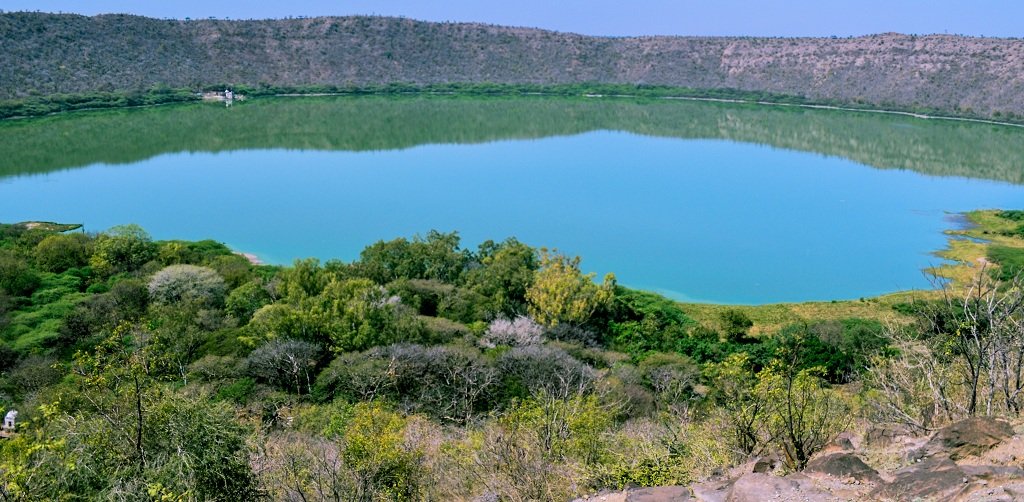

Temples in Lonar Lake are getting submerged and it is a cause of concern. The IIT Bombay has been roped in to study causes and suggested ways to check the submergence
Published Date – 21 December 2025, 09:13 AM
water levels rising in lonar lake submerging temples
Nagpur: A sharp rise in the water level of the world-famous Lonar Lake in Maharashtra’s Buldhana district, which has submerged many temples at the ancient site, has raised concerns about conservation and preservation.
The phenomenon, observed over the past few years, has prompted the district administration to engage experts from the Indian Institute of Technology (IIT) Bombay in seeking answers.
Lonar Lake, the world’s largest basaltic impact crater, was formed about 50,000 years ago by a high-velocity meteor strike. Its saline-alkaline waters and surrounding ecosystem have attracted extensive research from institutions in India and around the world.
The Ramsar Site (a wetland of international importance), about 460 km from Mumbai, is home to several temples, some dating back over 1,200 years. However, many of them, including the famous Kamalja Devi, have been submerged due to the increasing water level. The authorities are trying to ascertain the reasons behind the phenomenon.
Superintending Archaeologist Arun Malik from the Nagpur circle of the Archaeological Survey of India said that there are 15 temples on the lower rim of the lake, all of which fall under the ASI’s purview.
The Gaimukh temple complex has a natural spring that flows into the lake, he said.
Citing studies, Malik said the water level has been rising in the Lonar Lake for the last five to six years, which has put the ancient shrine structures at risk.
“No doubt this is a matter of research, but the water level has increased after the reserved forest came up there. If you look at the earlier images of Lonar Lake on Google Earth, you will find the water level very low,” he said.
The ASI official said that the Kamalja temple sees a large number of devotees, especially during Dussehra.
“We are planning to create an apron wall around the temple and build a platform so that even if the water level rises, it does not reach the temple. And the temple becomes accessible to the devotees during Dussehra,” he said.
The ASI official said he studied historical images, circle records and archives and found that the water level in the lake increased due to the surrounding reserve forest.
“The plantation and vegetation started growing around the crater due to the reserve forest, resulting in changes in the micro environment. I feel the water retention in the vicinity has increased due to the plantation and vegetation,” said Malik.
Local researcher and guide Sachin Kapure also said that the water level has increased in the past four to five years.
“It is a matter of great concern that the Kamalja temple is getting submerged. The Lonar crater is unique, and its conservation is very important,” he said.
Suresh Chopne, an environmentalist from the Vidarbha region, said he had been in Lonar a few years ago but is aware that the water level has been going up in the crater.
“Necessary steps must be taken to address the issue,” he said.
Buldhana District Collector Kiran Patil told PTI that there is a continuous flow of water from a spring at the Gaimukh temple.
“Of the several temples in the area, four are functional. The Kamalja temple has been submerged, and a well near the temple is also underwater. While the well contains sweet water, the surrounding lake water is saline due to the basaltic lava composition,” he said.
Patil said there is no outlet for water to drain from the lake. He said the rain pattern has changed in the past few years, and Lonal witnessed cloudbursts and heavy rains this year.
“Hence, we have set up an automatic weather station at Lonar,” he said. The flow of water from the Gaimukh spring has increased as well.
“Besides, many springs are active around the rim, which may also be causing the rise in the water level as is being claimed by others,” he said.
The official said there is no artificial intervention in the area.
“Experts from IIT Bombay have taken samples from the Lonar lake. They are trying to ascertain why this is happening and what steps should be taken. They are also trying to find out what the environmental impact is, as it is a natural place, and what is happening there is also natural,” the collector said.
Several other scientists have also collected samples from the Lonar lake, said Patil.
“There is no human intervention in the crater like water being pumped in and out. No one is allowed to bathe in the lake or do other activities. Everything is under CCTV surveillance,” he said.
Asked if the reserve forest around the crater was contributing to the increase in the water level, Patil said they do not know if that is the reason.
“However, a study will be carried out to find out if there is a botanical or soil impact,” he said.
The collector said that universities, students, guides and researchers are welcome to conduct studies at Lonar.
“We have a laboratory that can be used for research,” he added.

Comments are closed.