
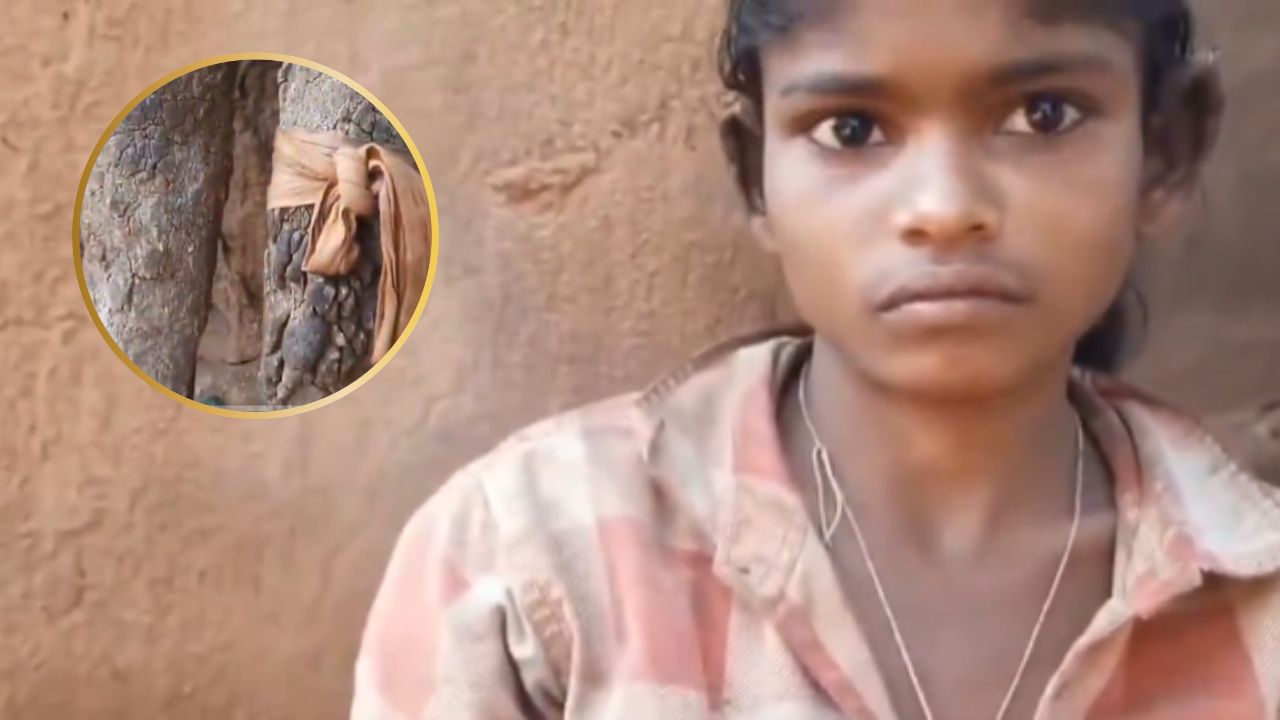
14 year old Rajeshwari is turning into stone in Chhattisgarh, what is Ichthyosis Hystrix disease? The family pleaded for saving

Chhattisgarh A heart-wrenching case has come to light in a remote tribal area of Uttarakhand, where a young girl Rajeshwari is suffering from a rare and serious disease. This disease is gradually making the skin of his body hard and like stone, due to which his daily life has become very painful. The case has attracted attention through viral videos on social media, where people are pleading for help from Chief Minister Vishnu Dev Sai (@vishnudsai). Let us understand this case in detail, including Rajeshwari’s condition, family challenges and reasons behind the illness.
Rajeshwari is a tribal girl from the Abujhmad area of Dantewada district of Chhattisgarh, located near Narayanpur (in some reports, the mention of Vijayawada may be by mistake, as Vijayawada is in Andhra Pradesh, while the reference is to Chhattisgarh). His age is said to be around 13-14 years, although in old reports in 2020, he was said to be 9 years old.
Read now on WhatsApp also, click to subscribe
skin is turning to stone
The case first made headlines in 2020, when a video showed stone-like blisters and hard layers on her skin. Recently, in December 2025, this video has again gone viral, in which Rajeshwari is seen showing her hands and legs. Her skin has become so hard and rough that it looks like tree bark or stone. In the video, she is sitting, and deep cracks and scales (layers) are clearly visible on her limbs, which are making it difficult for her to walk.
Four year old is facing pain
According to his family, the problem started at the age of four, when small blisters started appearing on his body. Gradually these blisters hardened and spread all over the body, on hands, feet, legs and other parts. The effect on the face is minimal so far, but on the rest of the body it is so severe that she is unable to sit or walk properly. The pain is so severe that everyday tasks like bathing, dressing or playing have become a challenge for him. The family is poor and lives in a rural area, where medical facilities are limited. Her uncle Kala Ram told that local people and children stay away from her out of fear because they think it is an infectious disease (which is wrong). This has left Rajeshwari socially isolated, and her mental health is also being affected. The family is searching for treatment, and the viral video appeals to the authorities for investigation and help.
Disease name and symptoms
According to The Sun, this disease is a rare skin disorder called Ichthyosis Hystrix. This is a severe form of ichthyosis. Ichthyosis means ‘fish-like skin’, because in it the skin becomes dry, scaly and hard. It is even rarer in the hysterix form, where stone-like hard blisters form on the skin. Only 24 such cases have been recorded worldwide, making research and treatment difficult.
Main characteristics:
Skin redness, scaling (formation of layers) and severe blisters
Hard, cracked skin on most parts of the body, which increases the risk of infection
Decrease in sweating, which leads to problem of overheating in summer
Pain, decreased mobility – difficult to walk, sit or work
Vitamin D deficiency and malnutrition, because thick skin affects nutrition absorption
If skin accumulates around the ears or eyes, there may be problems with hearing or vision.
This disease is not contagious, but congenital, and there is no complete cure. The growth of blisters can be stopped with medicine, but the side effects are high.
Due to illness
Ichthyosis histrionics is mainly caused by genetic mutations. It disrupts skin processes – normal skin produces new cells and sheds old ones every 28 days, but in this disease the cells harden and accumulate. Mutations at the gene level cause abnormal formation of keratin (skin protein), causing the skin to resemble fish scales or stones. It can be transmitted genetically, i.e. from parent to child. Environmental factors such as poverty, malnutrition or infection can make it worse, but the root cause is genetic. In tribal areas like Chhattisgarh, diagnosis is delayed due to lack of awareness and medical access.
treatment and suggestions
There is currently no cure, but symptoms can be managed by: Using soap-free cleansers and salt water baths to remove dead skin. Applying thick emollient-based moisturizers. Vitamin A Retinoid and Vitamin D Supplements. Antibiotics to prevent infection. Psychologist counselling, because social exclusion causes mental stress. According to The Sun, experts like Dr. Yasha Upendrava have suggested that quality of life can be improved with regular therapy. The family needs government help, NGO or crowdfunding. An appeal is being made to Chief Minister Vishnu Dev Sai to investigate the matter and provide assistance for treatment, because there should be a special scheme for rare diseases in rural areas.

Comments are closed.