
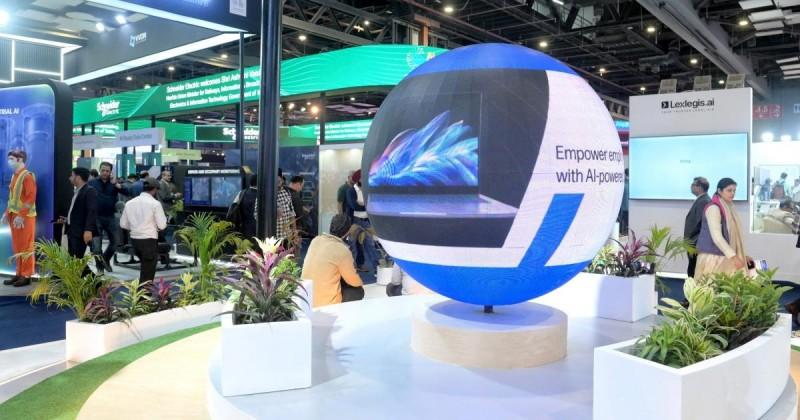
India AI Impact Summit 2026 spotlights inclusive, sovereign AI pathways amid China’s scale in parallel technological ecosystems

The India AI Impact Summit 2026, concluding today at Bharat Mandapam, has positioned India as a pivotal voice for the Global South in shaping responsible, human-centric artificial intelligence. As the fourth global AI governance event following Bletchley Park (2023), Seoul (2024), and Paris (2025), this summit emphasizes practical deployment, inclusivity, and equity under the banner of “People, Planet, and Progress.”
OpenAI CEO Sam Altman delivered a forward-looking keynote, forecasting that “true superintelligence” could emerge in the next couple of years and warning that by 2028, more intellectual capacity might reside in data centers than in humans. He strongly advocated for democratization, stating that centralization in one company or nation risks catastrophe, and praised India’s rapid adoption and sovereign model development as essential to balanced global progress. Altman highlighted India’s status as one of the fastest-growing markets for OpenAI tools like Codex, with widespread student usage of ChatGPT.
Google CEO Sundar Pichai expressed boundless optimism, declaring no technology inspires him more than AI. He announced the “India-America Connect” initiative for expanded subsea fiber-optic cables linking the US and India to bolster Global South connectivity, new national partnerships in science, education, agriculture, and renewables, the Google.org Impact Challenge: AI for Science with a $30 million fund, and the establishment of a Google Center for Climate Technology in India. Pichai also explored innovative ideas, including potential AI data centers in space to address energy and land constraints.
Other highlights included Reliance Industries Chairman Mukesh Ambani unveiling a massive ₹10 trillion investment commitment to AI infrastructure, Microsoft pledging up to $50 billion for AI capabilities in lower-income countries by decade’s end, and UN Secretary-General António Guterres calling for $3 billion in targeted funding for developing nations paired with robust safeguards. India showcased homegrown advancements: Sarvam AI’s 30B and 105B Mixture-of-Experts models, BharatGen Param2 (17B parameters supporting 22 Indian languages), and innovative tools like Kaze smartglasses. The concurrent India AI Impact Expo featured over 300 exhibitors from 30+ countries across 10 thematic pavilions, spotlighting “small AI” solutions optimized for low-connectivity settings.
While the summit promotes collaborative, frugal, multilingual, and sovereign AI tailored to diverse needs, China pursues a contrasting model of relentless execution, massive scale, and state-directed self-reliance across multiple fronts.
China Accelerates Technological and Economic Self-Reliance with Coordinated Advances in AI, Semiconductors, Clean Energy, Gold Reserves, and Trade Diversification
China is intensifying a state-backed industrial strategy aimed at achieving technological independence and reshaping global supply chains, with synchronized breakthroughs across artificial intelligence, domestic chip production, renewable energy dominance, strategic gold accumulation, and export reorientation toward the Global South. These developments, supported by recent corporate announcements, government data, independent reports from RAND, Bernstein Research, the Centre for Research on Energy and Clean Air (CREA), and the National Bureau of Economic Research (NBER), underscore Beijing’s focus on “new quality productive forces” amid U.S. export controls and tariffs.
AI: Coordinated Model Releases and Cost Leadership During Lunar New Year
Five major Chinese AI developers timed significant upgrades around the 2026 Lunar New Year (February 16-17), building on the disruptive momentum from DeepSeek’s 2025 releases.
Zhipu AI: Released open-source GLM-5 on February 11-12, engineered for agentic intelligence, advanced multi-step reasoning, long-horizon tasks, coding, creative writing, and problem-solving. It features 40 billion active parameters and was trained entirely on domestic Chinese chips.
ByteDance: Launched Doubao 2.0 over the prior weekend, with complex reasoning and multi-step task execution matching or exceeding OpenAI’s ChatGPT and Google’s Gemini in benchmarks, plus consumer applications. ByteDance also released Seedance 2.0, a competitive AI video-generation model.
Alibaba: Unveiled Qwen3.5 just before the holiday, supporting text, images, and video across 200 languages with visual agentic capabilities. The company claims it is 60 percent cheaper to run and processes large workloads eight times more efficiently than its predecessor; it also released Qwen-Image 2.0 for specialized tools.
Moonshot AI: Rolled out Kimi 2.5 (or K2.5) in late January, delivering strong open-source performance in agents, coding, image/video generation, and general intelligence.
DeepSeek: Beta-testing V4 (with full release anticipated imminently), focused on coding efficiency and accessible via the chatbot interface.
A January 14, 2026, RAND Corporation report (“U.S.-China Competition for Artificial Intelligence Markets”) confirms Chinese models operate at roughly one-sixth to one-fourth the cost of comparable U.S. systems, driven by open-source strategies, efficient architectures such as DeepSeek’s Mixture-of-Experts designs (activating far fewer parameters per token), and domestic infrastructure. Following DeepSeek R1 in January 2025, Chinese LLM global usage share surged from approximately 3 percent to 13 percent within months, reaching 10-30 percent in various markets by late 2025.
By contrast, an NBER working paper (February 2026) surveying nearly 6,000 CEOs, CFOs, and executives across the U.S., UK, Germany, and Australia found that over 80-90 percent of firms report no measurable impact from AI on employment or productivity (sales per employee) over the past three years, despite heavy investment. Executives anticipate modest future gains (1.4 percent productivity boost, 0.7 percent employment reduction over the next three years), underscoring a persistent “AI productivity paradox” in Western contexts.
Semiconductor Ecosystem: “Four Dragons” Public Listings and Huawei’s Scaling Ambitions
China’s domestic GPU/AI chip sector is maturing rapidly through capital markets and production ramps.
The “Four Dragons” advanced listings in late 2025-early 2026:
Moore Threads: STAR Market debut December 5, 2025; shares surged over 400 percent on day one.
MetaX: STAR Market December 17, 2025; raised nearly $600 million, shares jumped approximately 700 percent.
Biren Technology: Hong Kong main board early January 2026; first pure GPU listing there.
Enflame Technology (Tencent-backed): STAR Market application accepted January 22, 2026; entered inquiry stage February 2026.
Collectively, these firms and peers (e.g., Iluvatar CoreX, Cambricon) have shipped over 10,000 chips in recent batches, targeting 6nm/7nm nodes for training and inference.
Huawei plans to double Ascend 910C output to approximately 600,000 units in 2026 (from 2025 levels), with total Ascend line reaching up to 1.6 million dies. The company outlined a roadmap to 950/960/970 chips through 2028 for system-level parity with Nvidia. Bernstein Research (late 2025 updates) forecasts Nvidia’s China AI chip market share contracting to around 8 percent by 2026 (from 40-66 percent in prior years), while Huawei captures approximately 50 percent, with others gaining the remainder. Beijing has directed state telecom operators to phase out AMD and Intel chips by 2027, supported by expanded incentives (cumulative semiconductor funds exceeding prior targets).
Clean Energy: $1 Trillion Investment Driving One-Third of GDP Growth
Clean energy has emerged as a primary growth engine. According to CREA’s February 5, 2026, analysis for Carbon Brief:
Investment reached 7.2 trillion yuan (approximately $1 trillion) in 2025, roughly four times the $260 billion in fossil fuels.
These sectors generated 15.4 trillion yuan ($2.1 trillion) in output (11.4 percent of GDP, comparable to Brazil or Canada’s economy) and drove over one-third of 2025 GDP growth plus more than 90 percent of investment expansion.
China added a record 277 GW of solar capacity in 2024 (with over 315 GW reported for 2025), maintaining annual panel manufacturing capacity exceeding 1 terawatt. It produces over 70 percent of global EVs; nearly half of new car sales in China were electric in recent years. This low-cost renewable foundation directly powers expanding AI data centers, in stark contrast to ongoing U.S. subsidy debates.
Gold Reserves and Yuan Internationalization
The People’s Bank of China (PBOC) extended its gold-buying streak to 15 consecutive months in January 2026, adding 40,000 troy ounces (1.2 tonnes). Official holdings reached 74.19 million fine troy ounces (approximately 2,308 tonnes), valued at $369.58 billion (up roughly $50 billion from the prior month). The World Gold Council highlights central bank accumulation, including China’s, as a structural support for prices, with the Shanghai Gold Exchange expanding renminbi-denominated contracts overseas to facilitate yuan-based trade with partners such as Saudi Arabia, Brazil, and Indonesia.
Record Trade Surplus Redirected Globally
Customs data indicate 2025 exports reached a record $3.77 trillion (up 5.5 percent), yielding a $1.19 trillion surplus, the largest ever by any nation. Exports to the U.S. declined sharply (approximately 20-28.6 percent in key periods), offset by surges to Africa (26-27.5 percent), ASEAN (8-13 percent), and Belt and Road partners (now over 50 percent of total trade). Goldman Sachs raised its 2026 China GDP forecast to 4.8 percent (above consensus 4.5 percent), citing export resilience.
15th Five-Year Plan (2026-2030): Focus on Frontier Technologies
Recommendations adopted in October 2025 prioritize original innovation in quantum technology, biomanufacturing, hydrogen and fusion energy, brain-computer interfaces, embodied AI, and 6G communications. These build on self-reliance in integrated circuits, advanced materials, and “AI+” integration across industries, with increased basic research funding and national strategic projects.
Implications and Global Context
China constructs parallel ecosystems at significantly lower costs while pivoting trade and reserves. U.S. firms continue heavy AI capital expenditure with limited realized gains to date (per NBER). Analysts note risks of overcapacity in certain sectors but emphasize structural advantages in manufacturing scale, energy costs, and policy coordination. For investors, this reinforces interest in gold and precious metals (structural floor from PBOC buying), energy transition opportunities, and selective exposure to China’s high-tech supply chains, while Magnificent 7 valuations face scrutiny amid cost-competitive alternatives.
This multifaceted push positions China as a dominant force in defining the next decade’s technological and economic architecture. The full 15th Five-Year Plan, due for formal adoption in March 2026, will provide further operational details amid evolving geopolitics.
Global Comparisons: Divergent Models in a Multipolar AI Landscape
The India AI Impact Summit champions frugal, sovereign, and inclusive AI for the Global South, with India’s GPU additions exceeding 58,000, open multilingual models, and “small AI” focus contrasting the U.S. emphasis on massive frontier spending yet negligible productivity returns (NBER). Europe prioritizes regulatory frameworks post-Paris Summit, while China achieves deployment at 1/6-1/4 the cost, full domestic chip scaling via Huawei and the Four Dragons, and renewable self-sufficiency to sustain it. Where Western approaches debate and regulate, China builds and exports at volume; where India bridges digital divides through partnerships, China redirects record surpluses and gold reserves to deepen influence across Africa, ASEAN, and beyond. The U.S. retains leadership in foundational research and capital markets, India in democratic-scale applications and talent pools, and China in manufacturing velocity and cost efficiency, resulting in the most multipolar technological environment in modern history.
Futuristic Outlook: A Multipolar AI-Driven World by 2030
By the close of this decade, these converging trajectories will redefine the global economy. China’s terawatt-scale renewables and sub-dollar AI inference will likely fuel an unprecedented wave of applications throughout the Global South, driving industrialization on a scale surpassing historical precedents like the Marshall Plan. India’s inclusive, multilingual models and compute sovereignty could establish it as the essential bridge for ethical AI serving billions. The United States, assuming eventual productivity realization, will compete through high-value innovation and strategic alliances. Gold-backed yuan contracts and redirected trade flows may gradually erode dollar dominance in commodities, while advancements in 6G, quantum computing, and embodied AI under China’s 15th Five-Year Plan transform logistics, biomedicine, and beyond. The true victor will be humanity’s collective ability to navigate this once-in-a-century technological inflection point, provided today’s summits yield coordinated safeguards against fragmentation and foster shared prosperity. The realignment is no longer impending; it is actively unfolding from New Delhi to Beijing and across the world.
(Major General Dr. Dilawar Singh, IAV, is a distinguished strategist having held senior positions in technology, defence, and corporate governance. He serves on global boards and advises on leadership, emerging technologies, and strategic affairs, with a focus on aligning India’s interests in the evolving global technological order.)

Comments are closed.