
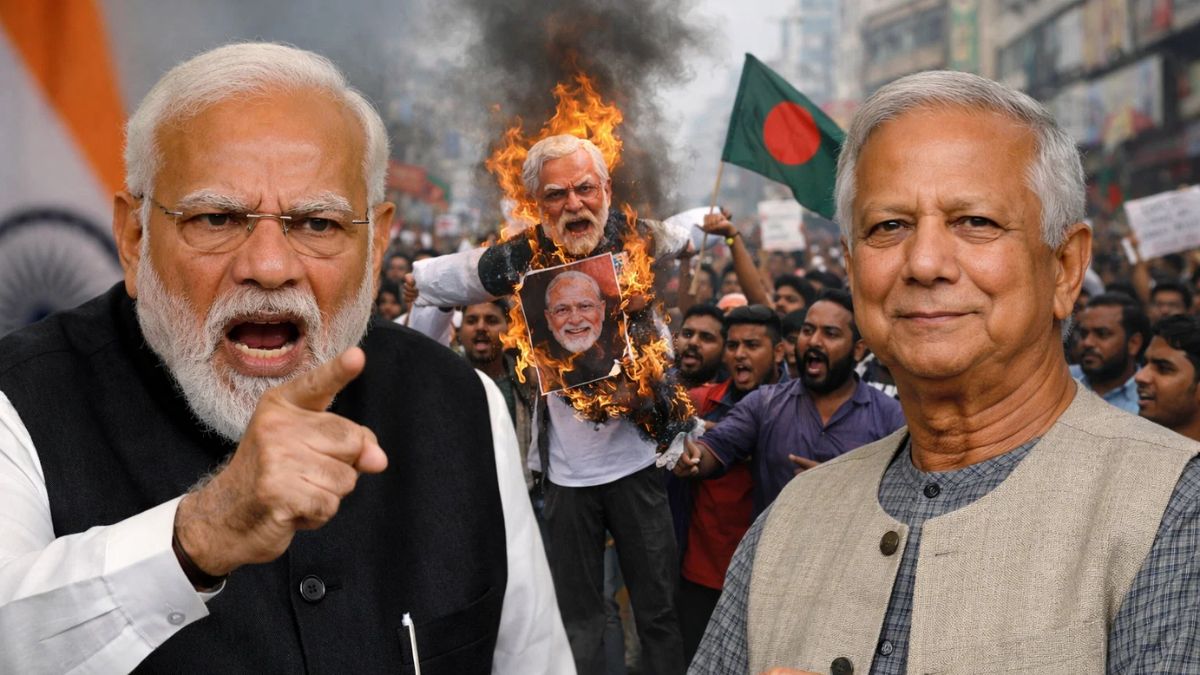
Protests from Dhaka to Rajshahi… India closed visa centres, summoned Bangladesh ambassador; Tension increased due to the death of Sharif Hadi

India Bangladesh tension: Once again the tension in the relations between India and Bangladesh has come to the fore. India has temporarily closed two visa application centers located in Khulna and Rajshahi amid ongoing political instability, protests and security concerns in Bangladesh. This decision has come at a time when relations between the two countries are already strained. Sheikh Hasina They remain tense regarding the granting of asylum by India.
Read now on WhatsApp also, click to subscribe
An official of India’s High Commission in Dhaka said that protests took place in Khulna and Rajshahi on Thursday, due to which the security situation deteriorated. “Whenever the security situation worsens, we are forced to close visa centres,” the official said. However, it is a matter of relief that Visa Application Center in Dhaka Has started work again.
March towards Indian Mission in Rajshahi
An organization named ‘July 36 Mancha’ took out a march towards the Indian Assistant High Commission in Rajshahi. This march started from Bhadra Mod at 12:30 pm, but the police stopped it by placing a barricade about 100 meters before the High Commission. After this the protesters staged a protest there and asked for permission to move ahead. Similar protests were seen in Khulna also.
Bangladeshi ambassador summoned, MEA expressed strong objection
Amidst these incidents, India’s Ministry of External Affairs (MEA) on Wednesday summoned Bangladesh High Commissioner Riyaz Hamidullah and lodged a strong protest. MEA expressed serious concern over the security of Indian missions in Bangladesh and said that it is the responsibility of the interim government to ensure the security of Indian establishments as part of its diplomatic obligations.
According to sources, a major reason for increasing tension was the recent controversial statement of National Citizen Party (NCP) leader Hasnat Abdullah, in which he had claimed that Bangladesh can give shelter to separatist forces against India and talked about separating the seven northeastern states of India.
Demonstration stopped in Dhaka also
Police also stopped the protesters moving towards the Indian High Commission in Gulshan area of Dhaka. These people were demanding the return of ousted Prime Minister Sheikh Hasina, who had gone to India during the July rebellion last year.
Political violence: death of Sharif Osman Hadi
Meanwhile, another incident came to light that shook the politics of Bangladesh. Sharif Usman Hadi, youth leader of 2024 July Movement, died during treatment in Singapore. Hadi was shot by unknown assailants in Dhaka last week, after which he was taken to Singapore for better treatment. Despite treatment in the Neurosurgical ICU at Singapore General Hospital, he could not be saved. Singapore’s Foreign Ministry confirmed his death and said the Bangladesh High Commission was being assisted in the process of sending the body to Bangladesh.
Hadi was the candidate from the Dhaka-8 seat, and the spokesperson of the party Inquilab Mancho, which was formed after the July movement that ousted Sheikh Hasina from power. The attempt to assassinate him took place at a time when the election schedule was announced on February 12, deepening concerns about political violence in the country. Bangladesh’s Chief Advisor Muhammad Yunus condemned the attack, saying election-related violence is completely unacceptable and any attempt to disrupt the democratic process will not be tolerated.
Why is this a matter of concern for India?
After the attack on Hadi, Bangladesh summoned the High Commissioner of India and sought cooperation in the investigation. Dhaka expressed apprehension that the accused involved in the attack may flee to India and requested India to immediately arrest and extradite them. However, India rejected these allegations outright.
Attackers have no connection with India: MEA
MEA clearly said that the attackers have no connection with India and India never allows its territory to be used for anti-Bangladesh activities. MEA reiterated that India is in favor of free, fair and peaceful elections in Bangladesh and expects the interim government to conduct the electoral process safely while maintaining law and order.
Overall, from the closure of visa centers to political violence and diplomatic spats, the current developments are pointing towards increasing tension in India-Bangladesh relations, which may have a deeper impact on the politics and diplomacy of both the countries in the coming days.

Comments are closed.