
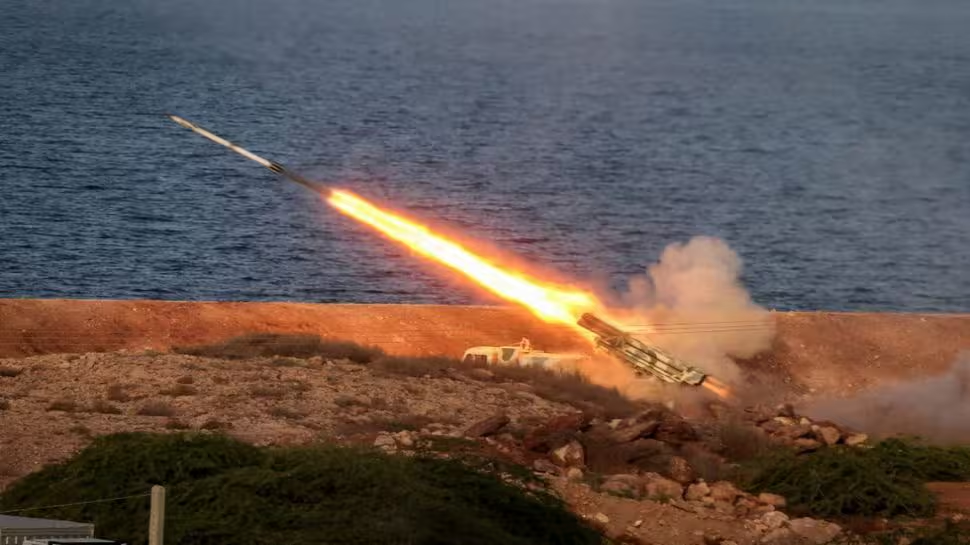
India Builds Deadly Sea-Based Missile Shield To Turn Ocean Into Graveyard For Pak-China Missiles | India News

New Delhi: India is moving fast to build what senior officials are already calling a floating missile wall in the Indian Ocean. This effort marks a major change in New Delhi’s defense thinking, as the Indian Navy and the Defense Research and Development Organization (DRDO) work together on a powerful sea-based Ballistic Missile Defense (BMD) system designed to eliminate enemy missiles long before they reach the coastline.
The project grew in urgency as China pushed ahead with DF‑21 “carrier‑killer” missiles and Pakistan advanced its Ababeel MIRV‑enabled system. Engineers are now preparing ship‑compatible versions of the AD‑1 and AD‑2 interceptors, both built to travel at hypersonic speeds and destroy incoming ballistic missiles of up to 5,000 kilometers in range.
The goal is to place this sea shield across strategic points in the Arabian Sea and the Bay of Bengal, with 2027 set as the operational target.
Add Zee News as a Preferred Source
A War Unfolding Beneath The Waves
Picture a missile racing seven times the speed of sound, skimming high above the sea, capable of wiping out a coastal city or a naval base in seconds. Now imagine another missile rising from an Indian warship and destroying that threat mid‑air.
This is not fiction. This is the silent contest playing out beneath the surface of the Indian Ocean, where every nation in the region is strengthening its missile forces.
China has been moving the DF‑21 into active deployment, a missile often described by analysts as an aircraft‑carrier threat. Pakistan is adding pressure with the Ababeel, a missile that can release multiple warheads aimed at separate cities.
India has responded by shifting focus away from land‑only defense and placing greater trust in the open sea, where incoming threats can be intercepted long before they reach land.
DRDO, Navy Push Ahead With Ship‑Based Interceptors
The sea‑based element of Phase‑II BMD has become the centrepiece of this transformation. According to sources quoted by idrw.org, lighter variants of the AD‑1 and AD‑2 interceptors are being prepared so that they can be mounted directly on warships.
These interceptors are designed to be quicker and far more agile than their land‑based counterparts.
Plans call for deployment across key points in the Arabian Sea and the Bay of Bengal, enabling India to stop a ballistic warhead in the air before it enters the atmosphere or descends toward a city.
What The AD‑1, AD‑2 Bring To The Fight
The AD‑1 uses solid fuel and two stages to strike targets within the atmosphere at altitudes up to around 150 kilometers. It weighs roughly a ton and is built to handle threatening missiles in the endo‑atmospheric phase.
The AD‑2 is designed for the upper reaches of the atmosphere, chasing missiles traveling at Mach 6 to Mach 7 during the mid‑course phase. Its role is to destroy weapons that could cover thousands of kilometres.
Both interceptors together form a new generation of defensive capability for India.
Warships That Can Hunt Missiles
India is preparing a canister‑based vertical hot‑launch system, similar to the architecture used in America’s THAAD program.
This approach allows missiles to be placed on ships without major redesign. Once installed, a warship becomes a mobile air‑defense platform or a missile shield that moves with the fleet.
The breakthrough test of July 24, 2024
A successful high-speed test on July 24 last year at the Chandipur range proved the concept. An AD‑1 variant destroyed a mock medium‑range ballistic missile in less than four minutes.
Data from sea- and land‑based radar networks fed the system throughout the mission, turning the exercise into a full rehearsal for the sea BMD network.
India Prepares For Hypersonic-Era Warfare
With both China and Pakistan improving their hypersonic capabilities, Indian scientists are working on advanced seekers and divert thruster systems and hit‑to‑kill technology. The purpose is to destroy MIRV warheads before they reach Indian airspace.
The Radar Eyes Behind The Shield
The backbone of the sea BMD system is a long‑range radar network. India is developing over‑the‑horizon radar capable of tracking beyond 1,500 kilometres. Indian warships are receiving new X-band and S-band AESA radars, while floating test‑range vessels continue to collect data and refine targeting performance.
The foundation for this radar‑missile pairing was already visible in the 2023 vertical‑launch BMD test, when a short‑range interceptor hit a Prithvi‑based target.
When Will This Giant Shield Be Ready?
Public information suggests that Phase‑II sea‑based BMD is being prepared for operational deployment around 2027. After that, Phase‑III aims to counter missiles with ranges beyond 5,000 kilometres, reaching into the realm of ICBMs.
India no longer plans to absorb a missile strike and respond later. The new approach aims to destroy an incoming threat in the very first moments.
The ships that patrol India’s waters are evolving into platforms capable of neutralizing ballistic missiles mid‑flight. As China and Pakistan expand their own missile programs, India is building a barrier at sea that will be extremely difficult to penetrate in the years ahead.

Comments are closed.