
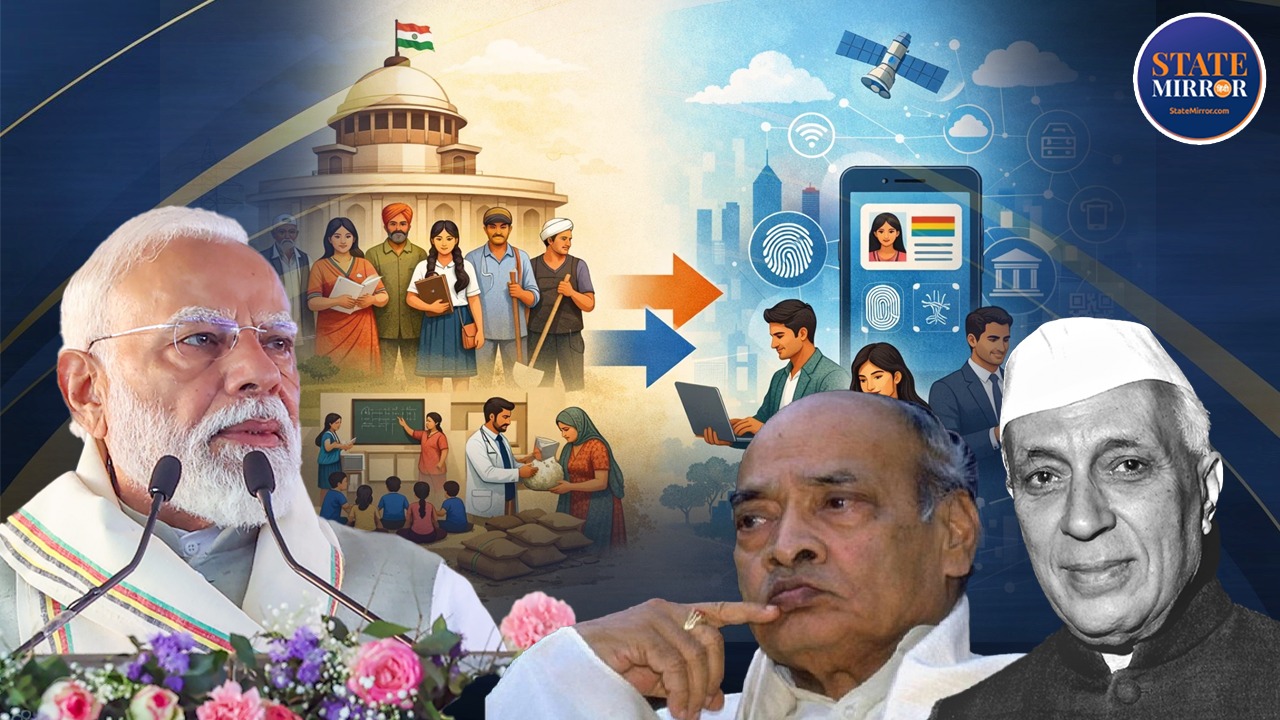
From ‘welfare state’ to ‘digital welfare’: How has the role and identity of the Indian government been changing?

India’s governance system has not always been stable, rather its character has been changing with time and circumstances. After independence, the country described itself as a welfare state (welfare state), where the aim of the government was to support the poor and provide protection to the weaker sections of the society. In the 1990s, the economic crisis and the wave of globalization changed the role of the government and it gradually became a “service provider state” providing services. Now in the third decade of the 21st century, with the expansion of digital technology, India seems to be moving towards a new model, the Digital Welfare State.
Systems like Aadhaar, Jan Dhan accounts, mobile connectivity and direct benefit transfer have made the relationship between the government and the citizen more direct and transparent than ever before. The question is, what happened that the identity of the Government of India kept changing in different periods? What economic, political and technological factors led to policy changes? And has India really now entered that era where a new definition of welfare state is being written through digital technology? This is the investigation in this Read special.
Read this also:HECI new regulator, will UGC-AICTE be abolished? Understand the complete plan of Vikas Bharat Education Foundation
In fact, since India’s independence till today, the role of the government has been continuously changing. Once the aim of the government was to eradicate poverty and provide social security, then it became a “service provider state” providing services, and now appears to be rapidly moving in the direction of a “digital welfare state”.
This change did not happen suddenly. In every era, economy, technology, global conditions and needs of society forced the government to change its role. This is the reason why today’s government not only makes schemes but also tries to reach the citizens directly through digital platforms.
But it is important to understand better what are Welfare State, Service Provider State and Digital Welfare State, and what historical reasons forced India to go through these three stages.
Read this also:LPG And Oil Crisis: Due to shortage of fuel, 10 countries are most affected due to war?
1. After Independence: Why did India become a “welfare state”?
At the time of independence in 1947, India was very poor, divided and struggling with lack of resources. The industrial infrastructure was weak and a large population was living below the poverty line. It is in this background that the makers of the Constitution set the goal of making India a “Welfare State”. That is, a state in which the welfare of the common citizen is the top priority of the government.
What is welfare state?
Welfare state is a system in which the government takes the responsibility of education, health, employment and social security of the citizens. In this model, the goal of the government is to reduce poverty, expand education and health, reduce social inequality, and provide protection to the weaker sections. This is the reason why Nehru laid the foundation of mixed economy. That means neither a government completely friendly to the capitalists nor a government that blindly sacrifices everything for the poor.
Key Features of the “Welfare State” Era
After independence, the government adopted a planned economy. Under this, some big steps were taken. These include five year plans,
Emphasis on public sector industries, government schools and hospitals and food security. During this period, the government was called “Mai-Baap Sarkar” because it tried to fulfill almost every need of the citizens.
Which leaders thought about this model?
The ideological roots of this policy were mainly in the socialist thinking of Jawaharlal Nehru. He believed that if the state did not play a strong role, social inequality would increase. Taking this thinking forward, Indira Gandhi had emphasized on eradicating poverty and nationalizing banks and abolishing private purses. During Indira’s era, the poor were also given loans against milch animals.
2. The turning point of 1991: How India became a “service provider state”
In 1991, India got caught in a serious economic crisis. Foreign exchange reserves were almost exhausted and the country had to take a loan from the IMF. Had to mortgage the gold. During this period, a coalition government began and Congress returned to power. Narasimha Rao became the PM of the country. Manmohan Singh, who was the Governor of RBI, became the finance of the country. During this period, the government and private sector emphasized on globalization and liberalization in the country. The Modi government, which Rahul Gandhi calls the government of capitalist friends, started during this period. The credit for these changes goes to P.V. Goes to Narasimha Rao’s government.
What is service provider status?
In this model, the government itself does not do everything but gives opportunities to the private sector and plays the role of providing services to the citizens.
Why did the government’s focus change?
Moving away from running the industry to providing regulation and services, encouraging private companies and promoting a market-based economy.
Why was this change necessary?
- The balance of payments crisis of 1991 was forcing the government to change its economic policies.
- The world was rapidly moving towards a global economy.
- Government enterprises were continuously incurring losses. Major changes took place during this period.
- License raj ended. Foreign investment was allowed, the private sector expanded and for the first time the service sector in the country gained momentum, which continues till today.
- This was the period when the IT sector and service based economy started changing the identity of India.
3. Phase Three: The Rise of the Digital Welfare State
In the second decade of the 21st century, India appears to be entering a new phase, which you can call ‘Digital Welfare State’. This change is especially visible during the reign of Narendra Modi.
What is a digital welfare state?
- Digital Welfare State is a system in which the government delivers schemes directly to the citizens through digital technology.
- Its main objectives include reducing corruption, removing middlemen, increasing transparency and making government services easier.
- In layman’s terms, digital welfare state is “operation of welfare schemes through digital platforms”.
During the last decade, the Modi government implemented many schemes through digital welfare despite severe criticism. In these:
1. Base : Aadhaar issued by Unique Identification Authority of India created digital identity of citizens.
2. Jan Dhan Account: Bank accounts of crores of people were opened under Pradhan Mantri Jan Dhan Yojana.
3. Mobile Connectivity: Smartphones and the Internet increased the reach of digital services. These three together are often called “JAM Trinity” (Jan Dhan-Aadhaar-Mobile).
4 Direct Benefit Transfer: Subsidy is sent directly to bank accounts through the government’s Direct Benefit Transfer system.
5. Gas Subsidy: Beneficiaries of Pradhan Mantri Ujjwala Yojana get subsidy directly.
6. Digital Payment: Unified Payments Interface made digital payments common.
7. Health Security: Digital health cards were made under Ayushman Bharat.
8. Farmer Assistance: Under Pradhan Mantri Kisan Samman Nidhi, money is sent directly to the bank accounts of farmers.
What were the benefits of digital transformation?
Many important benefits of the digital welfare model emerged. It is believed that transparency has increased and the role of middlemen has decreased, but there is a section which does not agree with this. Due to these schemes, benefits started reaching the beneficiaries directly. Administrative decisions were expedited. Implementation of government schemes was expedited. The government can now make plans based on data analytics.
Still, the challenges are still not less?
However, some challenges have also emerged with the digital welfare model. 1.4 billion population was divided into two parts. This was called digital divide. Internet and digital literacy is still low in rural areas. Security of citizens’ data or privacy has become a big issue. If the system fails, services may be disrupted.
Has India really become a digital welfare state?
Many experts believe that India is “moving towards a digital welfare state. The truth is that digital infrastructure is growing rapidly. Government services are going online. Digital payments are the fastest growing in the world, but digital inclusion is still a big challenge.”
Will the government of the future be “data driven governance”?
In the coming times, India’s governance system may move towards data-based administration. In this regard, there are many indications of possible changes coming to the fore. These include AI based government services, digital health ecosystem, smart agriculture platform, digital social security network and others.
Changing government with changing needs!
The history of India’s governance system shows that the role of government is not static, but keeps changing with time. Its identity is Welfare State after independence, Service Provider State after 1990 and now Digital Welfare State. It is possible that in the coming decade, India may become an example for the whole world as a “digital governance model”.
Why from Welfare to Digital India? Law professor gave this answer
Professor of Meerut University Law Department Dr. Vivek Tyagi When asked how do you see the transition from ‘welfare state’ to ‘digital welfare’. He said, no matter what the era, the aim of the government in every era has been to provide welfare to the people. You should take the Constitution of the country only. To put it in one or two words, it is a ‘public welfare document’.
He further said that Dr. Bhim Rao Ambedkar had also called the Constitution a social document. Since, the law made by the Constituent Assembly is applicable in the country. The entire population is governed by democratic systems. Therefore, no matter which government is in power, the basic foundation of its governance will be welfare.
Law Professor Dr. Vivek Tyagi said that as far as the government being a public welfare state since the country’s independence is concerned, Nehru had given importance to socialist ideas to achieve this goal. Therefore, big industries were established. Schools, colleges, hospitals, dams were built. Indira Gandhi nationalized the banks. LIC and GIC were promoted to expand the insurance sector. The slogan was given to eliminate poverty. After that the concept of privatization, liberalization and world-one village was taken forward.
Now that there is Modi government, the government has become digital welfare. It is not surprising that this happens. This is the era of technology. Due to technology the world has turned into a village. Therefore, no matter which government there is, whether it wants it or not, digitalization had to happen. Digital India is an inherent part in this respect. If we look at this from a legal perspective, there are shortcomings at many places regarding data protection and people’s privacy. This is a serious challenge. The government is taking positive steps in this regard also. There will be some solution for that too.

Comments are closed.