
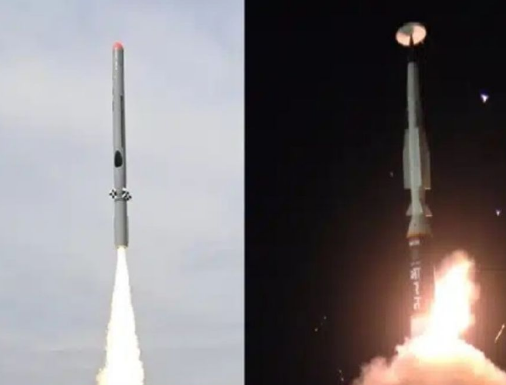

India has demonstrated its growing strength in the world of aerospace by successfully testing two long-range missiles within a week. These two will be the longest range conventional missiles in use by the Indian Armed Forces, with a longer range than the extended range BrahMos supersonic missile. India now needs a powerful rocket force, for which the guided Pinaka rocket will now be able to travel 60 km in 44 seconds after completing all 12 trials. It is capable of attacking from a distance with up to seven tons of explosives.
India conducted the first test of long-range hypersonic and subsonic naval missiles this month. Both the subsonic Long Range Land Attack Cruise Missile (LRLACM) and the Hypersonic Long Range Anti-Ship Missile (LRASHM) will complement the supersonic BrahMos missile, which is currently the primary strike weapon of the Indian Navy. India’s Defense Research and Development Organization (DRDO) conducted the first flight test of the Long Range Land Attack Cruise Missile (LRLACM) from the Mobile Articulated Launcher at the Integrated Test Range (ITR) at Chandipur, Odisha on 12 November.
During this time all sub-systems performed as expected and met the primary mission objectives. The missile’s performance was monitored by multiple range sensors such as radar, electro-optical tracking system and telemetry deployed at various locations in the ITR. The test off the Odisha coast was witnessed by senior scientists from DRDO laboratories as well as representatives of the three services, users of the system. LRLACM is configured to be launched from the ground using a mobile articulated launcher. It can also be launched from frontline ships using the Universal Vertical Launch Module system.
According to DRDO, the missile demonstrated the ability to perform various maneuvers while flying at different altitudes and speeds using way point navigation. The missile is also equipped with advanced avionics and software to ensure better and reliable performance. LRLACM has been developed by the Aeronautical Development Establishment, Bengaluru with contributions from other DRDO laboratories and Indian industries. Hyderabad-based Bharat Dynamics Limited and Bengaluru-based Bharat Electronics Limited are partners in the development and production of this missile system. Both the organizations are busy in the development and integration of the missile.
After this, DRDO late night on 16th November, Dr. India’s first long-range hypersonic missile was successfully tested from APJ Abdul Kalam Island. During flight testing the missile performed successful terminal maneuvers and struck with a high degree of accuracy. According to the Defense Ministry, this missile has been designed to carry various explosive materials for the armed forces to a distance of more than 1,500 kilometers. The missile was tracked by various ranging systems deployed in multiple domains. This missile was developed by Dr. The APJ Abdul Kalam Missile Complex has been indigenously developed by the laboratories of Hyderabad and various laboratories of DRDO and industry partners.
Defense Minister Rajnath Singh had described the successful flight testing of both the missiles as a historic achievement for India. On the testing of Long Range Land Attack Cruise Missile, he said that this will pave the way for indigenous cruise missile development programs in future. Congratulating DRDO, armed forces and industry for testing the long-range hypersonic missile, he said that with this India has joined the select group of countries which have such important and advanced military technology.

Comments are closed.