
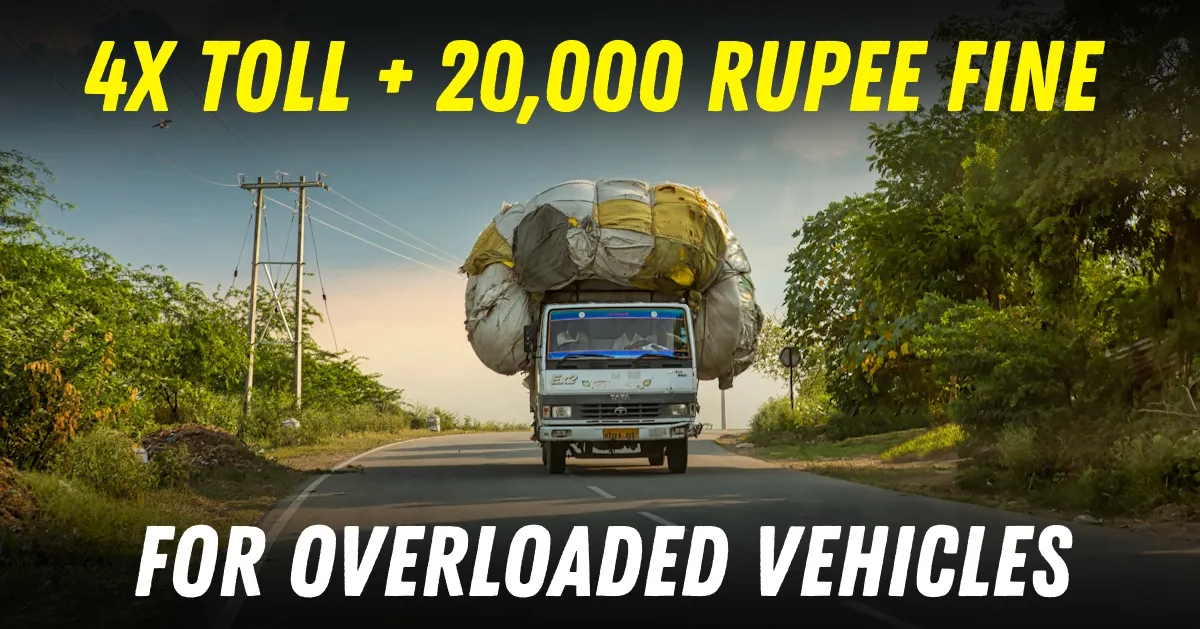

The Ministry of Road Transport and Highways has rolled out strict new regulations aimed at sharply curbing the problem of overloaded commercial vehicles on national highways. Effective from April 15, 2026, the amended National Highways Fee Rules bring in a graded penalty structure for vehicles carrying cargo beyond their permissible Gross Vehicle Weight. Just as importantly, the new system removes a large part of the human discretion that once surrounded overload enforcement by requiring mandatory digital reporting to the Vahan database.
The policy is aimed at two connected problems: asset protection and road safety. That matters because the highway network it is trying to protect is no longer small. India’s national highway network now stretches to around 1,46,560 km, and the length of 4-lane-and-above national highways has expanded to roughly 45,947 km.
High-speed corridors have also grown rapidly. In simple terms, the government is now protecting a far bigger and more expensive highway asset than it was a decade ago. That is why overloading is no longer being treated as a routine violation. It directly affects pavement life, bridge stress, braking distance, tyre temperatures and lane discipline.
Under the revised rules, the government has moved away from a simple flat-penalty approach and introduced a tiered structure tied to the degree of overload. Vehicles carrying up to 10 per cent excess weight get no additional overload fee. From 10 per cent to 40 per cent overload, the toll becomes double the normal rate. Above 40 per cent overload, it jumps to four times the normal toll. That creates a much steeper financial deterrent. To put that in practical terms, a truck that would normally pay Rs 500 at a toll plaza would now pay Rs 1,000 if it falls in the 10 to 40 per cent overload bracket, and Rs 2,000 if it crosses the 40 per cent mark.
The toll hit is only part of the cost. Because the data must now be logged into Vahan, the same offence can trigger further action under the Motor Vehicles framework. That means a transporter caught with major excess weight can face an additional penalty of Rs 20,000 plus Rs 2,000 for every extra tonne. So if a truck is found to be 15 tonnes overweight, that alone can translate into a further Rs 50,000 liability, apart from the multiplied toll. The legal consequence does not stop there. The vehicle is also not supposed to continue moving until the excess load is removed.

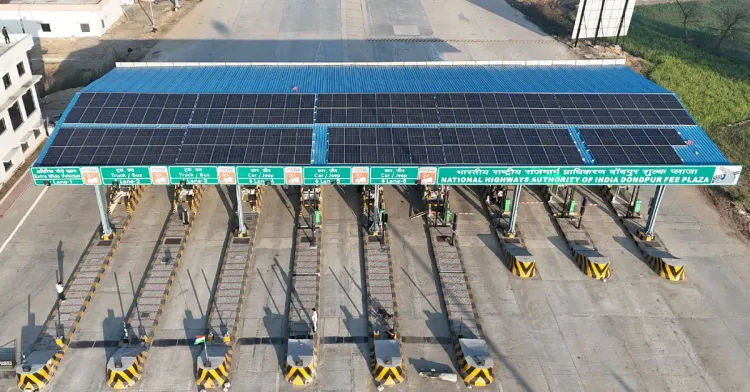
The rules also make enforcement more machine-led. Overloading has to be determined through certified weighment devices installed at fee plazas, and all overload fees must be collected only through FASTag.
If a toll plaza does not have a functional weighment system, it cannot levy overload charges. That is a critical clause because it shifts responsibility onto toll operators to keep weighing equipment operational and auditable.
In effect, the government is trying to shut three loopholes at once: under-measurement, cash leakage, and non-reporting. Once overloaded trucks begin leaving a digital record at toll plazas and on Vahan, repeat offences become much easier to track across states.
For fleet operators, that changes the calculation. Overloading may still bring one extra trip’s worth of cargo revenue, but the combined toll, penalty and unloading risk can now wipe out that gain very quickly.
Comments are closed.