
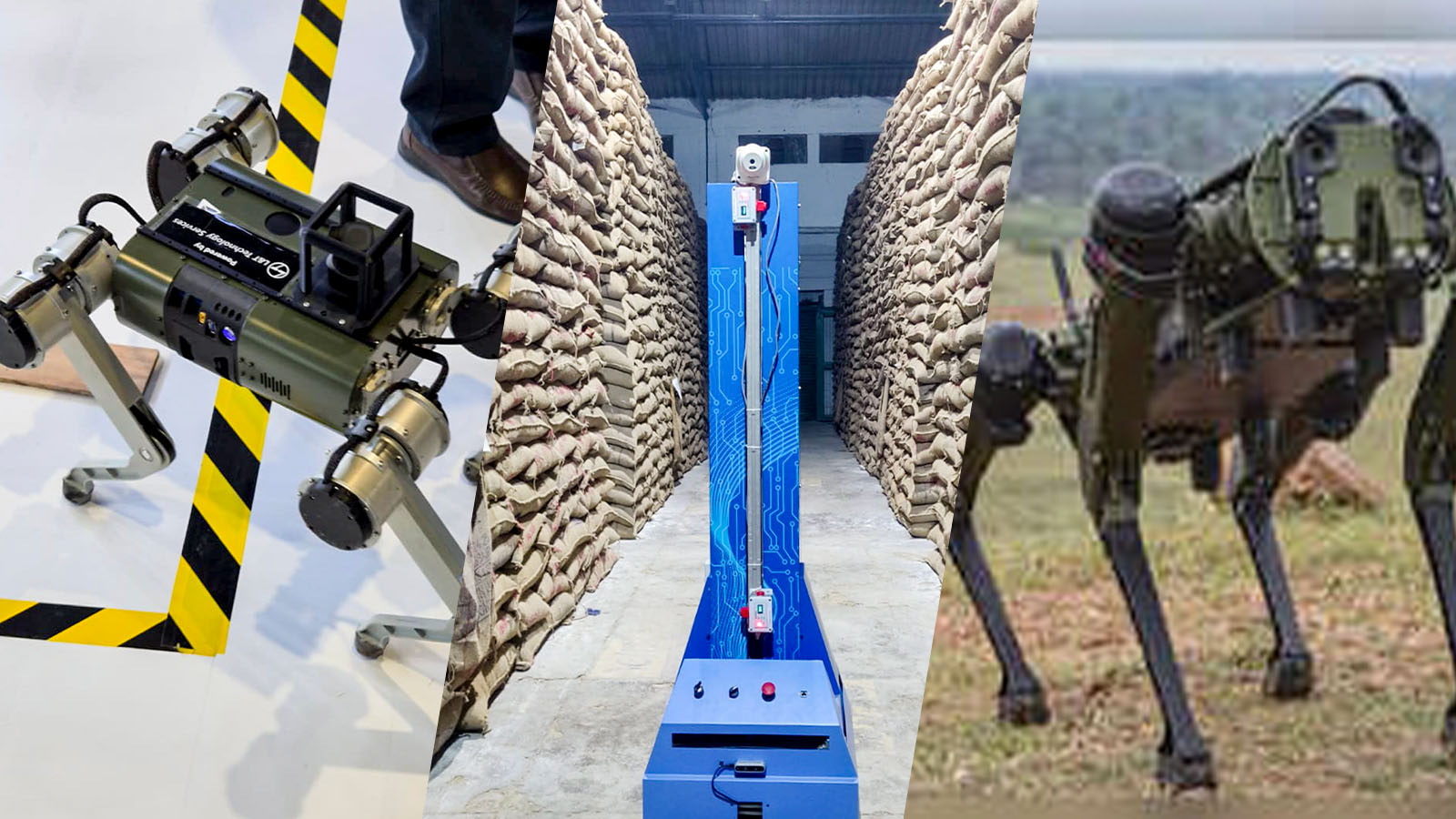

While the Galgotias controversy dominated the news generating bad press about indigenously manufactured robots, the India AI Impact Summit actually turned out to be a landmark moment for homegrown robotics. Several indigenous robots emerged as a major attraction at the summit in New Delhi despite an early row over an Indian university’s claim that a China-made robot dog was its own.
Private university Galgotias was widely criticised for trying to pass off a Chinese innovation as its own. The university was asked to vacate the event premises on Wednesday and remove its stall.
The AI Impact Summit was held from February 16-20 at the Bharat Mandapam, which saw the presence of several heads of state, many global artificial intelligence (AI) leaders, academicians and researchers, heads of global tech giants, and philanthropists.
Here are some of the robots that made a splash at the summit:
SVAN-M2
SVAN-M2, a robot dog developed by Kanpur-based startup xTerra Robotics, was a crowd puller. The co-founder of xTerra Robotics said the product took years of translational research by students and faculty of IIT Kanpur. SVAN-M2, which has an aluminium alloy body and legs, uses its light detection and ranging (LiDAR) device to create accurate 3D representations of its environment.
Also read: Galgotias’ robodog row: Blaming, philosophy, clarification, but no apology
It can be used for monitoring a hazardous area or at power stations for inspecting the facility with thermal imaging. In the security domain, the robot dog can play a key role in threat detection and save lives by 3D-mapping an area and relaying the images to a team away from the site. It’s designed for hazardous site inspections (like power stations) and security. Founded by Nimesh Khandelwal, Avinash Bhashkar, Amritanshu Manu, Aditya Rajawat and Shakti S Gupta in 2023, xTerra Robotics is on the IIT Kanpur campus.
The firm is planning to scale up production of SVAN-M2 and make the pricing more competitive, said co-founder Sakshi S Gupta. The start-up and L and T are working together to bring SVAN-M2 and other such robots to construction sites. “This scaling up would make the product extremely cost-competitive with the Chinese product. However, the current pricing of the product is at par with that from China in the same class,” she said.
Tower-Shaped Warehouse Bot (UN-WFP/India)
The United Nations World Food Programme’s (UNWFP) robot has also attracted considerable attention. Conceived and built in India, this eight-foot-tall, tower-shaped prototype is a pilot project designed for use in the warehouses of the Food Corporation of India and state-run godowns. Essentially, this robot monitors grain health and gas leakages (like phosphine) so humans don’t have to enter fumigated zones
It has a plug-and-play infrastructure, and depending on sensors, can simultaneously detect things such as temperature and leakage of gases, including phosphine, which can be fatal for humans if inhaled. The warehouses use phosphine as a fumigant to keep the pests away. “If this robot is in the warehouse, then no one has to go inside for inspection during the fumigation. Whatever is happening inside the godown…this is our eye for it,” said Amit Kumar of UN-WFP.
“We have just tested it in Narela (food storage depot). It needs a bit of optimisation, following which it will be piloted in a warehouse in around one to two months,” he said.
Yug Bot (Youngovator):
A 2-foot-tall, 3D-printed humanoid developed by school students in Madhya Pradesh.
Also read: Neo Sapien CEO on AI wearable innovation, summit chaos, and device theft
This 3D printed humanoid robot has been developed by students of Class 7 and 8 with support from startup, Youngovator. It was displayed at the Madhya Pradesh pavilion.
The two-foot-high Yug Bot has a skeletal structure made of plastic with a few wires running across the structure from top to bottom and left to right. Its head is cuboid, which has two small circles in the centre, with artificial eyes. “This is an out-and-out indigenous product,” said Karthik Pandey, head of technical operations at the Youngovator.
The startup, which supports children at various schools in their tech-related endeavours, plans to scale up the bot. Pandey said they are working with the Madhya Pradesh government and testing it for traffic and crowd management, given its hand-gesture functionalities.
Robotic Mule
Showcased by the Indian Armed Forces and developed by a Delhi-based startup Aeroarc at the summit.
These robots are also designed to operate in challenging environments, reducing risk to soldiers. These include perimeter security, asset protection, handling hazardous materials (CBRNE), bomb disposal, and intelligence gathering.
Reports said the Indian army has inducted 100 of these robots marking a new era of AI-powered military operations.

Comments are closed.