
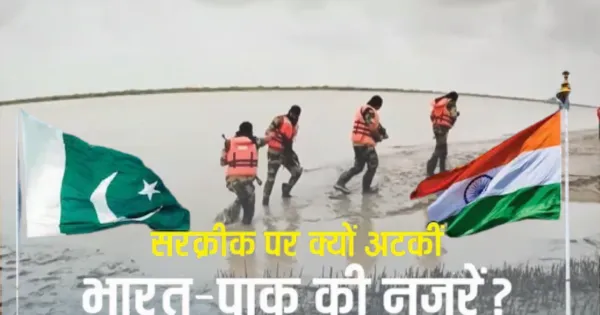
India-Pakistan Tension: The marshy land of Sir Creek again increased the tension, why did this disputed strip become a ‘gold mine’ for India-Pakistan?

India-Pakistan Tension: The Sir Creek dispute between India and Pakistan is again in the headlines. In recent months, Pakistan has stepped up its military presence in the region – adding additional troops, missile systems, drone capabilities and strengthened air defense networks. India’s Defense Minister Rajnath Singh, while addressing troops in Bhuj in October 2025, clearly warned that any action would “change both history and geography”.
Hearing this makes one wonder why a small marshy strip is creating so much tension? Let us understand why this 96 km long tidal estuary is so valuable for both the countries.
What is Sir Creek and where is it?
Sir Creek is a marshy, muddy area between the Rann of Kutch in Gujarat and the Sindh province of Pakistan, which opens into the Arabian Sea. At first glance it appears desolate, full of snakes, scorpions and swamps – no roads, no population, no significant infrastructure. But this seemingly ‘waste’ land is a game-changer for maritime boundaries.
Controversy that has been going on since the British era
The roots of the dispute go back to the British-era Sindh-Kutch Agreement of 1914.
– Pakistan claims: The border passes along the eastern bank of Sir Creek, making the entire creek part of Sindh (Pakistan).
– India claims: According to the thalweg principle of international law, the border should be through the middle of the main water stream. India refers to the 1925 map and the pillars placed in the middle.
In 1968 an international tribunal awarded large parts of Kutch (90% to India, 10% to Pakistan), but the issue of Sir Creek remained unresolved. Since then, despite dozens of rounds of talks, no solution has been found.
Real reason: Oil-gas, EEZ and economic maneuvers
This dispute is not just about land, but about maritime area and Exclusive Economic Zone (EEZ).
– If India’s proposal is accepted, India will get a large share in the Arabian Sea – where oil and gas reserves may be hidden.
If Pakistan’s talk is followed, India’s EEZ will be reduced and there will be economic loss.
This area is also rich in fish resources, which is important for both the countries.
Fishermen’s life and humanitarian crisis
Due to the border being unclear, Indian and Pakistani fishermen often venture into each other’s waters. outcome? Hundreds of fishermen are arrested, jailed, and their families wait for years. This is not just a border dispute but has also become a serious humanitarian problem.
The most delicate front of security
Focus on maritime security increased after the 2008 Mumbai attacks. There is always a threat of terrorist infiltration from Sir Creek – alerts are issued when empty boats, suspicious vessels are found. Recently, Pakistan’s increasing military activities (radar, missiles, drones) have made it more sensitive. India considers it very important strategically, because the route to Karachi can open from here.
To tell you briefly, Sir Creek is no ordinary swamp. It is a gateway to economic wealth, sea power and security. It is ‘sweet’ for both the countries because a lot is at stake if they lose. Tension is increasing, but there is hope that some way will be found through talks.

Comments are closed.