
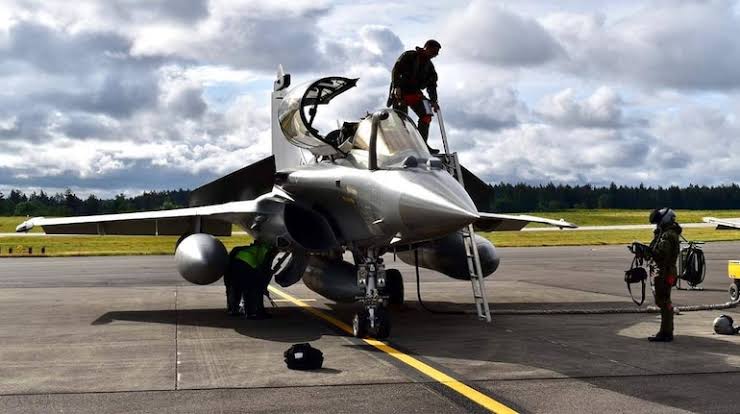

India has pressed France to ensure maximum localisation in the proposed procurement of 114 Rafale fighter jets, with a strong push for 50–60% indigenous content in aircraft to be manufactured in the country.
The issue was discussed during the 6th Annual Defence Dialogue co-chaired by Defence Minister Rajnath Singh and French counterpart Catherine Vautrin in Bengaluru.
Officials familiar with the discussions said India is focusing on local manufacturing, integration of indigenous weapons systems, and India-specific enhancements in the Rafale jets.
The fighter aircraft are manufactured by France’s Dassault Aviation.
10-Year Defence Pact Renewed
During the dialogue, India and France renewed their defence cooperation agreement for another 10 years. The two sides also signed agreements for:
Manufacturing French-origin missiles in India
Reciprocal deployment of army officers
Expanded defence research collaboration
The Defence Ministry stated that both countries emphasised closer industry partnerships, particularly in niche technologies and co-development of advanced military platforms.
The proposed Rafale deal follows the Acceptance of Necessity (AoN) cleared by India’s Defence Acquisition Council on February 12 for military hardware worth ₹3.6 lakh crore, including the 114 fighter jets.
Under the plan, 18 Rafales are expected to be delivered in fly-away condition, while 96 would be manufactured in India.
However, the deal remains in early stages, with tender issuance, technical evaluations, cost negotiations, and final approval by the Cabinet Committee on Security yet to follow.
Strengthening Indo-French Strategic Ties
The defence talks came days after Prime Minister Narendra Modi and French President Emmanuel Macron reaffirmed strategic cooperation.
India’s Defence Research and Development Organisation (DRDO) recently signed an agreement with France’s Directorate General of Armaments to expand collaboration in aeronautics, unmanned systems, artificial intelligence, cybersecurity, advanced materials, propulsion, space and underwater technologies.
An MoU was also signed between Bharat Electronics Limited (BEL) and Safran Electronics & Defense for manufacturing the Hammer (Highly Agile Modular Munition Extended Range) smart weapon in India.
The Hammer precision-guided munition is currently integrated with the Indian Air Force’s Rafale fleet.
H-125 Helicopter Assembly Line Inaugurated
Separately, Modi and Macron virtually inaugurated the H-125 helicopter final assembly line in Karnataka.
Airbus Helicopters has partnered with Tata Advanced Systems Limited to set up the production facility at Vemagal.
The H-125 programme involves an investment exceeding ₹1,000 crore and is expected to generate direct and indirect employment. The first helicopter from the Indian assembly line is projected to roll out in early 2027.
The 2.8-tonne H-125 can carry up to six passengers, reach a maximum altitude of 23,000 feet, has a range of 630 km, and a top speed of 250 kmph. It is suited for commercial transport, emergency medical services, disaster management, law enforcement, and firefighting operations.
Airbus projects demand for nearly 500 light helicopters of this class in India and South Asia over the next two decades.
Focus on Self-Reliance in Defence
India’s push for higher indigenous content aligns with its broader “Make in India” defence manufacturing strategy. Officials said deeper technology transfer and joint production could enhance India’s defence capabilities while strengthening regional security cooperation with France.
The negotiations on the Rafale deal are expected to continue in the coming months.

Comments are closed.