
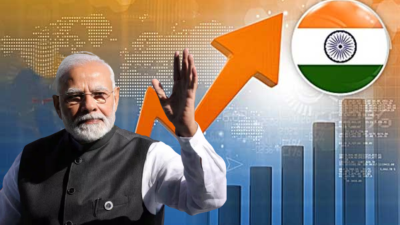
India world’s fourth largest economy: More than 7% growth in 2026, on track to overtake Germany

New Delhi: India, the world’s fourth largest economy, is on track to maintain a strong position in 2026 given favorable factors such as strong growth, low inflation and strong banking performance. Additionally, reform initiatives are also set to sustain the economic momentum seen through 2025.
Taking forward the themes of ease of living and ease of doing business, the Bharatiya Janata Party (BJP)-led central government is expected to announce new measures in the upcoming budget to encourage capital expenditure and private investment, making India a more attractive investment destination amid tariff and geopolitical uncertainties. The gross domestic product (GDP) growth rate, based on the base year 2011-12, has increased for consecutive quarters. It reached 8.2 percent in the second quarter of 2025-26 while retail inflation fell below the Reserve Bank of India’s lower limit of two percent by the end of the year.
A government statement said that India has overtaken Japan as the world’s fourth largest economy with a GDP of US $ 4180 billion. With an estimated GDP of 7300 billion dollars by 2030, it is on its way to overtake Germany to reach third place in the next two and a half to three years.
“The current macroeconomic situation reflects a rare strong period of high growth and low inflation,” it said. The government is also working on changing the base year for national accounts from 2011-12 to 2022-23, effectively addressing concerns raised by the International Monetary Fund (IMF) over the methodology for calculating gross domestic product (GDP).
On the domestic currency front, foreign portfolio investment outflows from stock markets kept the rupee under pressure, although rupee volatility eased in November compared to a month earlier. According to the economic assessment of the Reserve Bank of India (RBI), despite the challenging and uncertain environment at the global level, the Indian economy showed strong resilience in 2025 and the growth remained strong throughout the year.
This growth was mainly driven by strong domestic demand, especially rural consumption, moderation in inflation and an increase in fixed investment, which maintained the momentum. On the supply side, the services sector continued to expand steadily while the manufacturing sector bounced back after earlier lagging.
However, some signs of moderation also emerged towards the end of the year. The agricultural scenario has become supportive. Better kharif production and adequate food grain stocks helped control price pressures. The Reserve Bank of India raised GDP growth forecast for 2025-26 to 7.3 per cent from 6.8 per cent, reflecting broad momentum across key sectors. International agencies like World Bank, IMF, Moody’s, Organization for Economic Co-operation and Development (OECD), Fitch and S&P also confirmed this optimistic stance.
Experts believe that there may be some moderation in the growth rate but the economy will remain strong due to strong domestic fundamentals, favorable financial conditions and ongoing reforms. He said that external pressures arising from global trade uncertainties and their impact on exports can become a challenge.
However, early completion of the proposed India-US trade agreement may provide further boost to exports and the economy. Finance Minister Nirmala Sitharaman is widely expected to deepen reforms and announce additional measures to boost the economy in the Union Budget to be presented in February. Last time, he had announced measures to provide significant relief to taxpayers as well as promote domestic and foreign investment. Many global companies like Microsoft ($17.5 billion by 2030), Amazon ($35 billion in the next five years) and Google ($15 billion in the next five years) have announced big investments.
Apart from this, iPhone maker Apple, South Korean electronics company Samsung and ArcelorMittal Nippon Steel India have also announced major expansion plans. Experts say that the free trade agreements signed by India are also expected to help in the expansion of the economy. The proposed India-US trade agreement (which is likely to be implemented soon) will prove to be a catalyst for exports and industry, especially micro, small and medium enterprises (MSMEs). The government cut GST rates at the end of 2025 and implemented new labor codes. Bank of Baroda Chief Economist Madan Sabnavis said that despite being under the shadow of tariffs for most of the year, the Indian economy has shown remarkable strength in 2025.
“This was possible because of the extremely strong domestic economy,” he said. “Interestingly, exports also held up, indicating that exporters have interacted to some extent with US customers and diversified markets.”
He said the government will maintain its capital expenditure targets which will further support overall investment. There is less uncertainty expected in the year as the tariff related issue will be resolved through some agreement and the rupee may also see more stability.
On the outlook, Aditi Nair, chief economist at rating agency ICRA, said the growth rate is expected to remain around 6.5 to 7 per cent in the next few quarters, which will get policy support in the form of income tax and GST cuts and 125 basis points cut in policy rates.
CRISIL Chief Economist Dharamkirti Joshi also said the Indian economy outperformed expectations in 2025 with growth exceeding estimates and inflation remaining lower than expected. However, he said, the sentiment of foreign investors was affected due to heavy US tariffs. This resulted in challenges regarding capital flows and weakening of the currency. “We estimate GDP growth at 6.7 per cent and inflation (driven primarily by base effects) at five per cent in FY 2026-27,” Joshi said. “We believe weak capital flows and currency depreciation are temporary phenomena.”

Comments are closed.