
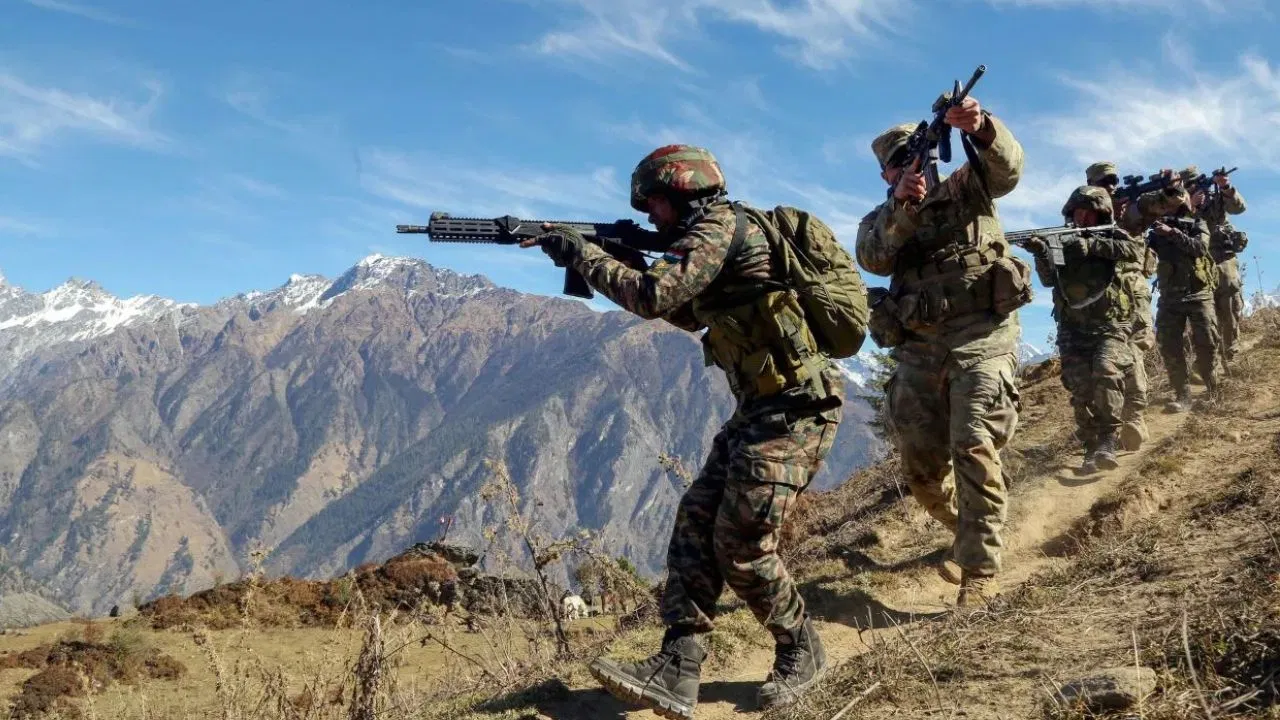

New Delhi: The Indian Army marked 2025 as a year of major operational, technological and organisational transformation, achieving milestones across combat operations, long-range firepower, aviation inductions, force restructuring, digitisation, military diplomacy and indigenisation. From a cross-border counter-terror operation following the Pahalgam attack to the induction of new weapon systems, unmanned platforms and innovative battlefield structures.
1. Operational employment and deterrence: Operation Sindoor (May 2025)
Operation SINDOOR was launched in May 2025 following the Pahalgam attack by Pakistan Army-backed terrorists. Entire operational planning was carried out at the Military Operations Branch of the Indian Army, while execution was monitored from the Operations Room of the Directorate General of Military Operations, with the Chief of Defence Staff and all three Service Chiefs present.
During the operation, nine terrorist camps across the border were destroyed. Seven camps were neutralised by the Indian Army, while the remaining two were destroyed by the Indian Air Force. The strikes were precise, calibrated and time-bound, reinforcing deterrence while maintaining escalation control.
Pakistan attempted retaliation through drone attacks on the nights of 7, 8, 9 and 10 May 2025, targeting military and civilian assets. Indian Army Air Defence units successfully neutralised all threats, preventing damage and casualties and demonstrating the effectiveness of integrated counter-UAS and layered air defence systems.
Along the Line of Control, more than a dozen terror launch pads were destroyed using Indian Army ground-based weapons, disrupting infiltration routes and terror logistics networks. On 10 May 2025, the Director General of Military Operations of the Indian Army was approached by his Pakistani counterpart seeking a ceasefire, following which an understanding was reached to stop firing and military action.
2. Long-range firepower and precision strike
A BrahMos missile unit of the Southern Command, with elements of the Andaman & Nicobar Command, executed a combat missile launch on 1 December 2025, validating high-speed flight stability and terminal accuracy under simulated battle conditions and reinforcing long-range precision strike readiness. Extended-range BrahMos development and testing also featured in open reporting through 2025 as India pushed for longer reach and faster sensor-to-shooter cycles.
On the rocket artillery front, two additional Most regiments were operationalised on 24 June 2025, strengthening stand-off firepower with an emphasis on rapid concentration of fires. On 29 December 2025, the Most Long Range Guided Rocket (LRGR), with a reported range of around 120 km, was successfully tested, marking a step towards higher-precision deep fires. Indigenous rocket evolution accelerated through the year, including reported work towards approximately 300 km-class Most variants for future deep-strike options.
3. Aviation and high-value inductions
The Indian Army received the first three AH-64E Apache attack helicopters for the Army Aviation Corps on 22 July 2025, with the remaining three delivered in December 2025. The induction progressed the long-pending plan to enhance Army Aviation’s attack helicopter capability.
4. New organisations and battlefield structures
A capability demonstration held in Rajasthan on 24 October 2025 showcased the integrated employment of newly raised organisations such as the Bhairav Battalion and Ashni Platoon, alongside recently inducted technological assets. The event signalled visible movement from conceptual planning to fielded capability.
Open reporting during October 2025 described plans to operationalise 25 Bhairav light commando battalions on an accelerated timeline, along with the raising of Ashni drone platoons across infantry units for intelligence, surveillance, reconnaissance and precision effects. New formations such as Shaktibaan Regiments and Divyastra Batteries were also structured to meet future challenges, equipped with unmanned aerial vehicles including loiter munitions.
5. Procurements and capability building
The Indian Army observed 2024 and 2025 as the Years of Tech Absorption, aimed at moving from technology adoption to integration and embedding new technologies into operational structures.
In 2025, six Apache attack helicopters were inducted, enhancing the Army’s combat aviation capability. The Army also achieved 91 per cent indigenisation of ammunition, with the majority of ammunition in use now domestically produced.
A wide range of unmanned aerial systems was inducted over the past year, including around 3,000 remotely piloted aircraft, about 150 tethered drones, swarm drones, logistics drones for high-altitude areas and kamikaze drones.
On 5 August 2025, the Defence Acquisition Council accorded Acceptance of Necessity for thermal imager-based driver night sights for BMP infantry combat vehicles, improving night mobility and mechanised operational tempo. The DAC also cleared MALE remotely piloted aircraft for tri-service surveillance and strike roles. On 29 December 2025, DAC approvals visibly tilted towards unmanned systems, counter-UAS and precision fires, reflecting lessons from modern conflicts and recent operational experience.
6. Technology enablement and digital transformation
The year provided momentum to technology absorption in the Indian Army, with a focus on inducting niche technologies, making structural changes to absorb them and preparing for future wars. Edge Data Centres were established to enable faster data-to-decision cycles closer to the tactical edge.
A large number of in-house software solutions were developed, including applications such as Equipment Helpline and Sainik traveler Mitra, reflecting a focus on responsive support systems and streamlined soldier-facing services.
7. Doctrine, readiness and senior-level reviews
The Army Commanders’ Conference held in Jaisalmer in October 2025 saw senior leadership deliberations on grey-zone warfare, the roadmap for jointness, and Atmanirbharta and innovation. The discussions aligned doctrine and force design with the evolving threat spectrum.
8. Military diplomacy and joint exercises
In 2025, the Indian Army conducted and hosted multiple bilateral exercises to deepen interoperability, counter-terrorism and urban operations readiness, and regional partnerships. These included Exercise SHAKTI with France (18 June–1 July), YUDH ABHYAS with the United States in Alaska (1–14 September), MAITREE-XIV with Thailand in Meghalaya (1–14 September), AUSTRAHIND with Australia in Perth (13–26 October), MITRA SHAKTI XI with Sri Lanka in Belagavi (10–23 November), AJEYA WARRIOR-25 with the United Kingdom in Rajasthan (17–30 November), and DESERT CYCLONE-II with the UAE in Abu Dhabi (18–30 December).
9. Defence dialogues and strategic thought leadership
The Chanakya Defence Dialogue 2025 was positioned as the Indian Army’s flagship strategic seminar series. Key milestones included the Young Leaders Forum on 31 October, a curtain raiser on 17 November featuring a podcast by General Upendra Dwivedi on major military issues, and the main dialogue held in late November, anchored to the theme of reform-to-transform for a secure and developed India.
10. Innovation and indigenisation: Inno-Yoddha
The Inno-Yoddha 2025–26 edition, conducted between November and December 2025, saw a record 89 innovations submitted, of which 32 were selected for further development and fielding pathways. The initiative reinforced bottom-up innovation and Atmanirbhar atmanirbhar capability creation within the Indian Army.

Comments are closed.