


The government has shared a concrete rollout plan for E100 fuel infrastructure with automobile and oil marketing companies for the first time, targeting 150 retail outlets in Delhi, Mumbai, Pune and Nagpur within the next month.
The plan, outlined by the Ministry of Petroleum and Natural Gas, then scales to 500 outlets across Delhi-NCR, Maharashtra, Bengaluru, Chennai, Kolkata and Hyderabad within 6 to 12 months. The medium-term target is 5,000 E100 dispensing stations nationally within 24 months.
E100 means pure ethanol, with no petrol mixed in. Flex-fuel vehicles, or FFVs, are cars and two-wheelers engineered to run on any blend from standard E20 petrol all the way up to E100.
The engine management system in an FFV detects the ethanol content in the fuel and adjusts ignition timing and fuel delivery accordingly. This is not a minor calibration change from a regular petrol car but a substantive engineering adaptation.

Every major four-wheeler and two-wheeler manufacturer in the market, including Maruti Suzuki, Hyundai, Tata Motors, Mahindra, Hero MotoCorp and TVS Motor Company, has already developed FFV prototypes.
None of them has launched these vehicles commercially. The reason is twofold: there have been almost no E100 pumps to fill them at, and the pricing of E100 relative to regular petrol has remained unclear.
Indian Oil Corporation ran a pilot with close to 400 E100 outlets, but uptake was negligible. The company has since scaled back sharply. The problem was structural: with almost no FFVs on the road and E100 delivering lower fuel efficiency per litre than petrol, there was no meaningful demand. This is a classic chicken-and-egg situation where neither side of the equation, vehicles or fuel, has moved first.
The new government-led roadmap is an attempt to break that deadlock by building the fuel infrastructure ahead of the vehicle rollout, giving carmakers a reason to launch FFVs knowing that buyers will have somewhere to fill them.
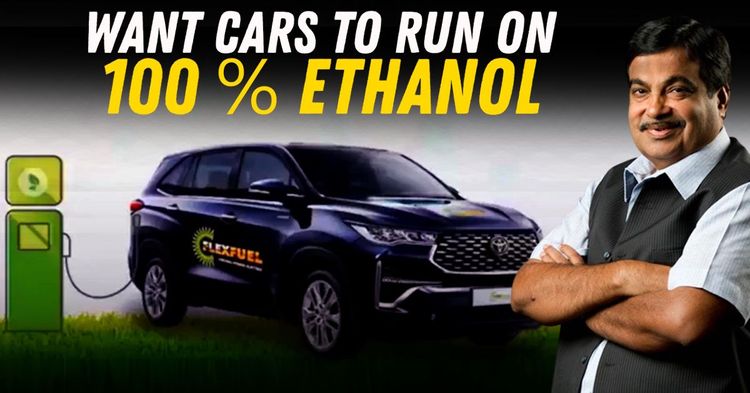
Ethanol contains less energy per litre than petrol. A car running on E100 will travel fewer kilometres per litre than the same car running on E20, typically around 25 to 30 percent fewer. For E100 to be attractive to buyers, it needs to be priced proportionally lower than petrol to deliver a comparable per-kilometre running cost.
The industry body SIAM has recommended that E100 be priced at least 30 percent below normal petrol. Without that discount, a buyer choosing an FFV pays more upfront for a car with specialised engineering and then gets no cost benefit at the pump. The government has not yet confirmed a pricing framework for E100, and this remains the central unresolved question in the entire flex-fuel programme.
India’s crude oil import bill for FY26 was Rs 10.9 lakh crore. Domestically produced ethanol, which comes almost entirely from sugarcane and surplus foodgrain, can directly substitute imported petrol on a volume basis. Every litre of E100 sold replaces a litre of imported petrol. The 5,000-station target over 24 months is calibrated with this import substitution goal in mind, not just the transport transition agenda.
For car and two-wheeler buyers, the near-term question is whether to consider an FFV when it eventually appears in showrooms. The engineering capability exists across manufacturers. The commercial launches will follow once the fuel network reaches a scale where buyers can be confident about filling up on a regular route, and once pricing is set in a way that makes the running cost equation work in the FFV’s favour
Comments are closed.