


Indian IT’s AI Revamp
Once seen as a shortcut, AI is now emerging as a performance metric. From mandatory weekly quotas to AI-driven performance reviews, Indian SaaS startups and enterprises are now institutionalising automation. So, how deeply are these firms using AI internally?
The Internal Mandate: Indian tech giants and SaaS startups are no longer just selling AI, they are becoming its most intensive users. For instance, Zoho is leveraging its Zia framework to test products internally before customer rollout, while Whatfix uses Claude-based systems to monitor customer analytics. Then, there is Amagi, which leverages the technology to track AI-generated code in its repositories.
AI As Talent Officer: Beyond productivity, IT services and SaaS players are also measuring how effectively their teams use the technology for coding, analytics, documentation and support. By embedding these metrics into performance reviews, Indian firms are quantifying AI adoption with surgical precision, transforming the technology into a core requirement for career growth and salary hikes.
Quality Gap: While AI accelerates output, it has also introduced a hidden cost known as the verification tax. Indian developers feel that the time saved by generating code or content is increasingly consumed by the gruelling process of auditing for hallucinations. As firms push for higher AI quotas, teams often find themselves trapped in a loop of fixing answers from AI bots, raising concerns that speed is being prioritised over genuine innovation.
Talent Reboot: The shift toward AI has triggered a surge in job insecurity as companies prioritise AI skills. While companies internally are countering this by offering AI certifications and peer-led playbooks, the pressure to evolve remains a significant psychological burden for many employees.
Despite the productivity rhetoric, a majority of the enterprises still spend less than 20% of their IT budgets on the emerging technology. So, are AI-led outcomes fostering a genuine workflow transformation or just mere vanity numbers? Let’s find out…
From The Editor’s Desk
Arrest In GainBitcoin Scam
- The CBI has arrested crypto startup Darwin Labs’ cofounder and CTO Ayush Varshney in connection with the crypto fraud case. The company’s other two cofounders – Nikunj Jain and Sahil Baghla – were arrested back in 2018.
- The enforcement agency alleged that the arrest was made as Varshney and his company helped develop key tech infrastructure used in the scam, including the MCAP token, wallet, mining pool platform and a Bitcoin payment gateway.
- The GainBitcoin scam was an alleged Ponzi scheme, where investors invested in a crypto token on the promise of high returns. These funds were subsequently misappropriated.
SEDEMAC’s Stellar D-Street Debut
- Shares of the deeptech company listed at ₹1,535 per share on the NSE, a premium of 13.5% to its issue price of ₹1,352. On the BSE, the stock listed at ₹1,510, a premium of 11.7%.
- With this, SEDEMAC has become the fifth Indian startup to go public in the first three months of 2026. The public issue comprised solely of an OFS component of 80.43 Lakh shares, helping early investors net a cumulative ₹1,087 Cr from the issue.
- Founded in 2007, SEDEMAC designs and manufactures electronic control systems for mobility and industrial applications. The company reported a net profit of ₹71.4 Cr in 9M FY26 against an operating revenue of ₹770.66 Cr.
CARS24’s Latest Acquisition
- The used-car marketplace has acquired Vehicle Info to build a full-stack vehicle ownership platform. The automotive utility startup allows users to access key vehicle details such as insurance validity, traffic challans, and FASTag balance in one place.
- This is Cars24’s third acquisition in the past year. It acquired automotive community platform Team-BHP in April 2025, followed by vehicle information and management platform CarInfo in January this year.
- The development comes as the company aims to go public by next year. Ahead of its IPO, it has been shutting or scaling down non-core verticals and laying off employees to improve its bottom line.
Mozark Nets $40 Mn
- The enterprise tech startup has raised around ₹370 Cr in its Series B round led by IFC and RMB Capitalworks to strengthen its AI stack, expand its footprint in the US and fuel strategic acquisitions.
- Founded in 2019, Mozark enables enterprises to test and monitor how well their digital services perform in real-world conditions. Its monitoring tools can identify performance gaps and pain points across data centers, networks and power infrastructure.
- With presence in 20 countries and 50+ clients, Mozark is eyeing a piece of the global AI-enabled digital testing industry, projected to become a $832.41 Bn opportunity by 2035.
CRED Gets PA Licence
- The fintech unicorn has received the final payment aggregator (PA) licence from the RBI. The licence will allow CRED to onboard merchants, collect payments on their behalf across instruments, and handle settlement and refunds.
- The nod comes two years after CRED first secured the in-principle approval from the central bank for its PA licence in 2024. With this, CRED now holds multiple regulatory licenses across payments, lending, insurance, and investments.
- Launched in 2017, CRED initially offered a credit card bill payments platform but has since become a super app. However, it continues to be in the red, clocking a loss of ₹1,644 Cr in FY24 against a top line of ₹2,397 Cr.
Inc42 Markets
Inc42 Startup Spotlight
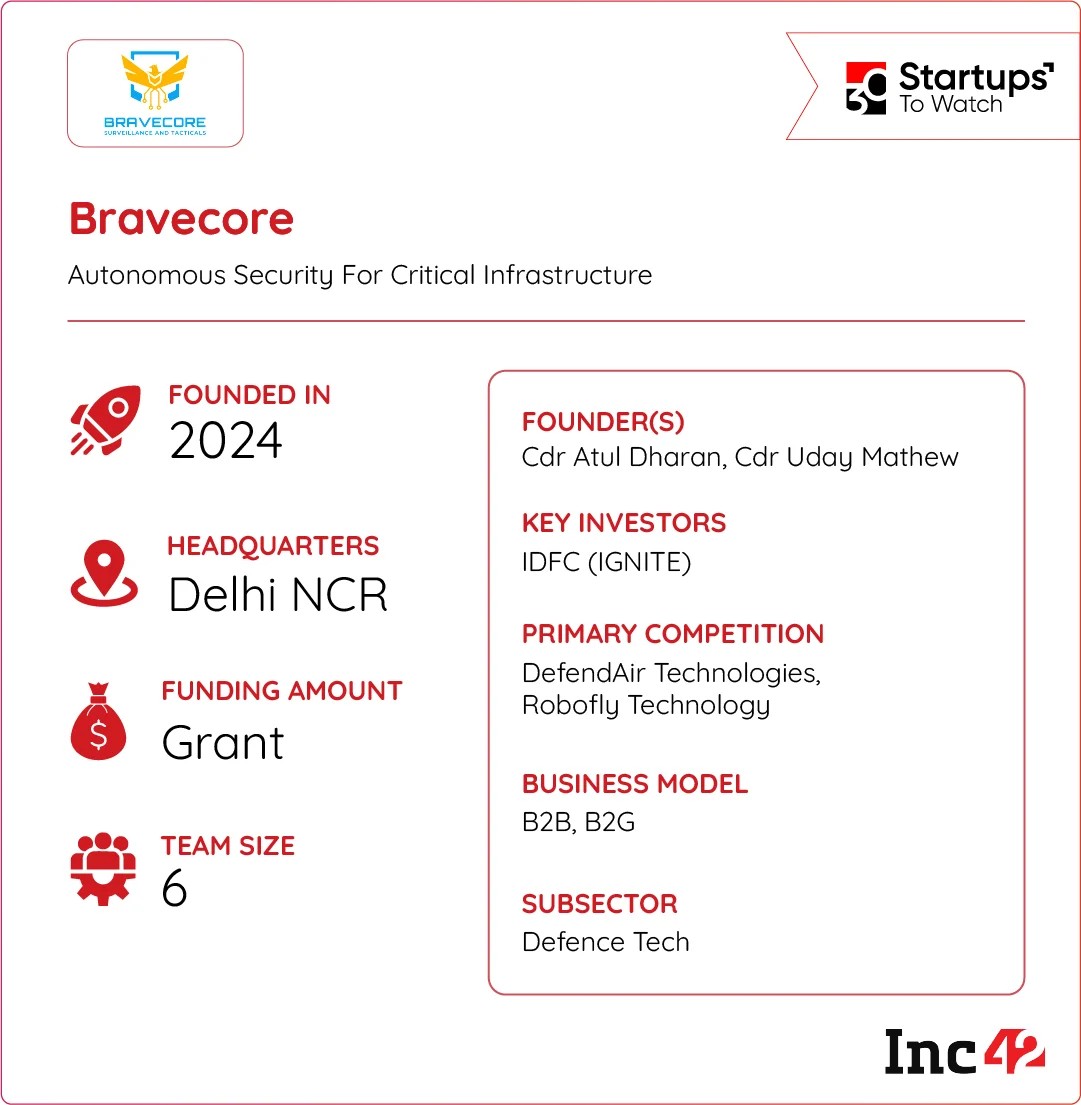
How Bravecore Is Reimagining India’s Surveillance Grid
India’s quest for self-reliance in defence and national security is marred by a lack of indigenous surveillance systems, which are capable of operating in complex terrains and high-risk zones. To solve this, Bravecore is building solutions that can respond faster than traditional surveillance grids.
Building Desi Intelligence: Founded in 2024, Bravecore designs autonomous drones and robotic platforms for military and critical infrastructure use. Its high-speed aerial systems are equipped with electro-optical and infrared payloads, enabling operations in low-visibility, high-risk zones.
Built for reconnaissance and intelligence gathering, these drones can also assist in missions that typically expose personnel to danger.
Managing Urban Security: Beyond battlefields, Bravecore is also developing rail-mounted robotic surveillance systems for metros, airports and transit hubs. These units autonomously patrol platforms, detect unattended baggage and monitor crowds by combining AI vision with predictive analytics to flag potential threats before escalation.
Riding The Market Surge: Buoyed by the momentum post-Operation Sindoor, Bravecore is positioning itself as a key indigenous technology enabler for defence and law enforcement. It is eyeing a piece of the homegrown UAV and autonomous systems market, which is projected to become a $1.8 Bn opportunity by 2030. So, can Bravecore’s blend of robotics and AI redefine how India safeguards its most critical frontiers?
Infographic Of The Day
India’s protein market is undergoing a clean-label shift as consumers become more health-conscious and demand for products with minimal additives rises rapidly. Here is what is spurring the rise of clean-label protein brands in the country…


Comments are closed.