
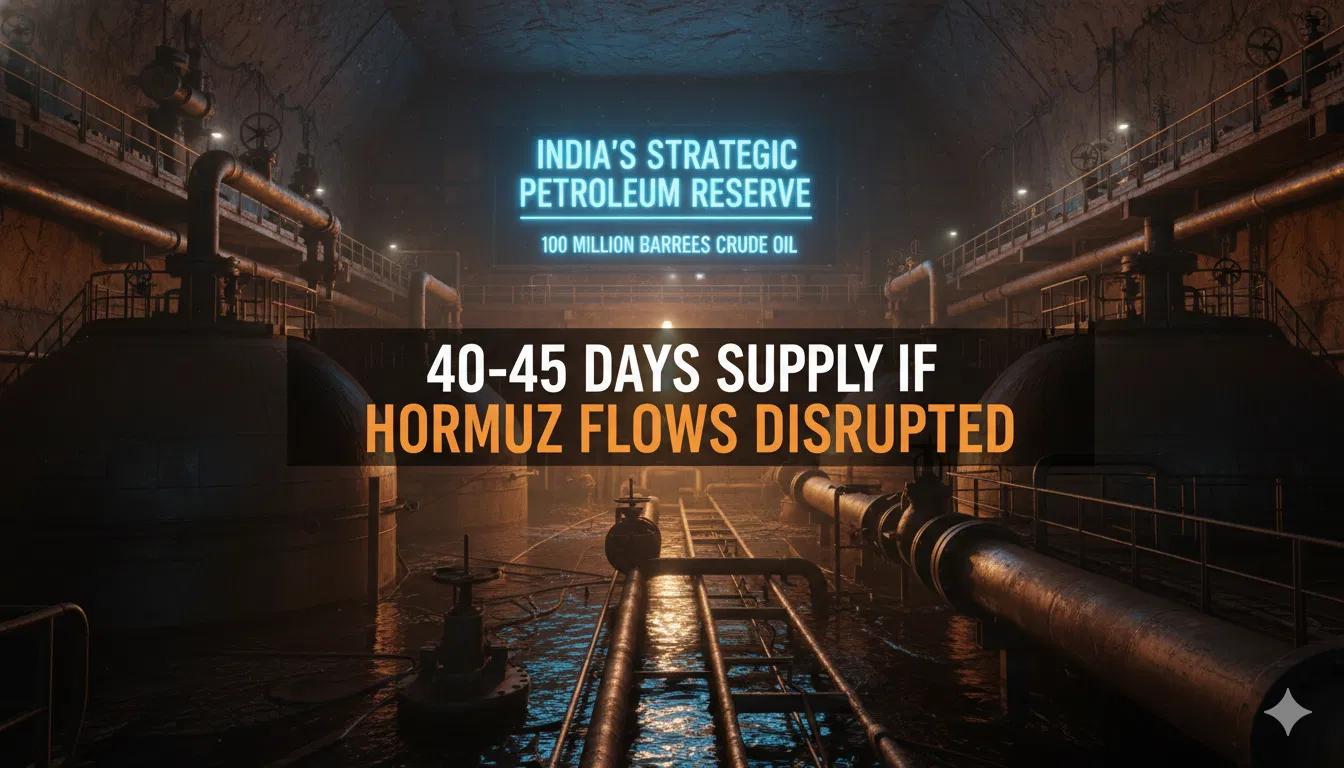

New Delhi: As US-Israel and Iran military conflict rages, one question which is of a major concern is how much crude oil reserves does India has to withstand the crisis emanating out of the Middle East crisis. India, the third largest importer of crude oil, has about 100 million barrels of commercial crude oil stocks – which included the reserves in in storage tanks, underground strategic reserves and on ships en route to the country.
At present, India’s total oil reserve could cover roughly 40-45 days of country’s if flows through the Strait of Hormuz are disrupted, Kpler reported.
India’s Crude Oil Reserves
India’s fuel needs are dependent upon the exports. The country imports about 88 per cent of the crude oil for its needs. It is heavily dependent on the Middle Eastern countries as more than 50 per cent it is supplied by the countries in this regions and the shipments take the Strait of Hormuz route. Notably, the sea strip has been disrupted amid the Iran crisis.
Sumit Ritolia, Lead Research Analyst, Refining & Modeling at Kpler, said if Middle Eastern crude are halted completely for a temporary period and the Strait of Hormuz remains closed for longer, it will have a big impact on the logistics and also supply risks would intensify
“However, refiners typically maintain commercial inventories, and cargoes already on water would continue to arrive, providing some short-term cushioning to the system,” Ritolia was quoted by PTI as saying. The expert further stated that if the disruption continues for a longer duration, it would lead higher import costs, freight exposure and the need to reroute supplies over longer distances.
“The country maintains strategic petroleum reserves alongside commercial inventories held by refiners and oil marketing companies. These buffers are intended to manage temporary supply shocks rather than sustained outages,” he said.
“Based on Kpler inventory data, commercial crude stocks are around 100 million barrels, including volumes in the strategic petroleum reserve (SPR) facilities at Mangalore, Padur and Visakhapatnam.”
Strait of Hormuz & India’s Oil Supply Risks
Around 2.5 million barrels of Crude oil passes through the Strait of Hormuz, about half of India’s just over 5 million bpd total crude imports, Ritolia said, adding these combined reserves could theoretically cover around 40-45 days of imports in a crude disruption scenario.
However, a prolonged conflict between US-Israel and Iran would mean higher oil prices. Brent, global benchmark, crossed USD 80 per barrel, roughly 10 per cent more since the Iran crisis.
The Crude oil supply has been hit after United States and Israel launched military strikes in Iran, with Tehran retaliating with missiles and drones aimed at Israel and countries hosting US forces, including Jordan and Saudi Arabia, Qatar, Kuwait, Bahrain, Iraq, and the United Arab Emirates.
Notably, Qatar supplies liquefied natural gas (LNG) supplier through the strait to India. Indi has the options to import crude oil and gas from West Africa, Latin Amercia and the US.
It may be noted that India, which purchased Russian crude oil in large quantities since 2022, had agreed to cut down purchases of Russian oil as part of a trade deal with the US.
“Russian cargoes currently floating in the Arabian Sea and wider Asian region without firm buyers could also be absorbed relatively quickly if required,” Ritolia said.
“In a more severe scenario, policy intervention would likely become a key stabilising tool. The government could prioritise domestic energy security by asking refiners to moderate or temporarily curb refined product exports to ensure adequate domestic supply,” he said.

Comments are closed.