

Rohit Kumar
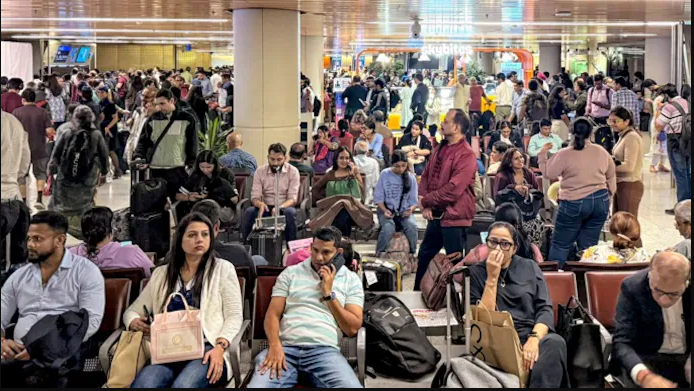
NEW DELHI, Dec 4: As passengers continued to face harassment at various airports across the county due to cancellation or abysmal delay in flight schedules, particularly of the services operated by IndiGo, lack of planning, mismanagement and “hiring freeze” policy adopted by the country’s largest airlines in the domestic sector has been blamed for the current chaotic situation.
Over 300 IndiGo flights were canceled on Thursday as chaos continued at major airports across India, with the carrier struggling to adapt to stringent new crew rostering rules. On Wednesday, the airline canceled over 200 flights and announced that it had initiated “calibrated adjustments” to its schedules for the next 48 hours.
The Federation of Indian Pilots has flagged that IndiGo inexplicably enforced a “hiring freeze” despite being aware of the impact of the new DGCA rules. “All other airlines have provisioned pilots adequately and remain largely unaffected due to timely planning and preparation. The current disruption is the direct consequence of IndiGo’s prolonged and unorthodox lean manpower strategy across departments, particularly in-flight operations,” the federation wrote in its letter to DGCA.
The pilots’ body said “despite the two-year preparatory window before full Flight Duty Time Limitations (FDTL) implementation, the airline inexplicably adopted a hiring freeze, entered non-poaching arrangements, maintained a pilot pay freeze through cartel-like behavior, and demonstrated other short-sighted planning practices.” It urged the DGCA to approve seasonal flight schedules only after airlines prove they have adequate pilot strength under the new FDTL norms.
The on-time performance (OTP) of IndiGo dropped to 19.7% on Wednesday from 35% a day earlier, according to civil aviation ministry data. An official said by evening 33 flights were canceled from Delhi, 68 from Hyderabad, 85 from Mumbai, and 73 from Bengaluru on Thursday and many more cancellations are in the pipeline. On Wednesday, at least 67 flights were canceled at Delhi airport (37 departures and 30 arrivals), 42 at Bengaluru, 40 at Hyderabad (19 departures and 21 arrivals), and 33 at Mumbai (17 departures and 16 arrivals).
In a statement on Wednesday, IndiGo said calibrated adjustments will remain in place for the next 48 hours and will normalize operations and progressively recover punctuality across the network. “Our teams are working around the clock to ease customer discomfort and ensure operations stabilize as quickly as possible.” The airline said the affected customers are being offered alternate travel arrangements to reach their destinations or refunds, as applicable. The airline did not issue an update on its flight operations on Thursday.
An emergency Airbus A320 software patch rushed through over the weekend of November 29–30 disrupted crew scheduling just as the airline was operating with minimal slack due to the FDTL rules.
The Directorate General of Civil Aviation (DGCA) data showed the airline had been under strain, having canceled 1,232 flights in November—755 of them attributed to FDTL issues—with OTP dropping to 67.70% from 84.1% in October.
IndiGo’s baggage systems at Delhi’s Terminal 1 and Terminal 3 encountered problems on Wednesday, compounding the aviation chaos. Flights were scrapped as passengers turned up to check in. Many said they missed onward connections.
New FDTL norms were implemented in two phases on July 1 and November 1. The rules have been designed to combat fatigue and boost rest periods. They mandated an increase of weekly rest periods to 48 hours, extension of night hours, and limited the number of night landings to two, down from six earlier.
The DGCA said on Wednesday it was investigating the situation and had summoned IndiGo to its headquarters “to present the facts leading to the current situation along with plans to mitigate the ongoing delays and cancellations”.
The airline operates around 2,200-2,300 flights daily to over 90 domestic and 45 international destinations. As of December 2, IndiGo had a total of 416 aircraft in its fleet, with 366 in operations and 50 on ground, up from 47 the previous month, according to aircraft fleet tracking website Planespotter.net.
The Airline Pilots Association of India, which represents over 800 pilots, on Wednesday criticized what it called “a failure of proactive resource planning” by dominant airlines. IndiGo’s OTP of just 35% on Tuesday was the lowest among Indian carriers and a steep fall from its typical 80%-plus performance at major airports.
IndiGo has blamed “a multitude of unforeseen operational challenges” for the situation. These include minor technology glitches, schedule changes linked to the winter season, adverse weather conditions, increased congestion in the aviation system and the implementation of updated crew rostering rules (Flight Duty Time Limitations).
While most of these factors are not so rare phenomena, the last is the big one. In January 2024, the DGCA, the national aviation regulator, made sweeping changes to regulations for passenger aircraft. The new rules focused on providing pilots and crew with adequate rest to enhance passenger safety.
Key highlights of these new rules are: extended weekly rest periods for flight crew, a changed definition of night, extending it by an hour, and a cap on maximum flight duty periods and the number of night landings. For example, night shifts for pilots and crew were reduced to just twice in a roster period, as compared to six earlier. As the new regulations kicked in, a lot of crew members could no longer be on duty as per the airlines’ earlier schedules. This led to roster chaos and cancellations, and delays.
While the new regulations were applicable to all the airlines, the main reason why IndiGo was hit the hardest was the sheer size of its operations. Considering that IndiGo operates about 2,200 domestic and international flights daily, it is about twice the number of flights Air India operates in a day. With such a massive scale, even 10-20 per cent of delayed or canceled flights effectively means 200-400 flights and an ordeal for thousands of passengers.
Another key factor is that IndiGo positions itself as a low-cost airline and has traditionally relied on high-frequency overnight operations, maximizing flight hours and minimizing downtime. All of these are at odds with the DGCA’s new regulations, leading to the chaos.
The Airline Pilots’ Association of India also said airlines got nearly a two-year window to implement DGCA’s new regulations. “Despite sufficient time being agreed, most airlines started preparing rather late, failing to properly adjust crew rosters, 15 days in advance as required. This suggests an initial managerial underestimation or delay in the strategic planning necessary to provision crew accordingly. While the new norms mandate increased rest periods and other restrictions to combat pilot fatigue, this does not necessarily increase the total number of pilots needed to maintain a schedule,” it said.
The Federation of Indian Pilots in its letter to the DGCA pointed out that “the current disruption is the direct consequence of IndiGo’s prolonged and unorthodox lean manpower strategy across departments, particularly in-flight operations and inexplicably followed a “hiring freeze” policy despite being aware of the impact of the new DGCA rules.
Airline Pilots’ Association of India mentioned another possibility. “Aviation experts have suggested that the resulting delays and cancellations across airlines could be an “immature pressure tactic” to arm-twist the regulator for further relaxations or dispensations in the new FDTL norms, thereby compromising the original, stricter safety intent,” it said, warning that granting unwarranted exemptions to FDTL would compromise passenger and crew safety, as the entire purpose of the new norms is to reduce pilot fatigue. “Any relaxation granted should be based on scientific assessment and adequate risk mitigation,” it said.

Comments are closed.