
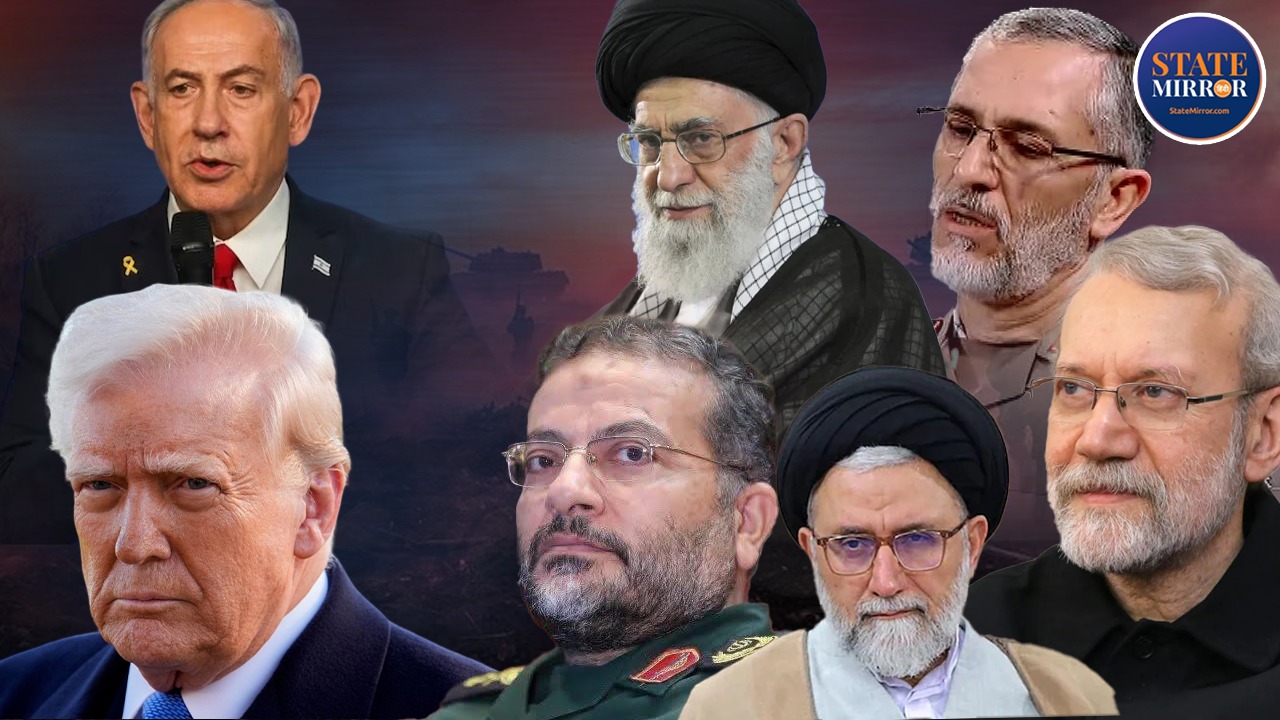

The war between Iran, America and Israel started on 28 February. Today is the 19th day of this war. This war in the Middle East has more or less engulfed the entire world. About a dozen countries in the Middle East have been badly affected by the consequences of the war. In this war, under a special strategy, Israel and America have targeted the top leadership of Iran. HT media, quoting a list related to ‘Operation Roaring Lion’ on the website of Israel Defense Forces, has said that from 28 February to 18 March 2026, 25 top leaders including Iran’s Supreme Leader Ayatollah Khamenei have been killed. But Iran is not retreating, so the fight is going on, that is, the more you kill, the more will stand.
After that, on March 8, five top leaders of Iran were killed. After that, one claim was made on March 12, two on March 17 and one on March 18 to eliminate Iran’s top leadership. According to the report, till now 25 top leaders of Iran have been assassinated by Israel. Come, let us know about these 10 top Iranian leaders and what role they played in political, administrative, country’s defense and other matters.
1. Ayatollah Ali Khamenei
Ayatollah Ali Khamenei was the supreme leader of Iran. He exercised ultimate control over the political, military and religious entity of Iran. Holding this post since 1989, he took a tough stance on Iran’s foreign policy, especially against the US and Israel. He had direct control over the army, Revolutionary Guard (IRGC) and the judiciary. He played a decisive role in Iran’s nuclear policy and regional strategy. Khamenei was considered not just a religious leader but the center of the entire power structure of Iran. Israel destroyed Iran on the very first day of its attack. This has affected not only Iran but the stability of the entire Middle East.
2. Mohammad Shirazi
Mohammad Shirazi was the head of Khamenei’s military bureau. Before he was killed in the Israeli attack, he was counted among the prominent religious leaders of Iran. His Shia community and religious institutions were strong. He was recognized as a religious leader who was in favor of political Islam and strengthening religious leadership. The religious leadership in Iran wields not only spiritual but also political power, so Shirazi’s role was that of an important strategist. His influence extended to many religious organizations and student networks, allowing his voice to reach the policy level.
3. Jalali Pour Hossein
Jalali Pour Hussein was the head of the Espionage Directorate in the Iranian Intelligence Ministry. It is believed to be connected to the administrative and security structure of Iran. He was among those officers who played a role in the country’s internal security matters and policy implementation. Hussain was an important link in implementing the country’s policies on the ground. His contribution, even while behind the scenes, was considered very influential. Especially at a time when the country is facing both external and internal pressures.
4. Seyed Yahya Hamdi
Seyed Yahya Hamdi was the deputy minister of intelligence for Israeli affairs and a senior figure in the Iranian ministry. He is considered to be among those prominent names of Iran who were directly related to religious and social leadership. He played a role in strengthening religious organizations and social structures at the local level. Leaders like Hamdi kept this network strong and conveyed the ideas of the supreme religious leader to the society. His role may not have been much discussed at the international level, but his influence within the country was considered important.
5. Gholam Reza Razaiyan
Ghulam Raza Razaiyan was the head of the Intelligence Directorate of the Internal Security Forces. He was counted among the important persons associated with the administrative and military structure of Iran. Such people played an important role in the implementation of policies and maintaining the security system. The governance system in Iran is multi-level, in which political, religious and military institutions work together. Officers like Razaiyan are an important link in the operation of this system. Their role is often not revealed publicly, but their contribution in implementing strategic decisions is important.
6. Akbar Ebrahimzadeh
Akbar Ibrahim Zadeh was the acting head of the Supreme Leader’s Military Bureau. They were associated with administrative or regional leadership. They played a role in the implementation of policies at the local and national level. In Iran, regional leaders are more important because they implement the central policies at the grassroots level. Names like Ibrahim Zadeh contributed in keeping the internal administrative structure of the country strong.
7. Abd al-Rahim Mousavi
Abd al-Rahim Mousavi was one of the main commanders of Iran’s regular army (Artesh). He led the country’s traditional military power and played an important role in the defense strategy. Apart from the IRGC, the regular army was also an important pillar of Iran’s security. Mousavi’s responsibility was to protect the country’s borders and handle military operations in case of war. His post was considered very important in the military structure of Iran.
8. Ali Shamkhani
Ali Shamkhani was Iran’s advisor to the Supreme Leader on security matters and secretary of the Defense Council. He was the former head of the National Security Council. He was considered a great strategist of the country’s security policy. He played an important role in regional diplomacy, especially in improving relations with the Gulf countries and China. Shamkhani was known as an experienced security expert, on whose advice many important policies of Iran were decided.
9. Ali Larijani
Ali Larijani was a senior and very influential politician of Iran. He was considered the “strategic face inside the system” in the country’s power structure. He was the Speaker of the Parliament (Majlis) of Iran from 2008 to 2020 and during this time he played an important role in creating a balance between law-making, the government and the Supreme Leader.
Larijani’s political career has been quite diverse. He has also previously been Iran’s nuclear negotiator and played an important role in talks with Western countries. Apart from this, he also served as the head of Iran’s national broadcasting network IRIB, which also strengthened his hold on the media and public narrative. His image is that of a leader who tries to maintain a balance between fundamentalism and reformism. This is the reason why he is considered important in both Iran’s internal politics and international diplomacy.
10. Esmail Khatib
Ismail Khatib was the Intelligence Minister of Iran. He was responsible for the internal security and intelligence system of the country. Their job was to prevent espionage, anti-terrorism operations and threats related to national security.

Comments are closed.